

The agent you choose has a real, measurable effect on how your sale goes, both the final price you achieve and how smooth the whole experience feels. Yet a lot of people pick the first name they recognize, or whoever quotes the lowest commission, or whoever suggests the highest selling price for your home, and then simply hope for the best. You can do far better than hope. Here is exactly how I would choose an agent if I were in your shoes, and I say that as someone who competes for this business every single week and knows what separates the good ones from the rest.
Start by confirming they are actually registered
This is the basic first filter, and it takes two minutes. Anyone selling real estate in Manitoba has to be registered, and the industry is regulated by the Manitoba Financial Services Agency under The Real Estate Services Act. You can read about that oversight on the MFSA real estate page. Better still, you can look someone up directly through the public registrant search to confirm they are active and in good standing. A true professional will not mind you checking, and if anyone bristles at the idea, that tells you something.
Look for genuine local track record
Real estate is intensely local, right down to the block. An agent who works your area knows what buyers there want, what recent homes actually sold for rather than what they were listed at, and how to price against the current competition. Someone who mostly sells across town, or two hours away, is guessing more than they let on, even if they are perfectly competent elsewhere.
So ask directly how many homes they have sold in your specific part of the city, whether that is Wolseley, Bridgwater, or a lake community like Gimli. Local experience shows up in sharper pricing and in an agent who can speak knowledgeably about the neighbourhood to prospective buyers.
Judge their pricing approach
How an agent arrives at a suggested price tells you a lot. A strong agent will show you the comparable sales that support their number and explain the adjustments they made. Be wary of anyone who simply throws out an impressive figure with no evidence behind it. Which brings me to one of the most common traps in this whole process.
Watch for the too good to be true list price
Some agents win your listing by quoting an eye popping price, higher than the market supports, precisely because it is what you want to hear. Then, once your home has sat for a few weeks with no offers, they start pressuring you to drop the price. Meanwhile you have lost the crucial early momentum when your listing was fresh. An honest agent tells you the truth about your home's value even when it is not the number you were hoping for, because a realistic price is what actually gets you sold for the most money. Do not choose the agent with the highest number, choose the agent with the best supported number.
Assess their marketing plan and communication
Ask what their marketing plan looks like beyond the MLS®. Who takes the photos, is it a professional or a phone in the agent's pocket? Where will your home be advertised? How will they reach buyers beyond your immediate neighbourhood? And just as importantly, how and how often will they communicate with you? A great agent who leaves you in the dark for two weeks at a time is a frustrating agent. You want someone who will keep you genuinely informed through the whole process.
Questions worth asking before you sign
Interview more than one agent, and ask each of them the same questions so you can compare real answers:
- How did you arrive at this suggested price, and can you show me the comparable sales?
- What is your marketing plan beyond the MLS®, and who takes the photos?
- How and how often will you communicate with me?
- What is your commission, and what exactly does it include?
- Can I speak with a couple of your recent clients?
Pay close attention to how they answer, not just what they say. You want straight, specific, confident answers, not a rehearsed pitch or vague reassurance. Trust your read on whether this is someone you want to be in close contact with for the next few months.
Do not choose on commission alone
It is tempting to simply go with the cheapest quote, but the fee is only meaningful next to the result it produces. An agent who saves you one percent on commission but prices poorly, markets thinly, and negotiates weakly can easily cost you far more than they saved, straight off your final sale price. Ask each agent to explain exactly what their commission includes, then weigh the fee against the plan behind it. Value matters more than rate, every time.
Red flags to watch for
- An eye popping list price that seems too good to be true, followed by pressure to reduce it later.
- Vague or evasive answers about marketing, communication, or how they priced your home.
- Pressure to sign a listing agreement immediately, before you have had time to think.
- No recent sales or client references they are willing to share.
- An agent who talks more than they listen, and does not seem interested in your specific situation and goals.
Frequently asked questions about choosing a REALTOR®
How do I check if a Winnipeg REALTOR® is registered?
Search the public registrant database maintained under the Manitoba Financial Services Agency. Registration confirms the agent is licensed and in good standing, and the check takes only a couple of minutes.
Should I choose the agent who suggests the highest price?
No. Some agents quote an inflated price to win your listing, then pressure you to lower it after it sits. Choose the agent with the best supported price, backed by real comparable sales.
Is it okay to interview more than one agent?
Absolutely, and you should. Any good agent expects it. Ask each of them the same questions and compare their answers and their approach.
Should I just pick the cheapest commission?
Not on its own. A lower fee is no bargain if weaker pricing, marketing, or negotiation costs you more off your final sale price. Weigh the fee against the plan behind it.
The right fit makes the whole thing easier
At its core, choosing an agent is about trust and competence. You want someone who knows your market cold, tells you the truth even when it is not what you hoped to hear, communicates well, and works genuinely hard for you from listing right through to possession day. Take the time to interview a couple of agents, ask the real questions, and choose deliberately. If you would like to see whether we are a good fit, reach out with your questions. Whether you are selling or buying, interviewing me alongside a couple of others is exactly what I would want you to do.


Almost every seller wants to know the same thing before they list: after everything is paid, what do I actually walk away with? Real estate commission is usually the single largest cost of selling a home, so it deserves a clear, straight explanation rather than a vague percentage tossed out at the kitchen table. Let me lay out exactly how commission works in Winnipeg, who pays it, what it actually buys you, and the other costs you should budget for so there are no surprises at the lawyer's office.
Commission is negotiable, not fixed
Start here, because it is the most important and most misunderstood point. There is no set, standard, or mandated commission rate in Canada. Rates are agreed between you and your brokerage, and in fact it would be against the law under the Competition Act for the industry to fix a standard rate. This is not a fringe opinion, it is the foundation of how the system is supposed to work. The Competition Bureau has been actively examining how commission rules affect competition in the industry, which is a useful reminder that this is a number you can and should discuss openly, rather than accept as if it were carved in stone.
Commission is typically expressed as a percentage of the final sale price, and it is usually paid by the seller out of the sale proceeds at closing. It is then split between the brokerage representing you, the listing side, and the brokerage that brings the buyer, the cooperating side. GST applies to the commission as well, which people frequently forget to account for when they estimate their net.
What the commission actually pays for
When you hire the right agent, the commission is not just for planting a sign on the lawn and unlocking the door. A full service commission covers a genuine body of work and expertise:
- Accurate pricing based on real comparable sales, so you neither leave money on the table nor scare off buyers with an inflated number.
- Preparation and staging advice to help your home show at its best.
- Professional photography and marketing, plus exposure across the MLS® and the major search portals where buyers actually look.
- Skilled negotiation on the price and the terms, which is where a good agent often earns their fee back and then some.
- Management of a complex transaction, with a lot of moving legal, financial, and logistical parts that have to come together on time.
A skilled negotiator frequently recovers their fee, and more, by getting you a stronger price and cleaner terms than you would have achieved on your own. I made the fuller case for exactly this in why you need a real estate agent. The right question is not simply how low is the rate, but what am I getting for it.
The other costs sellers should budget for
Commission is the big one, but it is not the only line item, and forgetting the others leads to a nasty surprise when you see your final net. Plan for these too.
- Legal fees. A real estate lawyer handles the paperwork, the title transfer, and the movement of money. You can find or verify a lawyer through the Law Society of Manitoba, which maintains a lawyer directory for the public.
- Mortgage payout and possible penalty. If you are breaking a fixed rate mortgage before the end of its term, your lender may charge a prepayment penalty, and it can be significant. Ask your lender for the exact figure before you list, so it does not blindside you.
- Adjustments. If you have prepaid property taxes past your possession date, the buyer reimburses you for that portion, and if you are behind, the reverse applies. Your lawyer sorts this out at closing.
- Preparation and moving. Small repairs, cleaning, possible staging, and the cost of the move itself.
One cost that is not yours: land transfer tax
This is a common and understandable point of confusion, so let me be clear. In Manitoba, land transfer tax is paid by the buyer, not the seller. So while your buyer is budgeting for it, you are not, at least not on the home you are selling. If you are also buying your next home, that land transfer tax will apply to you there, as a buyer. I explained how it is calculated and what to expect in my post on land transfer tax in Manitoba.
Frequently asked questions about the cost of selling
Is real estate commission negotiable in Winnipeg?
Yes. There is no fixed or mandated commission rate in Canada. Commission is agreed between you and your brokerage, and it is worth discussing openly rather than treating it as a set number.
Who pays the commission, the buyer or the seller?
The seller typically pays the commission out of the sale proceeds, and it is then split between the listing brokerage and the brokerage that brings the buyer. GST also applies to the commission.
Does the seller pay land transfer tax in Manitoba?
No. In Manitoba, land transfer tax is paid by the buyer. As a seller you do not pay it on the home you are selling, though you will pay it as a buyer on your next purchase.
What other costs should a seller budget for?
Legal fees, a possible mortgage prepayment penalty, property tax adjustments, and moving and preparation costs. Ask your lender for the exact penalty figure before you list.
Focus on your net, not just the rate
Here is the mindset shift that serves sellers best. The number that actually matters is not the commission rate, and it is not even the sale price. It is what lands in your account after commission, legal fees, your mortgage payout, and any penalties. A slightly higher commission paid to an agent who prices sharply, markets hard, and negotiates well can leave you with more money than a bargain rate on a listing that sits, gets stale, and eventually sells for less. Value beats rate.
Before you list a home in St. James, Southdale, or anywhere else in the region, I will walk you through an estimated net sheet, laying out the sale price against every cost so you can see your real bottom line before you commit to anything. Request a home evaluation or contact me, and we will run your numbers together, honestly and clearly.
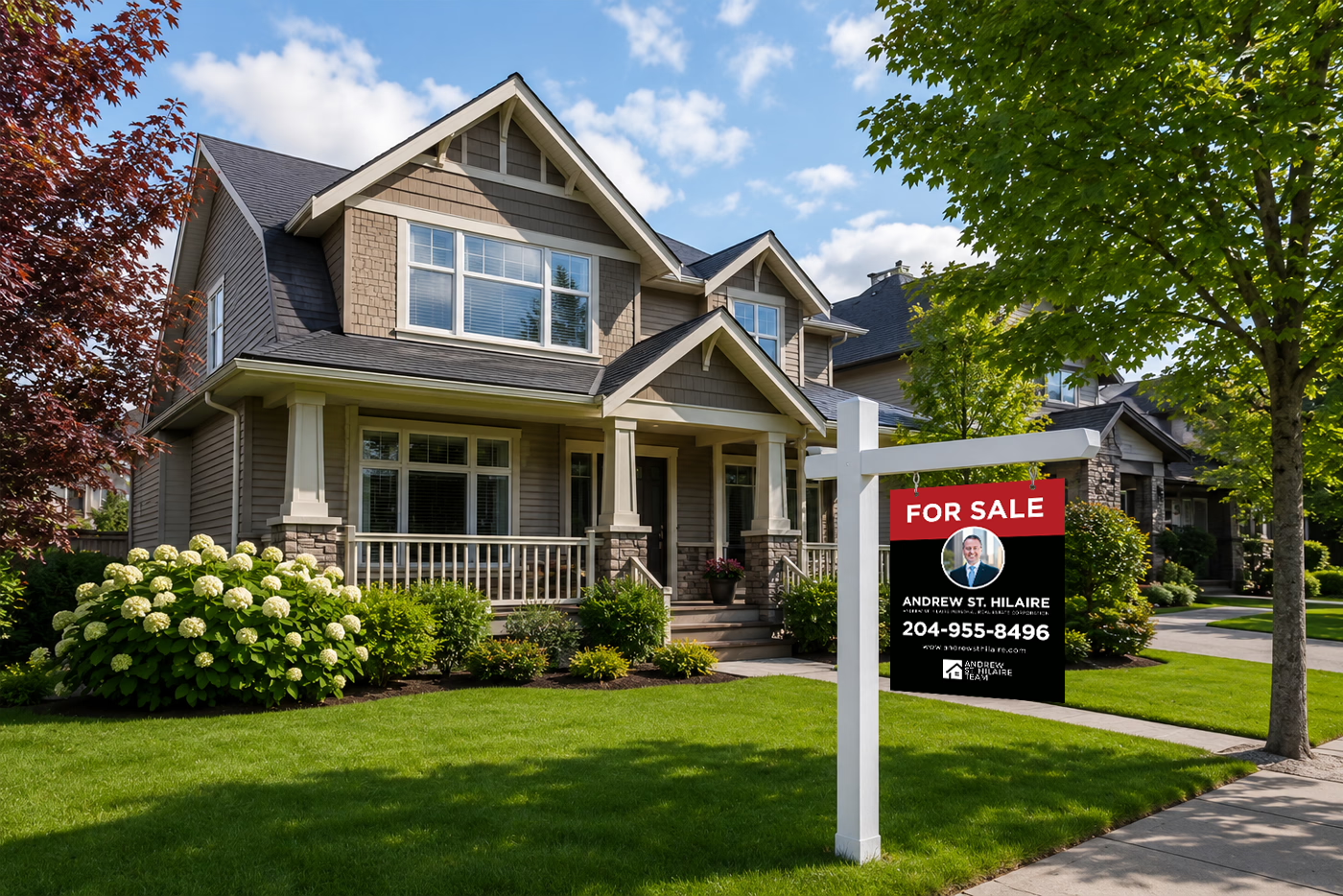
Sometimes life does not give you a leisurely timeline. A job transfer with a firm start date, a family change, a possession date on your next place that is bearing down on you, and suddenly you need your Winnipeg home sold quickly. The good news, and I mean this genuinely, is that a fast sale and a good price are not opposites. Most of what makes a home sell fast is the very same thing that gets you top dollar. The trick is doing all of it deliberately from day one, rather than reacting and chasing the market downward after the fact.
Here is what actually moves the needle on speed, in the order that matters.
Price it right the first time
This is the single biggest lever, full stop, and nothing else on this list matters as much. The homes that sit on the market are almost always the ones priced on hope rather than evidence. Here is why that is so damaging. The first two weeks on the market are when your listing gets the most attention, from the buyers who have been watching and waiting and from their agents. If the price scares those buyers off during that window, you lose your best and most motivated audience. By the time you finally drop the price, the listing already carries a stale feel, and buyers wonder what is wrong with it.
Pricing at or just under true market value does something that feels backwards but works reliably: it brings in more buyers, more showings, and sometimes competing offers that actually push the final number up rather than down. If you want the full logic on this, I broke it down in how to price your home to sell in Winnipeg. You can also see the current pace of sales in the Winnipeg Regional Real Estate Board's monthly statistics, which include average days on market so you know what a normal timeline looks like right now.
Make the home show well, fast
You do not need a full renovation, and you do not have time for one anyway. What you need is for the home to look cared for and close to move in ready to the widest possible group of buyers. A focused weekend of work usually does it.
- Declutter and depersonalize so buyers can picture themselves living there instead of touring your life. Pack away the excess now, since you are moving anyway.
- Deep clean everything, then keep it that way for showings. My post on cleaning tips to get your home sold covers the spots that matter most and the ones people forget.
- Handle the small stuff, the sticky door, the burnt out bulbs, the leaky tap, the scuffed baseboard. Buyers quietly add up little flaws and knock down their offer, or move on to the next listing.
- Consider light staging. Even just rearranging what you already own to open up the space helps a home photograph and show better. Staging pays off often enough that I wrote a whole post on staging to sell for top dollar.
Remember that most buyers see your home online before they ever set foot in it, so the way it presents in photos is the way it presents to the market. Great photos of a clean, decluttered home get more showings booked, and more showings mean a faster sale.
Get maximum exposure, not just a sign on the lawn
A quick sale needs your home in front of as many qualified buyers as possible on day one, not trickling out slowly. That means professional photography, a listing that hits the MLS® and the major search portals where buyers actually look, and marketing that reaches beyond your immediate neighbourhood. A well marketed home in Fort Rouge or North Kildonan can draw buyers who are also looking at surrounding towns like Stonewall, and when you are in a hurry, you want every one of those buyers to see it. The wider the net on day one, the faster the right buyer surfaces.
Be flexible with showings
This one is simple but people underestimate it. The faster you can say yes to a showing request, the faster you sell. Buyers on a deadline often want in that same day, and if your home is only available for a two hour window on a Sunday afternoon, you are filtering out real, motivated buyers before they ever walk through the door. For the couple of weeks that count, keep the home show ready and stay as flexible as you can. A little inconvenience now is worth a faster, cleaner sale.
A word on cash offer and we buy houses pitches
When you search for how to sell fast, you will inevitably see ads promising a quick cash offer for your Winnipeg home, no showings, no hassle. Be careful here. These buyers can genuinely close quickly, but the speed comes at a steep discount to market value, because that discount is exactly how they make their profit. For most sellers, even those on a real timeline, a properly priced and marketed listing sells quickly and nets far more money. If your situation truly demands an instant sale, fine, but get a real value on your home first so you know exactly what you would be giving up for the convenience.
Timing and seasonality
Winnipeg has a rhythm through the year. Spring and early summer bring out the most buyers, so a well priced home can move quickly then. Winter is quieter, but do not assume you cannot sell fast in the cold months. The buyers who are house hunting in a Winnipeg January tend to be serious and motivated, not casual browsers, which can actually work in your favour. A sharply priced, well presented home sells in any season, the season just changes how many buyers are in the pool.
Frequently asked questions about selling fast in Winnipeg
What sells a house the fastest?
Correct pricing from day one, above everything else, followed by strong presentation and wide exposure. An accurately priced, well presented home draws serious buyers quickly.
Should I accept a cash offer to sell faster?
Be cautious. Cash offer companies close quickly but pay well below market value. For most sellers, a properly listed home still sells fast and nets far more. Get a real value first so you know exactly what you would be giving up.
Does lowering my price guarantee a faster sale?
Not automatically. If the home shows poorly or is marketed weakly, a price cut alone may not fix it. Diagnose the real problem, whether it is price, presentation, or exposure, before simply dropping the number.
Can I sell quickly in winter in Winnipeg?
Yes. There are fewer buyers out in winter, but the ones who are looking tend to be serious and motivated. A sharply priced, well presented home sells in any season.
Start with the number and a plan
Every fast sale I have ever done started with an honest price and a clear plan built around the seller's real timeline. If you are on a clock, the worst thing you can do is guess at the price and hope. Request a home evaluation or get in touch and tell me your timeline, and we will build the sale around it. You can also learn how I approach selling a home in Winnipeg before we ever talk, so you know exactly what to expect.

If you have ever searched for a free home evaluation in Winnipeg, you have probably seen a dozen forms promising an instant number in exchange for your email address. Some of that is genuinely useful, and some of it is just a way to collect leads. I want to walk you through what a proper home evaluation actually involves, so you know exactly what you are getting, why it is worth your time, and how to make the result as accurate as it can possibly be.
The short version is this: a home evaluation is my professional opinion of what your property would sell for in the current market, based on real comparable sales and a first hand look at your specific home. It costs you nothing, and it does not commit you to listing. Plenty of people get an evaluation and then sit on it for a year, and that is completely fine.
What a home evaluation actually includes
When I do an evaluation, several things happen, and none of them are a hard sell. My job is to give you an honest number and the reasoning behind it.
- A walkthrough of your home. I note the things that move value, the updates you have made, the condition of the big ticket items like the roof, furnace, and windows, the layout, and the features that a listing photo would never capture, like natural light or a smart flow between rooms.
- A pull of recent sold comparables. I look at what genuinely similar homes in your area have actually sold for recently, whether that is St. Vital, Whyte Ridge, or a surrounding community like Oakbank, and I adjust for how those homes compare to yours.
- A read on the current market. A number that was right in a busy spring may not hold in a slower stretch, so I factor in what is happening right now. The Winnipeg Regional Real Estate Board's monthly statistics help ground that read in real data.
- An honest price range. Not a single inflated figure designed to win your listing, but a realistic range, along with clear suggestions for what would help you reach the top of it.
Evaluation versus appraisal: they are not the same thing
People use these two words interchangeably, but they are different tools for different jobs, and mixing them up causes confusion at exactly the wrong moment.
A home evaluation, or CMA
This is what I provide. It is a market opinion from an agent who sells in your area, it is free, and it is meant to help you set a list price and plan your sale. It leans heavily on recent comparable sales and current market conditions.
An appraisal
This is a paid, formal report prepared by an accredited appraiser. Lenders order appraisals to confirm that a property is worth the money they are lending against it. If a buyer needs a mortgage, their lender may order one during the conditional period to protect themselves. An appraisal is thorough and follows strict standards, but it serves the lender, not your pricing decision, and it is not the tool you use to decide your list price.
For most sellers, the free evaluation is the right starting point. An appraisal becomes relevant later, on the buyer's side, or occasionally when you need a formal valuation for legal or financial reasons such as an estate or a separation.
Why the assessed value is not your evaluation either
One more number to keep straight. Your City of Winnipeg assessed value, the one used to calculate your property taxes, is not the same as a market evaluation. Assessments are based on a fixed reference date that is set a couple of years in the past, so they can lag well behind current prices. You can read how the City handles that on its property assessment page. A home evaluation reflects today's market, which is what actually matters when you are deciding to sell.
How to prepare for the most accurate result
You do not need to renovate before I come by, and you certainly do not need to stress about staging at this stage. But a little preparation helps me give you a sharper, more defensible number.
- Make a list of the upgrades you have done, with rough dates. A new furnace, roof, windows, hot water tank, or an updated kitchen all matter, and I cannot always tell the age just by looking.
- Mention anything a buyer would eventually discover, like a past water issue, a foundation repair, or work done without a permit. It is far better factored in now than negotiated later under pressure. If older home quirks are on your mind, my post on foundation issues in older Winnipeg homes is worth a read.
- Tidy up just enough that I can see the space clearly, but do not go overboard. Deep cleaning and staging come later, only if you decide to list.
- Have your questions ready. This is your chance to ask about timing, the current market, what improvements are and are not worth doing, and roughly what you would net after costs.
What you actually do with the number
Once you have a realistic value, you can make real decisions instead of guessing. You can weigh whether to sell now or wait for a stronger market. You can figure out roughly what you would walk away with after commission, legal fees, and your mortgage payout. You can start planning your next move, whether that is upsizing, downsizing, or leaving the city entirely.
Some sellers get their evaluation and list within weeks. Others use it as a planning tool and act months later. There is no wrong way to use it, and there is no obligation attached. It is simply good information, and good information leads to good decisions.
Frequently asked questions about home evaluations
Is a home evaluation really free?
Yes. A home evaluation from an agent is provided at no cost and with no obligation to list. It is a normal part of how agents earn your business, and there is no catch.
What is the difference between a home evaluation and an appraisal?
An evaluation is a free market opinion from an agent, based on comparable sales, used to help you set a price. An appraisal is a paid, formal report by an accredited appraiser, usually ordered by a lender to protect their loan.
How long does a home evaluation take?
The walkthrough itself is usually under an hour. Preparing the comparable sales and settling on a price range takes a little longer, and I will go over the results and my reasoning with you clearly.
Does getting an evaluation mean I have to sell?
Not at all. Many people get an evaluation to plan ahead, then act months later, or decide not to sell at all. There is no commitment attached to it.
Ready when you are
A home evaluation is the natural first step for anyone thinking about selling, and it costs you nothing but a little time. When you are ready, you can request your free home evaluation and I will come take a look. If you would rather talk through your situation first, just reach out and we will start there. And if selling is the direction you are leaning, my guide on what to know before selling your home in Winnipeg is a good next step to read while you decide.

It is the first question almost every seller asks me, and it is the right one to start with. Before you decide to list, before you pick a moving date, before you even think about staging, you want to know one thing: what is my home actually worth? The honest answer is that your home is worth what a ready, willing, and able buyer will pay for it in today's market. Getting to that number takes a bit more than typing your address into a website, but it is not complicated once you understand the pieces.
I have walked through hundreds of homes across Winnipeg and the surrounding towns, and I can tell you that two houses with the same square footage on the same street can be worth noticeably different amounts. One has an updated kitchen and a newer roof, the other has original everything and a furnace on its last legs. The market sees that difference even when a quick online estimate does not. Here is how value is really put together, and why the number you may already have in your head could be off in either direction.
Market value is not the same as your assessed value
This is the single biggest source of confusion, so let us clear it up first. The assessed value printed on your City of Winnipeg tax statement is not your selling price. The City assesses property for one purpose, to divide up property taxes fairly among all owners, and it does this on a two year cycle using a reference date that is set well in the past.
For the 2027 general assessment, for example, the reference date is April 1, 2025. That means the assessed figure reflects what your property would have sold for back then, not what it will fetch when you list today. The City explains this openly on its property assessment page, where it describes assessing property at its market value as of that fixed reference date.
Because of that built in lag, your assessment can sit well below or above what the current market will bear, depending on how prices have moved since the reference date. In a rising market, assessments often trail actual sale prices. In a flat or softening stretch, they can look high. Either way, it is a useful data point and a starting reference, but it is not a listing price, and pricing your home off your tax assessment is a common and costly mistake.
What actually drives your home's value
When I prepare a value for a home, I am weighing a handful of things that buyers genuinely care about and pay for. None of these work in isolation, they combine, but each one moves the needle.
Location and neighbourhood
The same floor plan is priced differently in Charleswood than in Transcona or out in a growing town like Niverville. Schools, commute times, proximity to amenities, and the general character and desirability of the street all factor in. Even within a single neighbourhood, a quiet crescent can command more than a spot on a busy through street.
Lot and setting
Lot size and shape, orientation, mature trees, whether you back onto green space or a lane, a pie shaped lot versus a narrow one, all of this affects value. A larger or more private lot is a real asset that buyers will pay for.
Size and layout
Above grade square footage, the number of bedrooms and bathrooms, and whether the layout feels functional to a modern buyer all matter. Two homes with identical square footage can feel very different if one has an awkward, chopped up floor plan and the other is open and practical.
Condition and updates
This is where the online estimates fall apart. A newer roof, windows, furnace, and updated kitchens and bathrooms carry real weight. So does deferred maintenance, in the other direction. Buyers mentally tally up what they will have to spend, and they adjust their offer accordingly.
The market right now
Interest rates, how much competing inventory is out there, and even the season all affect what buyers will offer this month. The very same home can be worth more in a busy spring market with low inventory than in a quiet, well supplied stretch.
Why online estimates miss the mark
Automated home value tools are fine for a rough gut check, and I understand the appeal of an instant number. But they work off public data and broad averages. They do not know that you gutted the kitchen last year, or that your basement takes water every spring, or that the comparable sale they leaned on down the block was actually a private family deal at a discount.
They also cannot see condition, which is often the biggest single variable. That is why two homes an algorithm calls identical can be tens of thousands of dollars apart in reality. Treat those instant estimates as a very loose ballpark, not a listing price, and never make a real decision based on one alone.
The reliable way to get your number: a comparative market analysis
The tool I actually use is a comparative market analysis, or CMA. I look at what genuinely similar homes near you have sold for recently, not what they were listed at, and then I adjust up or down for the differences between those homes and yours. Recent sold data is the closest thing there is to reading the market's mind, because it reflects what real buyers actually paid, not what hopeful sellers asked.
To build a good CMA, I look for recent sales in your immediate area that match your home on the things that matter, then make careful adjustments. If a comparable had a finished basement and yours does not, I account for it. If yours has a double garage and the comparable had a single, I account for that too. You can see the broader trend behind all of this in the Winnipeg Regional Real Estate Board's monthly market statistics, which track average prices and how long homes are taking to sell across the region and by area.
A CMA is different from a formal appraisal. An appraisal is a paid report from an accredited appraiser that a lender relies on to approve a mortgage. A CMA is a pricing opinion from someone who sells in your area every week and knows what buyers are responding to right now. For the purpose of deciding your list price, the CMA is usually exactly what you want.
How to get an accurate number for your specific home
If you want a real figure rather than a guess, that is exactly what a home evaluation gives you. I come through, look at the things a screen simply cannot see, pull the right comparables, and give you an honest range along with a clear explanation of what I would do to reach the top of it. There is no cost and no obligation, and you are under no pressure to list.
Come to the meeting ready to help me help you. Make a quick list of the upgrades you have done and roughly when, since a new furnace or roof is not always obvious at a glance. Mention anything a buyer would eventually discover, because it is better factored into the number now than negotiated later. If you are still in the early research stage, browsing current Winnipeg listings and reading how I approach pricing a home to sell will give you a good feel for the market before we ever sit down.
Frequently asked questions about home value in Winnipeg
Is my property assessment the same as my home's market value?
No. Your City of Winnipeg assessment is based on a reference date set about two years in the past and is used to calculate property taxes, not to set a sale price. Market value is what a buyer will pay today, which can be higher or lower than your assessment.
How accurate are online home value estimates?
They are a rough ballpark at best. Automated tools work off averages and public data, and they cannot see your home's condition, your updates, or your specific location advantages. Use them for a loose idea, never as a listing price.
Do I need a paid appraisal to know what my home is worth?
Usually not, for the purpose of setting your list price. A free comparative market analysis from a local agent is the right tool for that. A formal appraisal is typically ordered later by a buyer's lender.
How recent should my home value be if I am planning to sell?
The market shifts through the year, so if you are actively planning to sell, a value from within the last month or two is ideal. A figure that is six months or a year old can be well off in a moving market.
Your value is the foundation for every other decision
Knowing your number is not just about satisfying curiosity. It is the foundation for deciding whether to sell now or wait, for estimating what you would walk away with after costs, and for planning your next move with confidence. Get that number right, grounded in real comparable sales rather than a tax figure or an online guess, and every other part of the sale gets easier. When you are ready for an honest, no pressure read on what your home would sell for today, reach out and I will put the numbers together for you.
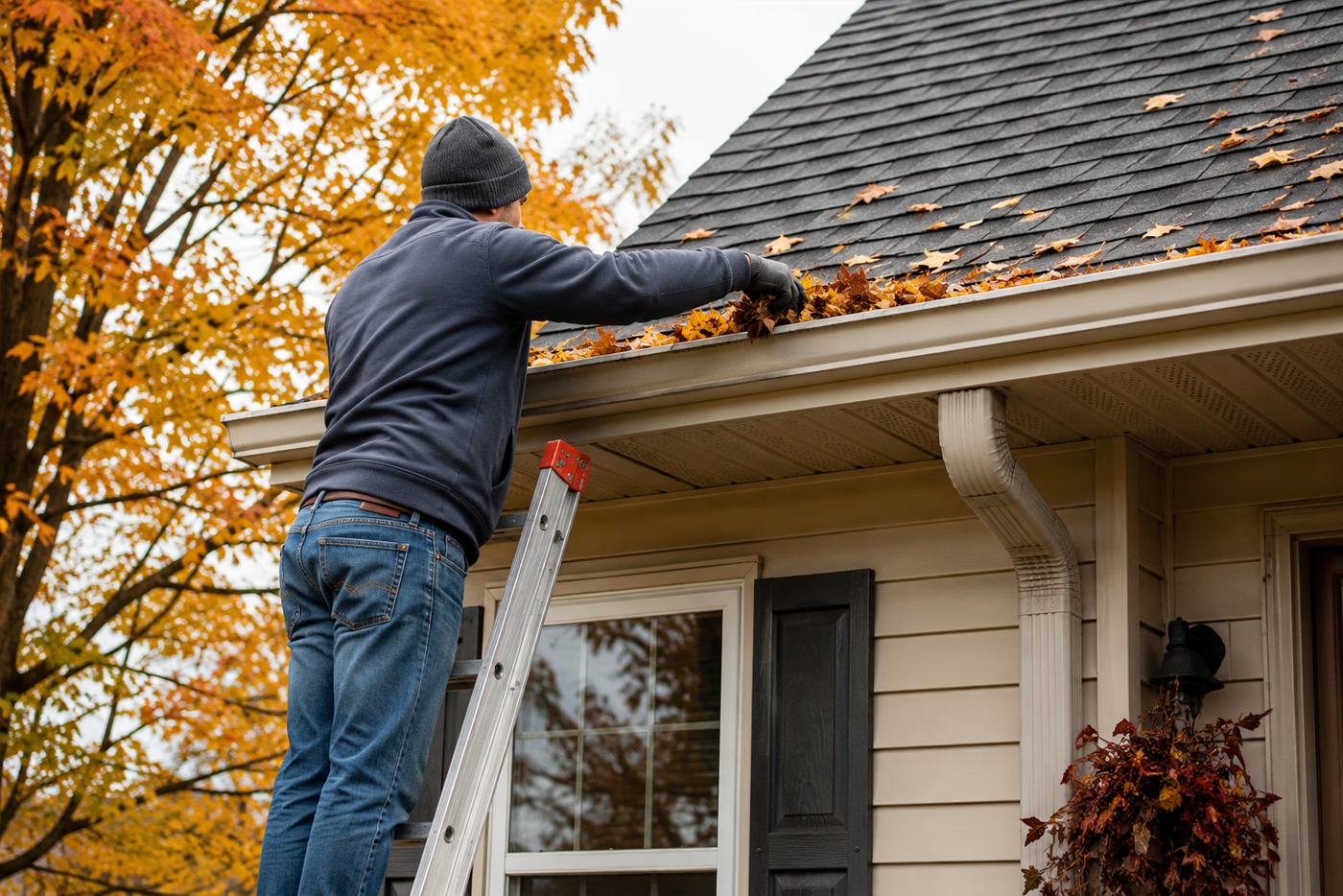
If you've lived through even one Manitoba winter, you already know it's no joke. Temperatures regularly drop below -30°C, and a cold snap can expose every weak point in your home. The good news is that most winter problems are preventable if you put in some work before the first freeze hits.
I've seen what happens when homeowners skip their fall prep. Burst pipes, ice dams, sky-high heating bills, furnaces that quit on the coldest night of the year. None of that is fun, and most of it is avoidable.
Here's a practical checklist to get your Winnipeg or Manitoba home through winter without any nasty surprises.
When should you get your furnace serviced?
This is the single most important thing on the list. Your furnace works harder here than almost anywhere else in Canada, and it needs annual professional maintenance to keep running safely and efficiently.
Book a furnace inspection and tune-up in September or early October, before the HVAC companies get slammed with emergency calls. A technician will check the heat exchanger, clean the burners, inspect the blower motor, and make sure everything is operating properly.
While you're at it, replace your furnace filter. A dirty filter forces the system to work harder, which drives up your energy bills and shortens the life of your furnace. During the winter months, check your filter every 4 to 6 weeks and swap it out when it looks dirty.
If your furnace is more than 15 to 20 years old, it's worth having a conversation about replacement before it fails on you mid-January. Newer high-efficiency models can cut your heating costs significantly. Manitoba Hydro offers rebates and financing programs for energy-efficient heating upgrades that can offset some of the cost.
How do you prevent frozen pipes in a Manitoba home?
Frozen pipes are one of the most common and most expensive winter problems in Manitoba homes. When water freezes inside a pipe, it expands and can split the pipe wide open. The damage doesn't show up until the ice thaws, and by then you could be dealing with serious flooding.
Here's what to do:
- Insulate exposed pipes in unheated areas like the garage, crawl space, and basement. Foam pipe insulation is cheap and easy to install.
- Disconnect and drain outdoor hoses. Shut off the interior valve that feeds your outdoor faucets and open the outdoor tap to let any remaining water drain out.
- Know where your main water shut-off valve is. If a pipe does burst, being able to shut off the water quickly can save you thousands in damage.
- If you're leaving town, don't set your thermostat below 15°C. Better yet, have someone check on the house every day or two.
How do you seal drafts around windows and doors?
Start by feeling for cold air around window frames, door frames, exterior-wall outlets, and anywhere pipes or wires enter the house. Apply weatherstripping around doors and windows, caulk gaps around frames and trim, install foam gaskets behind outlet covers on exterior walls, and add door sweeps to exterior doors with a gap at the bottom. For especially drafty older windows, interior window insulation kits noticeably reduce heat loss as a temporary fix.
Heat loss through gaps around windows and doors is one of the biggest energy wasters in older Manitoba homes. Even newer homes can develop gaps as materials expand and contract with temperature changes.
For quick fixes:
- Apply weatherstripping around doors and windows
- Use caulk to seal gaps around window frames and trim
- Install foam gaskets behind outlet and switch covers on exterior walls
- Use door sweeps on any exterior doors that have a gap at the bottom
For older windows that are especially drafty, interior window insulation kits (the plastic film kind you shrink with a hair dryer) actually work surprisingly well as a temporary measure. They're not pretty, but they can noticeably reduce heat loss and condensation.
What should you check on your roof and attic before winter?
Before the snow arrives, inspect your roof for missing, cracked, or curling shingles, damaged flashing around vents and chimneys, and clogged gutters. Clean gutters and make sure downspouts direct water 4 to 6 feet from the foundation. In the attic, confirm you have enough insulation — R-50 to R-60 is the recommended level for our climate zone, and if you can see the tops of the ceiling joists, you almost certainly need more.
Your roof takes a beating in a Manitoba winter. Before the snow arrives, do a visual inspection or hire a professional to check for:
- Missing, cracked, or curling shingles
- Damaged or deteriorated flashing around vents, chimneys, and skylights
- Clogged or damaged gutters and downspouts
Clean your gutters and make sure downspouts direct water at least 4 to 6 feet away from your foundation. Ice dams form when heat escaping from your attic melts snow on the roof, and the meltwater refreezes at the eaves. Proper attic insulation and ventilation are the real fix for ice dams.
Speaking of attic insulation, this is a big one. Many older Winnipeg homes don't have enough insulation in the attic. The current recommended level is R-50 to R-60 for attics in our climate zone. If you can see the tops of the ceiling joists when you look in your attic, you almost certainly need more. Topping up attic insulation is one of the most cost-effective upgrades you can make. Manitoba Hydro's insulation rebate programs can help with the cost.
How do you winterize your home's exterior?
The outside of your home needs attention too.
Grading and drainage. The ground around your foundation should slope away from the house on all sides. Water pooling near your foundation in the fall will freeze and expand, which can worsen existing cracks and create new ones. Check your grading before the ground freezes.
Walkways and steps. Repair any cracked or uneven concrete on walkways, steps, and your driveway. Water gets into cracks, freezes, and makes the damage worse every cycle. A small crack in October becomes a trip hazard by March.
Trees and branches. Trim back any branches that hang over your roof or are close to power lines. Heavy snow and ice loading can bring branches down, and you don't want them landing on your roof or taking out your electrical service.
Outdoor furniture and equipment. Store patio furniture, drain your garden hose, and winterize any outdoor plumbing fixtures. If you have a deck, give it a good cleaning before winter. Trapped moisture under snow and ice accelerates wood rot.
How do you prepare for winter power outages?
Keep flashlights, extra batteries, a battery-powered radio, blankets, bottled water, non-perishable food, and a fully charged portable phone charger on hand, since extended outages happen every Manitoba winter. If you have a sump pump, consider a battery backup system so a flooded basement doesn't follow a power failure. Never run a gas generator, barbecue, or any fuel-burning device indoors, and make sure carbon monoxide detectors work on every level of your home.
Extended power outages can happen in Manitoba, whether from ice storms, high winds, or equipment failures. Being prepared makes a huge difference.
Keep the following on hand:
- Flashlights and extra batteries
- A battery-powered or hand-crank radio
- Blankets and warm clothing accessible (not packed away in storage)
- Bottled water and non-perishable food
- A fully charged portable phone charger
- Matches or a lighter if you have a wood-burning fireplace
If you have a sump pump, consider a battery backup system. A power outage during a thaw or heavy snowfall can mean a flooded basement if your sump pump stops running.
Never use a gas generator, barbecue, or any fuel-burning device indoors or in an attached garage. Carbon monoxide poisoning is a real and serious risk. Make sure you have working carbon monoxide detectors on every level of your home.
Should you run a humidifier in winter?
Yes. Manitoba winters are brutally dry, and indoor humidity can drop well below 30%, causing dry skin, respiratory irritation, static, and even damage to hardwood floors and furniture. If your furnace has a built-in humidifier, have it serviced, replace the water panel, and turn it on for the heating season. Aim for 30% to 35% indoor humidity; going much higher can cause condensation on windows, especially older or single-pane ones.
Manitoba winters are brutally dry. Indoor humidity levels can drop well below 30%, which causes dry skin, respiratory irritation, static electricity, and can even damage hardwood floors and wood furniture.
If your furnace has a built-in humidifier, make sure it's serviced and turned on for the heating season. Replace the water panel or evaporator pad, clean the unit, and check that the water supply line is connected and flowing.
A target indoor humidity level of 30% to 35% in winter is a reasonable goal. Going much higher than that can cause condensation problems on your windows, especially if they're older or single-pane.
When should you test smoke and carbon monoxide detectors?
This should be a year-round habit, but it's especially critical going into heating season. Test all smoke detectors and carbon monoxide detectors in your home. Replace batteries if they're more than a year old, and replace the entire unit if it's past its expiration date (usually 7 to 10 years for smoke detectors, 5 to 7 years for CO detectors).
With furnaces, fireplaces, and space heaters all running during winter, the risk of fire and carbon monoxide exposure goes up. Working detectors are non-negotiable.
Should you reverse your ceiling fans in winter?
Reversing your ceiling fans is a small change that genuinely helps in winter. Most fans have a switch on the motor housing that reverses blade direction; set them to run clockwise on low speed. This pushes warm air that has risen to the ceiling back down along the walls, distributing heat more evenly and potentially reducing your heating costs.
This is a small thing that actually helps. Most ceiling fans have a switch on the motor housing that reverses the blade direction. In winter, you want the fan running clockwise on a low speed. This pushes warm air that has risen to the ceiling back down along the walls, which helps distribute heat more evenly and can reduce your heating costs.
What winter supplies should you stock up on?
Stock up before the first big snowfall on ice melt or sand (avoiding salt on concrete less than two years old), a good quality snow shovel, extra furnace filters for the season, and emergency car supplies if you park outside. A roof rake is also worth adding if your home has issues with ice dam buildup.
Don't wait until the first big snowfall to buy a snow shovel or pick up ice melt. Stock up early on:
- Ice melt or sand (avoid using salt on concrete less than two years old)
- A good quality snow shovel and/or snow blower maintenance
- A roof rake if you have issues with ice dam buildup
- Extra furnace filters for the season
- Emergency car supplies if you park outside
When should you tackle each winterizing task?
Book your furnace service, check attic insulation, and inspect the roof in September. October is for disconnecting hoses, sealing drafts, cleaning gutters, trimming branches, and checking grading around the foundation. In November, switch on the humidifier, reverse ceiling fans, prepare emergency supplies, and test detectors. Through winter, check furnace filters monthly, keep snow cleared from vents and the gas meter, and monitor for ice dams.
September: Book your furnace service. Check attic insulation. Inspect the roof.
October: Disconnect hoses. Seal drafts. Clean gutters. Trim branches. Check grading around the foundation.
November: Switch on the humidifier. Reverse ceiling fans. Prepare emergency supplies. Test detectors.
Ongoing through winter: Check furnace filters monthly. Keep snow cleared from foundation vents, exhaust vents, and your gas meter. Monitor for ice dams.
It Protects Your Investment
Whether you plan to stay in your home for decades or you're thinking about selling in the next few years, proper winter maintenance protects your property's value. Buyers notice when a home has been well maintained, and issues like foundation damage from poor drainage or a neglected roof can cost tens of thousands to repair.
If you have questions about how your home's condition might affect its value, or you're curious about what buyers in Winnipeg and surrounding areas are looking for, feel free to reach out to our team. We're always happy to chat.
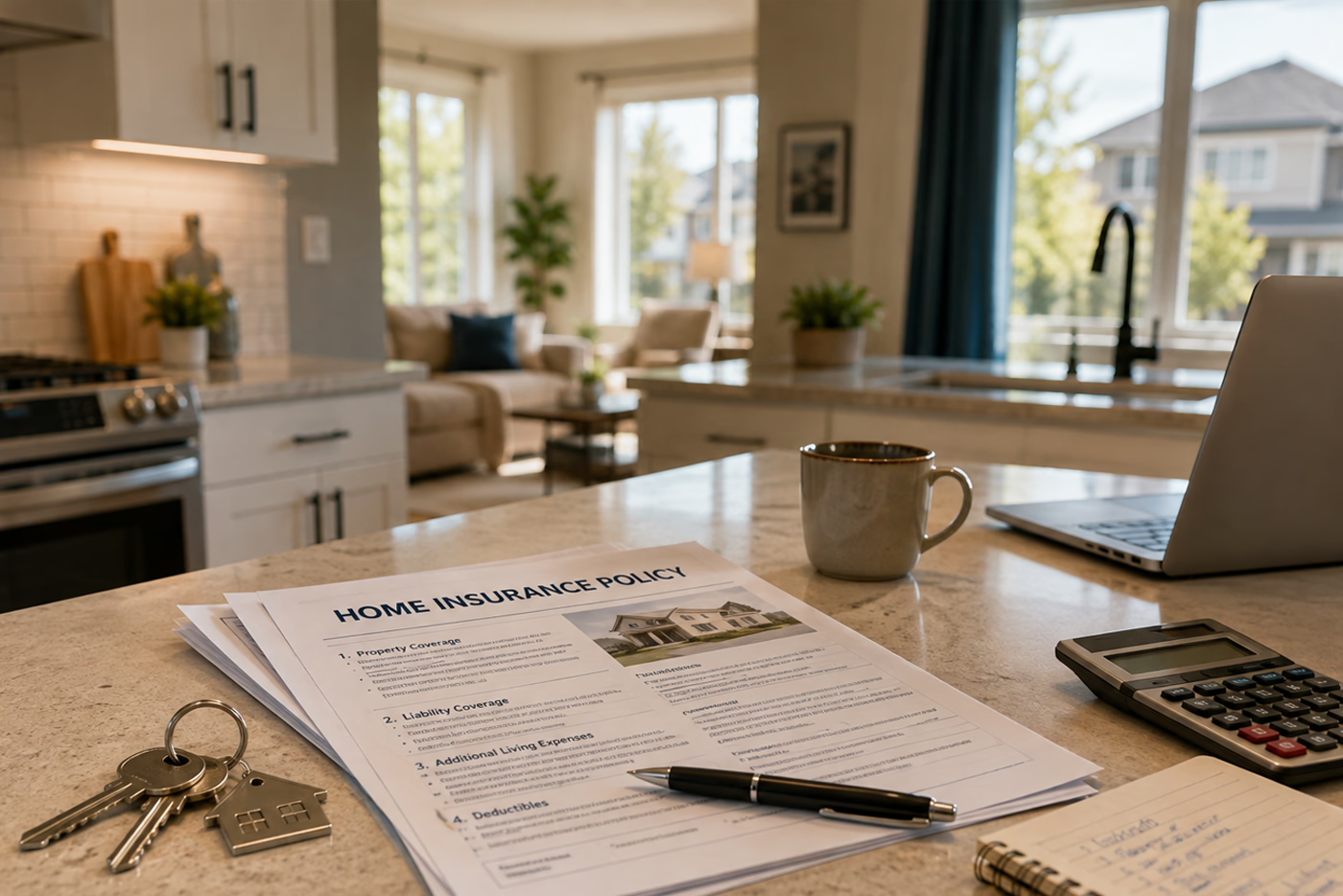
Home insurance is one of those things you don't think much about until you need it. But if you're buying a home in Manitoba, your mortgage lender will require it, and even if you own your home outright, going without coverage is a risk most people shouldn't take.
Manitoba has some unique factors that affect home insurance. Extreme winters, flood risk zones, aging housing stock in certain neighbourhoods, and severe summer storms all play a role in what you'll pay and what coverage you need. Here's a practical guide to understanding home insurance in this province.
What Does Home Insurance Cover?
A standard homeowner's policy in Manitoba includes four main types of coverage: dwelling coverage to repair or rebuild your home after covered events like fire, wind, hail, or lightning; personal property coverage for your belongings; liability coverage (usually $1 million to $2 million) if someone is injured on your property; and additional living expenses if your home becomes uninhabitable while repairs are made. High-value items like jewellery or art may need additional riders.
A standard homeowner's insurance policy in Manitoba typically includes several types of coverage:
Dwelling coverage. This covers the cost to repair or rebuild your home if it's damaged by a covered event like fire, wind, hail, or lightning. The amount should reflect the full replacement cost of your home, not the market value.
Personal property coverage. This protects your belongings inside the home, including furniture, electronics, clothing, and appliances. There are usually limits on high-value items like jewellery, art, or collectibles, so you may need additional riders for those.
Liability coverage. If someone is injured on your property and you're found legally responsible, liability coverage helps cover legal fees and potential settlements. Most policies include $1 million to $2 million in liability coverage.
Additional living expenses. If your home becomes uninhabitable due to a covered event (say, a fire), this covers the cost of temporary accommodations, meals, and other extra expenses while your home is being repaired.
What's Not Covered?
Standard Manitoba home insurance policies typically exclude overland flooding, sewer backup, earthquakes, gradual wear and tear, home-based business equipment beyond a small threshold, and possibly liability related to certain dog breeds. Overland flood and sewer backup coverage can usually be added as endorsements, and both are strongly recommended for Manitoba homeowners.
This is just as important as what's included. Standard home insurance policies in Manitoba typically exclude:
- Overland flooding (though this can often be added as a separate endorsement)
- Sewer backup (again, available as an add-on and highly recommended)
- Earthquakes (not a major concern in Manitoba, but worth noting)
- Gradual wear and tear or lack of maintenance
- Certain dog breeds may affect your liability coverage depending on the insurer
- Home-based business equipment beyond a small threshold
The two most important add-ons for Manitoba homeowners are overland flood coverage and sewer backup coverage. I'll get into why below.
Why does flood and sewer backup coverage matter in Manitoba?
Manitoba is flat, sits at the bottom of the Red River drainage basin, and experiences regular spring flooding — yet standard policies don't cover overland flooding, so it must be added as an endorsement. Sewer backup matters just as much: heavy rains can overwhelm Winnipeg's combined sewer system in older neighbourhoods, flooding basements through floor drains, with cleanup and restoration costs easily running into the tens of thousands.
Manitoba has a complicated relationship with water. The province is flat, it sits at the bottom of the Red River drainage basin, and spring flooding is a regular occurrence. The 1997 "Flood of the Century" and the 2011 flooding along the Assiniboine River are reminders of how serious it can get.
If your property is in a flood-prone area, overland flood insurance is critical. Standard policies don't cover it. You'll need to add it as an endorsement, and in some high-risk areas, it may be expensive or difficult to obtain. The Insurance Bureau of Canada has a helpful overview of how overland flood coverage works and what it includes.
Sewer backup is equally important. Heavy rains can overwhelm Winnipeg's combined sewer system in older neighbourhoods, causing basement flooding through floor drains. This happens more often than most people expect, and the cost of cleanup and restoration can easily run into the tens of thousands.
When you're shopping for insurance, ask specifically about both of these coverages and get clear answers about limits and deductibles.
How Much Does Home Insurance Cost in Manitoba?
Home insurance premiums in Manitoba vary significantly based on several factors, but you can expect to pay roughly $1,200 to $2,500 per year for a typical single-family home in Winnipeg and the surrounding areas. Some properties will be higher, some lower.
The premium you pay depends on:
Your home's age and condition. Older homes, particularly those with original electrical panels, plumbing, or roofing, tend to cost more to insure. If you've upgraded the electrical system, plumbing, and roof, make sure your insurer knows.
The replacement cost of the home. A larger home with higher-end finishes will cost more to insure because it costs more to rebuild. Your insurer will estimate the replacement cost based on the home's size, construction type, and features.
Your location. Homes in flood-prone areas or areas with higher claim rates will have higher premiums. Proximity to a fire station and fire hydrant can also affect your rate.
Your claims history. If you've made previous claims, your premium may be higher. Multiple claims in a short period can significantly increase your costs or make it harder to get coverage.
Your deductible. A higher deductible (the amount you pay out of pocket before insurance kicks in) means a lower premium. Most homeowners choose a deductible between $500 and $2,500.
Security features. A monitored alarm system, smoke detectors, and a sump pump with battery backup can sometimes earn you discounts.
What's the difference between replacement cost and actual cash value?
Replacement cost coverage pays to repair or replace damaged property with new items of similar quality — if fire destroys your roof, you get a new roof at today's prices. Actual cash value pays only the depreciated value, so a destroyed 15-year-old roof gets you what a 15-year-old roof is worth. Replacement cost coverage costs more, but the premium difference is usually modest compared to the potential coverage gap when you make a claim.
This is an important distinction when choosing your policy:
Replacement cost coverage pays to repair or replace damaged property with new items of similar quality. If a fire destroys your roof, you get a new roof at today's prices.
Actual cash value coverage pays the depreciated value of the damaged property. If your 15-year-old roof is destroyed, you'd only receive what a 15-year-old roof is worth, not what a new one costs.
Replacement cost coverage is more expensive, but it's what I'd recommend for most homeowners. The difference in premium is usually modest compared to the potential gap in coverage when you need to make a claim.
How do you get good coverage at a fair price?
Bundle your home and auto policies for a discount, raise your deductible if you can comfortably absorb a small loss, and install a sump pump with battery backup, which many insurers reward with lower premiums. Review your policy annually so it reflects renovations or downsized belongings, ask about loyalty and claims-free discounts, and shop for competitive quotes every two to three years to make sure you're not overpaying.
Bundle your policies. Most insurers offer a discount if you bundle your home insurance with auto insurance. In Manitoba, your basic auto insurance is through Manitoba Public Insurance (MPI), but you can bundle your home policy with your optional MPI extension coverage or with a private insurer for your home and any additional auto coverage.
Review your policy annually. Your coverage needs change over time. If you've renovated, added a deck, or finished your basement, your replacement cost has gone up and your policy should reflect that. On the flip side, if your kids have moved out and you've downsized your belongings, you might be able to reduce your personal property coverage.
Increase your deductible if you can absorb a small loss. Moving from a $500 deductible to a $1,000 or $2,000 deductible can meaningfully reduce your premium. Just make sure you have that amount readily available in savings.
Install a sump pump with battery backup. If you have a basement, this reduces your flood risk and many insurers will give you a discount for having one. It also provides real peace of mind during heavy rain events.
Ask about loyalty and claims-free discounts. Staying with the same insurer for several years without making a claim can qualify you for significant discounts. Ask your broker or agent what's available.
Shop around every few years. Insurance premiums can vary widely between companies. Even if you're happy with your current insurer, it's worth getting competitive quotes every two to three years to make sure you're not overpaying.
Should you use an insurance broker or go direct?
For most people, working with a local independent broker is the better approach. Brokers represent multiple insurance companies, shop your coverage across several providers for the best combination of price and protection, understand Manitoba-specific risks, and advocate for you if you need to make a claim. Going direct works too — companies like Winnipeg-headquartered Wawanesa offer online quoting tools — just make sure you're comparing equivalent coverage between quotes.
In Manitoba, you can buy home insurance directly from a company (like through an online portal) or through an independent insurance broker.
A broker represents multiple insurance companies and can shop your coverage across several providers to find you the best combination of coverage and price. They also advocate for you if you need to make a claim. For most people, working with a local broker is a good approach because they understand Manitoba-specific risks and can make sure you're properly covered.
If you prefer to go direct, companies like Wawanesa (which is headquartered right here in Winnipeg) and other national insurers offer online quoting tools. Just make sure you're comparing equivalent coverage when looking at different quotes.
Which types of properties need special insurance considerations?
Four property types need extra attention: older homes in core neighbourhoods like Wolseley or the North End, which may have knob-and-tube wiring or aging foundations that raise premiums; rural properties, where distance from a fire station and well or septic systems affect rates; condos, where you need your own unit policy to fill gaps in the corporation's master coverage; and homes with rental suites, which must be disclosed or your policy could be voided entirely.
Older homes in Winnipeg's core neighbourhoods. Properties in Wolseley, West Broadway, the North End, or other established areas may have knob-and-tube wiring, galvanized plumbing, or aging foundations. Insurers will want to know about these, and you may face higher premiums or requirements to upgrade before they'll insure the property. A home inspection before purchase is essential.
Rural properties. If you're buying outside the city in areas like the RM of Springfield, RM of East St. Paul, or further out toward Steinbach or Portage la Prairie, distance from a fire station can increase your premium. Well and septic systems (instead of municipal water and sewer) may also be factors.
Condos and townhomes. If you're buying a condo, the condo corporation will have a master insurance policy covering the building's structure and common areas. You'll still need your own policy (often called condo or tenant-style insurance) to cover your personal belongings, upgrades inside your unit, and personal liability. Make sure there aren't coverage gaps between the condo corporation's policy and yours.
Homes with rental suites. If the property has a legal or illegal secondary suite, you need to disclose this to your insurer. Having tenants in part of your home affects your coverage, and failing to disclose it can void your policy entirely.
When do you need home insurance in place when buying a home?
When you're buying a home, you'll need to have home insurance in place before your closing date. Your mortgage lender will require proof of insurance as a condition of releasing the mortgage funds.
Here's a practical checklist:
- Start getting quotes at least two to three weeks before closing
- Make sure the policy effective date matches your closing date
- Confirm your coverage amounts with your lender
- Add overland flood and sewer backup coverage
- Provide your lawyer and lender with the insurance certificate
Don't leave this to the last minute. If there's an issue with insuring the property (maybe due to an old electrical panel or proximity to a flood zone), you'll want time to sort it out before closing day arrives.
Home insurance isn't the most exciting part of buying a home, but it's one of the most important. Get the right coverage, review it regularly, and you'll have one less thing to worry about.
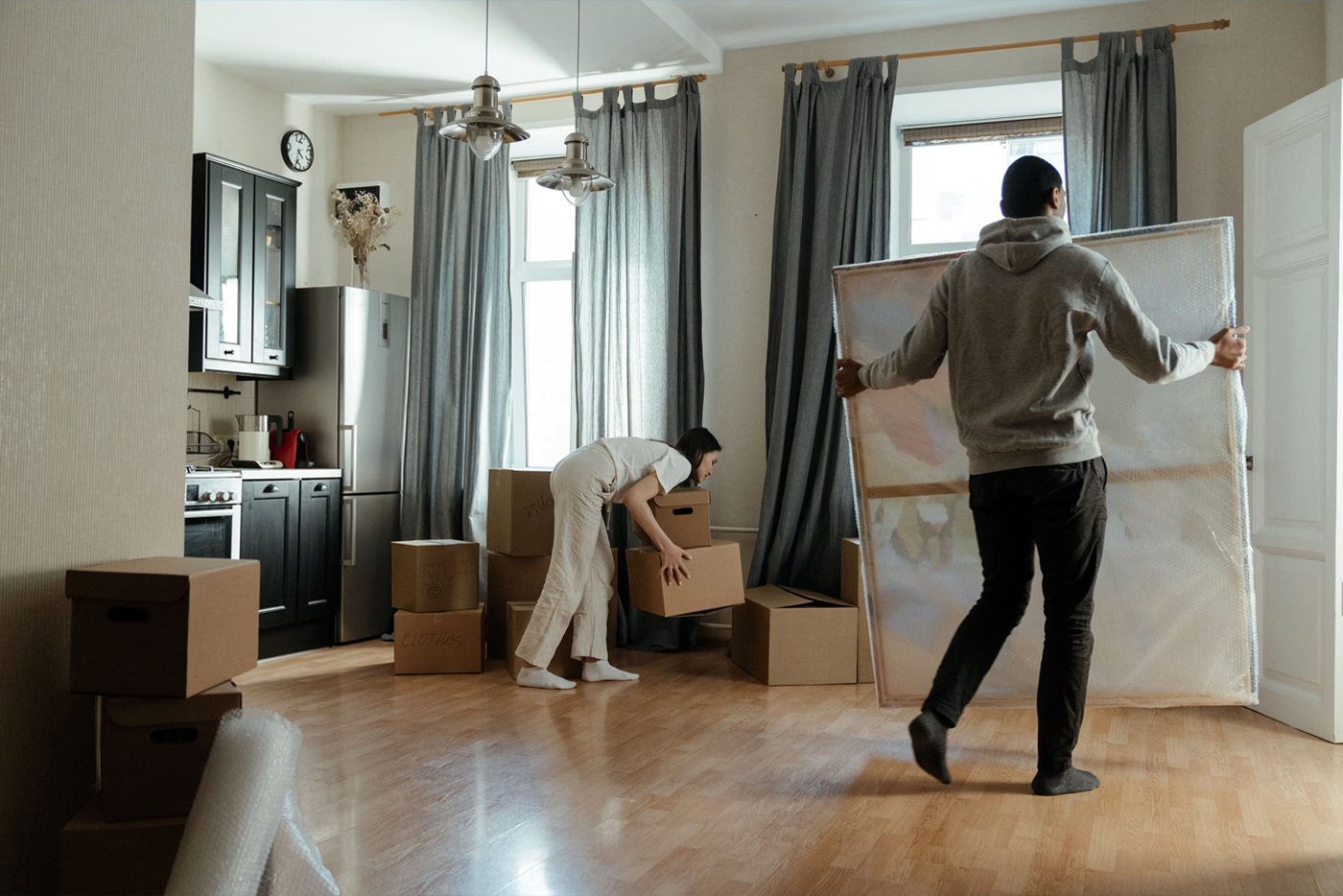
You've accepted an offer, worked through conditions, and now closing day is approaching. For many sellers, this is the light at the end of the tunnel. But if you've never sold a home before (or it's been a while), you might be wondering what actually happens on closing day and what you need to do to make sure everything goes smoothly.
The good news is that by the time closing day arrives, most of the heavy lifting is done. Your lawyer handles the bulk of the legal and financial work. But there are still things you need to know and a few responsibilities that fall on you.
What Is Closing Day, Exactly?
Closing day (in Manitoba, usually called the possession date) is the day that ownership of the home officially transfers from you to the buyer. It's the date written into your purchase agreement, and it's the day the buyer gets the keys.
In Manitoba, the actual transfer of funds and the registration of the land title happen through the lawyers representing each side. You don't physically sit across a table from the buyer signing documents together, like you might see in movies. Most of the paperwork is handled in the days leading up to closing, and the actual day itself is mostly about logistics and waiting for confirmation.
What happens in the days before closing?
In the week or two before closing, your lawyer prepares the transfer of land, the statement of adjustments, and any mortgage discharge documents, and you'll typically meet a few days ahead to sign everything. Your lawyer also contacts your lender for the exact mortgage payout amount, including accrued interest and any prepayment penalties.
The real preparation for closing day happens in the week or two before the actual date.
Your Lawyer's Role
Your lawyer will prepare the legal documents required to transfer the property. In Manitoba, ownership is recorded on the land title, and the document that transfers it to the buyer is called a transfer of land. Your lawyer will also prepare a statement of adjustments, which is a financial breakdown that accounts for things like prepaid property taxes, utility adjustments, and any other credits or debits between you and the buyer.
You'll typically meet with your lawyer a few days before closing to sign documents. This is when you'll review and sign:
- The transfer of land conveying title to the buyer
- The statement of adjustments
- Any mortgage discharge documents (if you have an existing mortgage on the property)
- An undertaking to provide vacant possession and to leave the property in the agreed-upon condition
Your lawyer will also coordinate with the buyer's lawyer to make sure all funds are in place and the transaction can proceed on schedule.
Mortgage Discharge
If you have a mortgage on the home, your lawyer will arrange for it to be discharged (paid off) from the sale proceeds. They'll contact your lender to get the exact payout amount, which includes any interest accrued up to closing day and any applicable penalties.
If you're in a fixed-rate mortgage and breaking it before the end of the term, there may be a prepayment penalty. This is something to check with your lender well in advance so you're not surprised on closing day. The Financial Consumer Agency of Canada has information on how prepayment charges are calculated.
What happens on closing day in Manitoba?
On closing day, the lawyers handle everything behind the scenes. The buyer's lawyer sends the purchase funds to your lawyer, and your lawyer takes care of the title transfer, your mortgage payout, and all the adjustments. Your job is to be fully moved out, with the home in the agreed-upon condition, by the possession time in your agreement.
You don't get paid on closing day itself. When your money arrives depends on what you and the buyer agreed to in the offer to purchase. If the offer specifies the New Conveyancing Protocol (NCP), your net proceeds typically arrive within 7 to 10 days. If not, the funds can't be touched until the land title is confirmed registered in the buyer's name, which typically takes about 4 weeks. Your lawyer will tell you when to expect your cheque or direct deposit. If you're buying another property at the same time, your lawyer may apply the proceeds directly toward that purchase.
The statement of adjustments your lawyer prepared will show exactly how the numbers break down, including the sale price, any adjustments for property taxes, the mortgage payout, legal fees, real estate commission, and your net proceeds.
Keys and Possession
The buyer gets access to the property at the time specified in the purchase agreement. You need to have the home completely vacated and cleaned by that time.
Leave all keys, garage door openers, mailbox keys, alarm codes, and any other access items for the buyer. Your lawyer usually coordinates the keys handoff but sometimes your REALTOR® may be involved for the handoff.
What do you need to do before closing day?
Move out completely and leave the home in at least broom-swept condition, removing everything from the garage, shed, and basement. Arrange final utility readings with Manitoba Hydro and other providers, set up mail forwarding, and notify your bank, insurer, employer, and the Canada Revenue Agency of your address change. Keep your home insurance active until closing is complete, and leave behind keys, garage door openers, alarm codes, and any appliance manuals or warranties.
Here's a checklist of things to take care of in the days leading up to closing.
Move out completely. Unless you've negotiated a later possession date, you need to be fully moved out by the time specified in the agreement. Don't leave behind items the buyer didn't agree to take. Anything left behind becomes their problem, and it can create disputes.
Clean the home. Leave the home in a clean, broom-swept condition at minimum. Many sellers hire a professional cleaning service, which is a nice gesture and avoids potential issues. Remove all personal belongings, garbage, and anything stored in the garage, shed, or basement.
Cancel or transfer utilities. Contact Manitoba Hydro, your water utility, internet provider, and any other services. Arrange for final readings on closing day and either cancel or transfer the accounts. Don't shut off utilities before the buyer takes possession.
Notify relevant parties of your address change. This includes Canada Post (set up mail forwarding), your bank, insurance company, employer, Canada Revenue Agency, and any subscriptions or services.
Provide documentation. Leave behind any manuals for appliances, warranties, paint codes, or information about the home that would be helpful for the new owners. This isn't mandatory, but it's a considerate touch that buyers appreciate.
Review your insurance. Your home insurance needs to stay active until the closing is complete. Contact your insurance provider to cancel or adjust your policy as of the possession date.
What can go wrong on closing day?
The most common hiccups are delayed funding (the buyer's mortgage funds arriving late, which can push closing back a few hours or to the next business day), possession-day issues like damage or unfinished repairs, unexpected title problems that need clearing, and mortgage penalty surprises. Most of these are avoidable or manageable. Confirm your prepayment penalty with your lender early, and leave the home in the condition you agreed to.
Most closings go smoothly, but occasionally things come up. Here are the most common hiccups.
Delayed funding. Sometimes the buyer's mortgage funds don't arrive on time. This can push the closing back by a few hours or, in rare cases, to the next business day. Your lawyer will keep you informed.
Possession-day issues. If the buyer walks through the home on closing day and finds problems, such as damage that wasn't there before, missing items, extra items left behind, or unfinished repairs, it can cause disputes or delays while the issue is resolved. This is why it's important to leave the home in the condition you agreed to.
Title issues. Occasionally, there are unexpected issues with the property title that need to be cleared before transfer. Your lawyer handles this, but it can cause delays.
Mortgage penalty surprises. If you didn't confirm your mortgage prepayment penalty in advance, a larger-than-expected penalty can catch you off guard on the statement of adjustments. Always check with your lender early.
What happens after closing day?
Once the registration is complete and the keys have been handed over, the sale is done. Your lawyer will provide you with a final reporting letter that summarizes the transaction and includes all relevant documents for your records.
Keep these documents in a safe place. You'll need them for tax purposes, especially the sale price and any capital gains information if the property was not your principal residence. For more on how selling your home affects your taxes, the Canada Revenue Agency has guidelines on the principal residence exemption.
It's Less Stressful Than You Think
Closing day can feel like a big deal, and it is. But the reality is that most of the work happens behind the scenes with your lawyer and your REALTOR® coordinating the details. Your main job is to make sure the home is clean, vacated, and in the condition you agreed to. If you've done that, closing day is mostly about handing over the keys and letting the lawyers finish the details. Your cheque follows once everything is settled.
If you're getting ready to sell and want to understand what the full process looks like from listing to closing, check out our seller's guide for more information.

Winnipeg is already one of the most affordable major cities in Canada to buy a home. Compared to Toronto, Vancouver, or even Calgary, your dollar goes significantly further here. But "affordable" is relative. If you're a first-time buyer working with a limited down payment, or a family trying to get into a detached home without stretching beyond your comfort zone, you still need to be strategic about where you look.
I've worked with plenty of buyers who assumed they'd need to settle for a condo or move outside the city to stay within budget. In many cases, they were surprised to find neighbourhoods inside Winnipeg where a detached home was well within reach.
Here are some of the areas where affordable homes tend to be more available, along with what to expect in each.
The North End and West End
Let's start with the areas that consistently offer some of the lowest price points in the city. The North End (broadly, the area north of the CPR yards) and the West End (west of downtown, roughly between Portage Avenue and Notre Dame Avenue) have detached homes available in the $100,000 to $250,000 range.
At these prices, you're typically looking at older homes that may need some updating. Many were built in the early to mid-1900s and have solid bones but outdated kitchens, bathrooms, and mechanicals. For a handy buyer or someone willing to renovate gradually, there's genuine value here.
These neighbourhoods have gotten an unfair reputation in some circles. Parts of the North End and West End are revitalizing, with new investment, community organizations, and small businesses contributing to positive change. That said, it's important to drive through specific blocks and get a feel for the area before buying. Conditions can vary significantly from one street to the next.
What to watch for: Some homes in these areas may have deferred maintenance issues. Always get a thorough home inspection. Check the foundation, roof, plumbing, and electrical carefully. Also, verify property tax arrears and any outstanding orders from the City of Winnipeg before making an offer.
Transcona
Transcona, in the east end of the city, has long been one of Winnipeg's most underrated neighbourhoods for value. It started as a railway town and has maintained a strong community identity. Residents are fiercely loyal, and homes don't always come up as frequently as in other areas.
You can find solid bungalows and two-storey homes in the $250,000 to $400,000 range. Newer areas of Transcona, closer to the Perimeter Highway, offer homes at slightly higher price points but still below what you'd pay in southwest or south Winnipeg for a comparable property.
Transcona has its own commercial district along Regent Avenue with grocery stores, restaurants, and services. The community has an active recreation scene with the Transcona Centennial Square hosting events throughout the year.
Schools are served by the River East Transcona School Division, which operates several schools in the area.
Commute: Downtown is about 15 to 20 minutes via the Disraeli Freeway or Regent Avenue. If you work in the east end or near the Perimeter, the commute is even shorter.
St. Vital (Older Sections)
St. Vital is a large area, and the price range varies quite a bit depending on where you look. The newer sections closer to the Perimeter Highway tend to be pricier. But the older parts of St. Vital, particularly the areas between St. Mary's Road and St. Anne's Road north of Bishop Grandin, offer more affordable options.
Homes here were largely built in the 1950s through 1970s. You'll find well-maintained bungalows and bi-levels in the $280,000 to $380,000 range. The lots are a decent size, and many have mature landscaping. It's a quiet, established area with good access to schools and parks.
St. Vital Centre, one of Winnipeg's larger shopping malls, is nearby, along with plenty of amenities along St. Mary's Road and St. Anne's Road.
Elmwood and East Kildonan
Just east of the Red River, Elmwood and East Kildonan offer affordable homes with good access to downtown and the rest of the city.
Elmwood is the more affordable of the two, with smaller homes and bungalows in the $180,000 to $300,000 range. It's a compact neighbourhood with a mix of long-time homeowners and newer buyers attracted by the prices. Kildonan Park is nearby, which is one of the best green spaces in the city.
East Kildonan, stretching along Henderson Highway, offers a step up in price and home size. Expect to find bungalows and split-levels in the $280,000 to $400,000 range. The area has a suburban feel with tree-lined streets and good proximity to grocery stores, schools, and recreation.
Both areas are served by the River East Transcona School Division.
Fort Richmond and University Heights (Condos and Townhomes)
If you're open to a condo or townhome, the areas around the University of Manitoba can be surprisingly affordable. Fort Richmond and University Heights have condo buildings and townhome complexes where units start in the $150,000 to $250,000 range.
These work well for first-time buyers, students, investors, or anyone who wants a manageable monthly payment while building equity. The location near the university, shopping, and transit makes them practical for a wide range of lifestyles.
Garden City and the Maples
North of the airport, Garden City and the Maples offer affordable suburban homes built primarily in the 1970s through 1990s. You'll find bi-levels, split-levels, and bungalows in the $250,000 to $380,000 range.
The area has good schools, nearby shopping at Garden City Shopping Centre, and easy access to the Perimeter Highway. It's a practical choice for families who want space and don't need to be in the trendy parts of town.
Transit: The area has decent bus service along McPhillips Street and Leila Avenue. The commute to downtown is about 20 minutes by car.
What does "affordable" actually mean in practice?
Real affordability goes beyond the purchase price. Factor in property taxes, maintenance costs (a $200,000 home needing a new roof, furnace, and windows is really that price plus $40,000 to $60,000 in repairs), insurance — which can be harder to get on older homes with dated electrical — and utilities, since heating an inefficient home through a Manitoba winter can add hundreds per month. If your down payment is under 20%, CMHC mortgage insurance also increases your monthly payments.
Finding an affordable home isn't just about the purchase price. Here are a few other costs that affect your real affordability.
Property taxes. They're based on assessed value, and a lower-priced home will generally have lower property taxes. But rates can vary. Use the City of Winnipeg Property Tax - Mill Rates to see what you'd pay on a specific property.
Maintenance and repair costs. A $200,000 home that needs a new roof, furnace, and windows within the first five years isn't really a $200,000 home. It's a $200,000 home plus $40,000 to $60,000 in repairs. Always factor in the condition of major systems when evaluating price.
Insurance. Older homes, particularly those with older electrical systems (knob and tube, 60-amp service) or past claims, may be harder or more expensive to insure. Get an insurance quote before you finalize your offer.
Mortgage insurance. If your down payment is less than 20% of the purchase price, you'll need CMHC mortgage default insurance. This gets added to your mortgage balance and increases your monthly payments.
Utilities. Older homes are often less energy-efficient. Higher heating bills in a Manitoba winter can add hundreds per month. Ask the seller for utility bill history, and consider whether insulation or window upgrades would be needed.
How do you buy a home on a budget?
Get pre-approved first so you know exactly what you can work with before you start looking. Look past cosmetic issues like dated flooring and ugly wallpaper — they're cheap fixes that scare off other buyers — and consider fixer-uppers or homes that have sat on the market 30 to 60 days, where sellers may be motivated to negotiate. First-time buyer programs like the FHSA, the RRSP Home Buyers' Plan, and the First-Time Home Buyers' Tax Credit can also make a significant difference.
Get pre-approved first. Know your numbers before you start looking. A pre-approval from a mortgage broker or bank tells you exactly what you can work with, and it prevents the disappointment of falling in love with a home you can't afford.
Don't overlook cosmetic issues. Ugly wallpaper, dated flooring, and outdated paint colours are cheap fixes that scare off other buyers. If the bones of the house are solid, cosmetic updates can turn a below-average-looking home into a great one for a fraction of the cost of buying something move-in perfect.
Consider a fixer-upper. If you're handy or willing to learn, buying a home that needs work can be one of the best ways to build equity. The key is knowing the difference between cosmetic work and structural problems. A good home inspector is essential.
Look at homes that have been sitting on the market. In Winnipeg, a home that's been listed for 30 to 60 days may have a motivated seller willing to negotiate. There might be a good reason it hasn't sold, or it could simply be priced a bit too high. Either way, it's worth investigating.
Explore first-time buyer programs. The Government of Canada offers several programs that can help. The First Home Savings Account (FHSA), the RRSP Home Buyers' Plan, and the First-Time Home Buyers' Tax Credit can all make a significant difference. Details are available on the Government of Canada's homebuying page.
The Opportunity in Winnipeg
Winnipeg's housing market gives buyers options that simply don't exist in most Canadian cities. A detached home under $300,000 is not a fantasy here. It's a real possibility in multiple neighbourhoods.
The key is doing your homework, understanding the true cost of ownership, and being open to areas you might not have considered initially. Some of the best-value purchases I've seen were in neighbourhoods the buyer had never visited before we started their search.
If you're looking for affordable homes and want to see what's currently available, browse our listings page or reach out and we can set up a search tailored to your budget and priorities.

Not everyone who works in Winnipeg wants to live inside the city. Some buyers want a bigger lot, more privacy, lower property taxes, or just a quieter pace at the end of the day. If that sounds like you, the communities surrounding Winnipeg deserve a serious look.
East St. Paul, Headingley, and Niverville are three of the most popular options for people who want to live close to the city without being in it. Each one has a different feel, different price points, and different trade-offs. Here's what you need to know.
East St. Paul: Close to the City, Country Feel
East St. Paul sits immediately north of Winnipeg, just past the Perimeter Highway along Henderson Highway and Raleigh Street. It's technically a separate municipality within the Rural Municipality of East St. Paul, and that distinction matters for things like property taxes and services.
The biggest draw is the combination of proximity and space. Many parts of East St. Paul are less than 15 minutes from the north end of Winnipeg. Some areas are closer to downtown Winnipeg than parts of the city itself. Yet the lots are significantly larger, the streets are quieter, and the overall feel is distinctly rural-residential.
Homes and pricing. East St. Paul features a mix of older acreage properties, established homes on large lots, and some newer developments. Prices typically range from the mid-$300,000s for older or smaller homes up to $700,000 or more for newer builds on large lots. If you're looking for acreage with outbuildings, options do come up, though they move quickly.
Schools. The River East Transcona School Division serves the area. Families generally have access to quality schools, though some students may need to bus to schools in north Winnipeg depending on their specific location.
Services and amenities. East St. Paul has some local businesses, restaurants, and services, but you'll likely head into Winnipeg for most shopping and entertainment. The trade-off is intentional for most residents. They chose East St. Paul for the space and quiet, not for walkable retail.
Property taxes. This is a significant factor. Municipal taxes in East St. Paul are set by the RM and are often lower than Winnipeg's rates, though it varies by property. Water and sewer services depend on location, as some properties are on well and septic systems. Make sure you understand the servicing situation for any property you're considering.
Commute. Downtown Winnipeg is 20 to 30 minutes from most of East St. Paul, depending on traffic. Henderson Highway and Main Street are the primary routes, and they can get congested during peak hours.
Browse East St. Paul listings here.
Headingley: West of the City, Growing Fast
Headingley is located just west of Winnipeg along the Trans-Canada Highway (Highway 1). It was once a small, quiet community, and while it's still relatively small, it's grown steadily over the past two decades. New subdivisions have brought younger families, and the community has developed more local services as a result.
The appeal of Headingley is its position. You're minutes from the western edge of Winnipeg with easy access to the highway system, yet you're in a community with its own identity and a more relaxed pace.
Homes and pricing. Headingley offers a range of options. Newer subdivisions feature modern two-storey homes in the $500,000 to $700,000+ range. Older properties on larger lots, including some acreages, are also available and can range widely in price depending on the land and condition of the home. There are also more affordable options in the $300,000 to $400,000 range for smaller or older homes.
Schools. Headingley is served by the St. James-Assiniboia School Division. Headingley Community School is right in town, and there are options for older students in nearby areas.
Recreation. Headingley has a solid community centre, local parks, and access to the Assiniboine River for outdoor activities. The Beaudry Provincial Park is nearby, offering hiking and nature trails just minutes from home.
Commute. Getting to western Winnipeg takes about 10 to 15 minutes. Downtown is roughly 20 to 30 minutes via Portage Avenue or the Trans-Canada. If you work in the western part of the city, Headingley is exceptionally convenient.
Growth. Headingley has attracted developers in recent years, and new builds continue to go up. The community is managing growth carefully, maintaining the balance between development and the rural character that drew people there in the first place.
See what's available in Headingley.
Niverville: Small-Town Life with Big-Town Access
Niverville is about 30 minutes south of Winnipeg on Highway 59. It's grown from a small agricultural town to one of the fastest-growing communities in Manitoba. The population has roughly doubled in the last 15 years, and new residential development continues at a steady pace.
Unlike East St. Paul or Headingley, Niverville feels like its own distinct town rather than a suburb of Winnipeg. It has its own downtown core, its own schools, its own recreational facilities, and a strong community identity. People who move to Niverville typically aren't looking for "close to Winnipeg." They're looking for small-town life with the option of an easy drive to the city when they need it.
Homes and pricing. This is where Niverville really stands out. You can get a lot more home for your money compared to Winnipeg. Newer builds in the $350,000 to $550,000 range are common, and the quality of construction has been strong as builders compete for the growing market. Older homes and properties on the edges of town offer even more affordable options.
Schools. Niverville is served by the Hanover School Division. The town has its own elementary and high school, and the community's growth has led to investments in educational facilities.
Amenities. Niverville has a grocery store, restaurants, a recreation centre, a public library, and a growing list of local businesses. It's not Winnipeg-level variety, but for day-to-day living, most essentials are covered. The Niverville Heritage Centre hosts events and activities year-round.
Commute. This is the biggest consideration. Highway 59 into Winnipeg is a 30 to 40-minute drive depending on where you're headed. In winter, road conditions can extend that. If you work in south Winnipeg or along the Perimeter, the commute is manageable. If you work downtown, you're looking at closer to 40 to 45 minutes each way.
Community. Niverville has a strong volunteer culture and active community events. The annual Olde Fassioned Christmas and summer festivals draw people from across the region. If you want to know your neighbours and be part of a tight-knit community, Niverville delivers on that.
Explore Niverville listings here.
How Do They Compare?
East St. Paul offers large lots at mid-range to higher prices with a 20 to 30-minute downtown commute but limited local amenities. Headingley mixes newer subdivisions with larger rural properties, also mid-range to higher and 20 to 30 minutes from downtown, with a growing set of local shops. Niverville is the most affordable for new construction and the most self-sufficient, with its own town core and the strongest independent identity, but the longest commute at 35 to 45 minutes.
Price and Value
- East St. Paul: Mid-range to higher. You're paying for proximity to Winnipeg plus larger lots.
- Headingley: Mid-range to higher for newer builds. Acreages can vary widely.
- Niverville: Most affordable of the three for new construction. Best value per square foot.
Commute to Downtown Winnipeg
- East St. Paul: 20 to 30 minutes
- Headingley: 20 to 30 minutes
- Niverville: 35 to 45 minutes
Lot Size and Privacy
- East St. Paul: Large lots are common. Some properties have acreage.
- Headingley: Mix of subdivision lots and larger rural properties.
- Niverville: Standard subdivision lots in town. Larger properties on the outskirts.
Local Amenities
- East St. Paul: Limited. Winnipeg is your main shopping destination.
- Headingley: Growing. Some local shops and restaurants.
- Niverville: Most self-sufficient of the three with its own town core.
Community Identity
- East St. Paul: Quiet, residential, close to the city.
- Headingley: Small-town feel with suburban-style development.
- Niverville: Strongest independent identity. Feels like its own town.
What should you consider before buying outside Winnipeg?
Check whether the property uses well water and a septic system rather than municipal services, and have those inspected before buying. Compare municipal property taxes and what services they include, ask your insurance provider for an address-specific quote since distance from fire services can raise premiums, and confirm high-speed internet availability if you work from home. Finally, be honest about winter highway driving — all three communities require it to reach Winnipeg.
If you're used to living in the city, there are a few things to think about before making the move.
Water and sewer. Some properties outside Winnipeg use well water and septic systems rather than municipal services. This isn't a dealbreaker, but it does require different maintenance and awareness. Have these systems inspected before purchasing, and budget for maintenance over time.
Property taxes. Each municipality sets its own tax rate. In many cases, taxes outside Winnipeg are lower on a comparable home, but services may also differ. Check what's included, such as garbage collection, road maintenance, and snow clearing.
Insurance. Proximity to fire services can affect your home insurance rates. Properties further from a fire station or hydrant may carry higher premiums. Ask your insurance provider for a quote specific to the address before making an offer.
Internet and cell service. Coverage has improved significantly in recent years, but it's still worth checking. Some rural properties may not have access to high-speed internet from all providers. If you work from home, this is worth confirming early in your search.
Winter driving. All three communities require highway driving to reach Winnipeg. In a Manitoba winter, that means planning for icy roads, reduced visibility, and the occasional highway closure. It's part of the lifestyle, and most residents adjust quickly, but it's something to factor in honestly.
Who Should Consider Moving Outside the City?
These communities suit buyers who value space over convenience, don't mind driving for errands, want a quieter environment for their families, and appreciate paying less per square foot than they would inside city limits. If that describes you, East St. Paul, Headingley, and Niverville are all worth exploring — spending a Saturday driving through each one is often the best way to find the right fit.
The people I've seen thrive in these communities tend to share a few things in common. They value space over convenience. They don't mind driving for errands. They want a quieter environment for their families. And they appreciate paying less per square foot than they would inside city limits.
If that describes you, all three of these communities are worth exploring. If you're not sure which one is the best fit, sometimes the best approach is to spend a Saturday driving through each one. Walk the streets, check out the local shops, and see which one feels right. Real estate is as much about the feeling of a place as it is about the numbers.
For current listings in all three areas, check out our community pages for East St. Paul, Headingley, and Niverville.

When you buy a home in Manitoba, the purchase price isn't the only number on your mind. One cost that catches many buyers off guard is the land transfer tax, sometimes called property transfer tax. It's a mandatory provincial fee you pay when the title of a property transfers to your name, and in Manitoba, it can add several thousand dollars to your closing costs.
Here's how it works, how much you can expect to pay, and what you need to budget for.
What Is Land Transfer Tax?
Land transfer tax is a fee charged by the Province of Manitoba when ownership of a property changes hands. Every time real estate is bought or transferred, the new owner must pay this tax to register the property in their name at the Land Titles Office.
This isn't unique to Manitoba. Most provinces in Canada have some form of land transfer tax, though the rates and rules vary. In Manitoba, the tax is calculated on a sliding scale based on the fair market value of the property.
You can find more information through Manitoba Land Titles.
How Is It Calculated?
Manitoba uses a tiered system similar to income tax brackets: 0% on the first $30,000 of the property's value, 0.5% from $30,001 to $90,000, 1.0% from $90,001 to $150,000, 1.5% from $150,001 to $200,000, and 2.0% on anything over $200,000. For a typical home in Winnipeg and the surrounding areas, that works out to roughly $3,000 to $6,000 — for example, $3,650 on a $300,000 purchase and $5,650 on a $400,000 purchase.
Manitoba uses a tiered system. The tax rate increases as the property value goes up, but each tier only applies to the portion of the value within that range. Think of it like income tax brackets.
Here are the current land transfer tax rates in Manitoba:
- 0% on the first $30,000
- 0.5% on the portion from $30,001 to $90,000
- 1.0% on the portion from $90,001 to $150,000
- 1.5% on the portion from $150,001 to $200,000
- 2.0% on anything over $200,000
Let's run through a few examples so you can see what this looks like in practice.
Example 1: Home purchased for $300,000
- First $30,000 — 0% — $0
- $30,001 to $90,000 ($60,000) — 0.5% — $300
- $90,001 to $150,000 ($60,000) — 1.0% — $600
- $150,001 to $200,000 ($50,000) — 1.5% — $750
- $200,001 to $300,000 ($100,000) — 2.0% — $2,000
Total: $3,650
Example 2: Home purchased for $400,000
- First $30,000 — 0% — $0
- $30,001 to $90,000 ($60,000) — 0.5% — $300
- $90,001 to $150,000 ($60,000) — 1.0% — $600
- $150,001 to $200,000 ($50,000) — 1.5% — $750
- $200,001 to $400,000 ($200,000) — 2.0% — $4,000
Total: $5,650
Example 3: Home purchased for $550,000
- First $30,000 — 0% — $0
- $30,001 to $90,000 ($60,000) — 0.5% — $300
- $90,001 to $150,000 ($60,000) — 1.0% — $600
- $150,001 to $200,000 ($50,000) — 1.5% — $750
- $200,001 to $550,000 ($350,000) — 2.0% — $7,000
Total: $8,650
As you can see, for a typical home in Winnipeg and the surrounding areas, you're looking at roughly $3,000 to $6,000 in land transfer tax. It's a significant expense, and it's due at closing.
When Do You Pay It?
Land transfer tax is paid when your lawyer registers the property transfer at the Manitoba Land Titles Office. This happens as part of your closing process, so the cost is typically included in the funds your lawyer collects from you before closing day.
Your lawyer will calculate the exact amount and include it in your closing cost statement. You don't need to submit anything to the province yourself.
Are There Any Exemptions?
Manitoba offers only limited exemptions: transfers between spouses or common-law partners (including as part of a separation or divorce), certain family farm corporation transfers, and some property passed through inheritance. Unlike Ontario and British Columbia, Manitoba does not offer a first-time homebuyer exemption or rebate — every buyer pays the full amount, which often surprises buyers relocating from provinces that do offer a break.
Manitoba offers a limited number of exemptions and situations where the land transfer tax may be reduced or waived:
Transfers between spouses or common-law partners. If you're transferring property between spouses (including as part of a separation or divorce), the transfer may be exempt from land transfer tax.
Transfers to a family farm corporation. Certain family farm transfers qualify for exemptions under specific conditions.
Transfers through inheritance. When property passes to beneficiaries through an estate, the land transfer tax may not apply depending on the circumstances.
First-time homebuyer exemption? Unlike Ontario and British Columbia, Manitoba does not currently offer a first-time homebuyer exemption or rebate on land transfer tax. Every buyer pays the full amount regardless of whether it's their first purchase.
This is worth knowing because buyers relocating from provinces that offer first-time buyer rebates sometimes assume they'll get a similar break here. Unfortunately, that's not the case in Manitoba.
How Does Manitoba Compare to Other Provinces?
Manitoba falls in the middle of the pack. On a $400,000 home, land transfer tax runs approximately $5,650 in Manitoba, compared to about $4,475 in Ontario (nearly double in Toronto with its added municipal tax), $6,000 in British Columbia, and $3,600 in Saskatchewan, while Alberta charges no land transfer tax at all. It's more than the Prairie neighbours but generally less than BC and far less than buying in Toronto.
Manitoba's land transfer tax rates are moderate compared to the rest of Canada. Here's a rough comparison on a $400,000 home:
- Manitoba: Approximately $5,650
- Ontario: Approximately $4,475 (though Toronto adds a municipal land transfer tax on top, nearly doubling it)
- British Columbia: Approximately $6,000
- Alberta: Alberta doesn't charge land transfer tax at all, though there are smaller registration fees
- Saskatchewan: Approximately $3,600
Manitoba falls in the middle of the pack. It's more than Alberta and Saskatchewan but generally less than BC and significantly less than buying in Toronto, where double land transfer tax can run into the tens of thousands.
Is land transfer tax different on new construction?
Whether you're buying a newly built home or a resale property, you'll pay land transfer tax either way. The tax is based on the fair market value or the purchase price of the property, whichever is higher.
For new builds, there's sometimes confusion about whether GST is included in the land transfer tax calculation. The land transfer tax is calculated on the property value before GST. However, new home purchases in Manitoba are subject to GST (and potentially the GST new housing rebate), which is a separate cost from the land transfer tax.
If you're considering a new build in one of Winnipeg's growing communities or in the surrounding areas, make sure your budget accounts for both the GST and the land transfer tax as separate line items.
How should you budget for land transfer tax?
Treat it as what it often is — the single largest closing expense after the down payment: roughly $2,650 on a $250,000 home, $5,650 at $400,000, and $7,650 at $500,000. Add lawyer fees ($1,200 to $2,000), a home inspection ($400 to $600), title insurance, and property tax adjustments, and total closing costs on a $400,000 home will likely land between $8,000 and $12,000. Keep these funds in a separate bucket from your down payment savings.
When I'm working with buyers, I always make sure land transfer tax is front and centre in their closing cost estimate. It's often the single largest closing expense after the down payment itself.
Here's a quick reference for common price points in the Manitoba market:
- $250,000 home: Approximately $2,650
- $300,000 home: Approximately $3,650
- $350,000 home: Approximately $4,650
- $400,000 home: Approximately $5,650
- $450,000 home: Approximately $6,650
- $500,000 home: Approximately $7,650
Add these figures to the rest of your closing costs, which include lawyer fees ($1,200 to $2,000), home inspection ($400 to $600), title insurance, and any property tax adjustments. For a $400,000 home, total closing costs including land transfer tax will likely be in the $8,000 to $12,000 range.
If you're using the FHSA or the RRSP Home Buyers' Plan for your down payment, make sure you have additional funds set aside for these closing expenses. Your down payment savings and your closing cost savings should be in separate buckets.
Can You Finance the Land Transfer Tax?
The land transfer tax itself cannot be added to your mortgage. It's a cash expense due at closing. Some buyers use a line of credit or other personal savings to cover it, but you need to have the funds available.
That said, if you factor land transfer tax into your overall purchase budget from the beginning, it shouldn't be a surprise. A good mortgage broker will walk you through all the costs you'll need at closing, not just the down payment amount.
What About Refinancing or Adding Someone to Title?
If you refinance your mortgage, you generally don't trigger a new land transfer tax payment because the property ownership isn't changing. However, if you add someone to the title (for example, adding a spouse after the initial purchase), that transfer of partial ownership may be subject to land transfer tax on the value of the portion being transferred. Your lawyer can advise on the specifics.
The Bottom Line
Land transfer tax is a straightforward cost that every Manitoba homebuyer needs to plan for. It's calculated on a predictable sliding scale, it's paid through your lawyer at closing, and there are no first-time buyer exemptions in this province.
For most homes in Winnipeg and the surrounding areas, expect to pay between $3,000 and $8,000 depending on the purchase price. It's one of those costs that won't derail your plans if you know it's coming, but it can cause real stress if you don't budget for it.
If you're starting to plan your home purchase and want to get a clearer picture of your total costs, our first-time homebuyer guide breaks down the full process from start to finish.

A home inspection is one of the best ways to understand the true condition of a home before you buy it. In a competitive market, though, buyers sometimes face a real dilemma. When a seller is weighing several offers at once, they often favour the one with the fewest conditions, so keeping an inspection condition can make an offer less competitive. That pressure leads some buyers to forego an inspection, not to save the inspection fee, but to strengthen their offer and win the home. It's a legitimate decision, and it's a trade-off. I've seen a buyer waive the inspection to land the property, then discover a costly problem a few months later: the basement floods, the furnace dies, or the roof turns out to need a full replacement.
Whether or not you keep an inspection as a condition of your offer, understanding what it is, what it can find, and what it can't, helps you make a smart, clear-eyed decision. Here's everything you should know.
What Exactly Is a Home Inspection?
A home inspection is a visual examination of a property's major systems and components, conducted by a trained professional. The inspector goes through the home from top to bottom, looking at the structure, exterior, roof, plumbing, electrical, heating and cooling, insulation, ventilation, and interior finishes.
The goal isn't to find every minor flaw. It's to identify significant issues, potential safety hazards, and major repairs that could affect the home's value or livability. After the inspection, you receive a written report (usually with photos) that details the findings.
A standard residential home inspection in Winnipeg typically takes two to three hours depending on the size and age of the property. You're encouraged to attend. Walking through the home with the inspector is one of the best ways to learn about the property you're buying.
What Does a Home Inspector Look For?
A home inspector examines eight main areas: the foundation and structure, roof, plumbing, electrical, heating and cooling, insulation and ventilation, exterior, and interior. In Winnipeg, foundation checks matter especially because clay soil and freeze-thaw cycles are tough on foundations, so horizontal cracks, bowing walls, and past water intrusion are red flags. In older homes, inspectors also watch for galvanized steel or polybutylene pipes, knob-and-tube wiring, and 60-amp electrical service.
A thorough inspection covers a lot of ground. Here are the main areas:
Foundation and Structure. The inspector checks for cracks in the foundation, signs of settling, water damage in the basement, and structural integrity. In Winnipeg, where clay soil and freeze-thaw cycles can be tough on foundations, this is especially important. Horizontal cracks, bowing walls, and evidence of past water intrusion are all red flags.
Roof. The condition of the shingles or roofing material, flashing around chimneys and vents, gutters, downspouts, and signs of leaks. A roof replacement can cost $8,000 to $15,000 or more, so knowing the remaining lifespan is valuable.
Plumbing. Water pressure, drainage, visible pipes, water heater condition, and signs of leaks. In older Winnipeg homes, the inspector may note galvanized steel pipes (which corrode over time) or polybutylene pipes (which are prone to failure).
Electrical. The electrical panel, wiring type, grounding, outlets, and visible connections. Older homes may still have knob-and-tube wiring or 60-amp service, both of which can be expensive to upgrade and may affect your insurance.
Heating and Cooling. The furnace, air conditioner (if applicable), ductwork, and ventilation. The inspector will note the age and condition of the HVAC system. In Manitoba, where winter temperatures regularly drop below minus 30, a reliable furnace isn't optional.
Insulation and Ventilation. Attic insulation levels, vapour barriers, bathroom fans, and overall ventilation. Poor insulation means higher heating bills. Poor ventilation can lead to moisture buildup and mold.
Exterior. Siding, windows, doors, grading around the foundation, driveways, walkways, and decks. The inspector looks for signs of water damage, rot, improper drainage, and deterioration.
Interior. Walls, ceilings, floors, doors, windows, and visible signs of water damage. Stains on ceilings, soft spots in flooring, and doors that don't close properly can all indicate underlying issues.
What a Home Inspection Can and Can't Tell You
This is the part buyers most often misunderstand, so it's worth being clear. A home inspection is a visual, non-invasive assessment. The inspector evaluates what they can see and safely access on the day of the inspection. They don't cut into walls, lift flooring, dig around the foundation, or move the seller's furniture and stored belongings to look behind them.
Good inspectors do go beyond the naked eye. Many carry tools like thermal imaging (infrared) cameras and moisture meters that can reveal things you'd otherwise miss, such as missing insulation, hidden moisture, or certain electrical issues. These tools are genuinely useful, but they have limits too. They read surfaces and temperature differences; they don't see through walls like an X-ray.
Because of this, an inspection reduces your risk, but it can't eliminate it. No inspector can guarantee they'll catch every problem. Issues hidden behind finished walls, buried underground, or that only show up under certain conditions (a leak that appears only in heavy rain, for example) can go undetected. Think of the inspection as a thorough snapshot of the home's accessible condition on that day, not a warranty that nothing is wrong.
A standard inspection won't:
- Open up walls, ceilings, or floors
- Move furniture or personal belongings
- Test for mold, radon, or asbestos (though they may recommend further testing if they suspect a problem)
- Inspect inside sewer lines
- Provide firm cost estimates for repairs
If the inspector spots something that warrants a closer look, they may recommend a specialized inspection. For example, signs of water issues in the basement might prompt a sewer line camera inspection, and suspect materials in an older home might prompt asbestos testing.
How Much Does a Home Inspection Cost in Winnipeg?
A standard home inspection in Winnipeg typically costs between $450 and $650. Larger homes, older homes, and properties with additional features like septic systems or wells (common in rural areas around Winnipeg) may cost more.
Some common add-ons and their approximate costs:
- Radon testing: $150 to $200
- Sewer camera inspection: $200 to $350
- Well water testing: $100 to $250
- Thermal imaging: Often included, sometimes an add-on of $100 to $200
For most buyers, that's a small price for a professional, detailed look at the home before they commit. That said, cost is rarely the real reason buyers forego an inspection. In a competitive market, the harder question is usually whether to keep it as a condition of your offer at all, which we'll get into below.
How to Find a Good Home Inspector
Not all home inspectors are created equal. In Manitoba, there's no mandatory licensing for home inspectors, which means the quality can vary. Look for an inspector who:
- Is a member of a recognized professional association like the Canadian Association of Home and Property Inspectors (CAHPI) or the National Home Inspector Certification Council
- Carries errors and omissions insurance
- Has specific experience with the type of home you're buying (older homes, condos, rural properties, etc.)
- Provides a detailed written report with photos
- Is willing to let you attend the inspection and ask questions
Ask for a sample report before you hire someone. A good report should be clear, well-organized, and easy to understand, not just a checklist with boxes ticked.
Your REALTOR® can often recommend inspectors they've worked with and trust. At the Andrew St. Hilaire Team, we maintain a list of qualified inspectors we've seen produce thorough, reliable work.
What Happens If the Inspection Finds Problems?
Finding problems doesn't automatically mean walking away; it depends on how significant they are. Minor issues like a dripping faucet or worn weatherstripping are normal, especially in older homes. For major issues such as foundation problems, a failing roof, or knob-and-tube wiring, you can negotiate repairs or a price reduction with the seller, accept the home as-is and budget for the work, or back out under your inspection condition and get your deposit back.
Finding issues doesn't necessarily mean you should walk away from the deal. It depends on what was found and how significant the problems are.
Minor issues like a dripping faucet, a missing handrail, or some worn weatherstripping are normal, especially in older homes. Every house has a list of small items. That's just homeownership.
Major issues are different. If the inspector finds foundation problems, a failing roof, knob-and-tube wiring, or a furnace that's on its last legs, those are things that could cost thousands of dollars to address. In those cases, you have a few options:
Negotiate. Ask the seller to make the repairs before closing, or request a reduction in the purchase price to cover the cost. This is common and perfectly reasonable.
Accept it as-is. If you love the home and the price is already accounting for the condition, you might decide to take on the repairs yourself. Just make sure you budget for them.
Walk away. If your offer includes a home inspection condition, you have the right to back out if the inspection reveals issues you're not comfortable with. You'll get your deposit back and can move on to the next property.
Should you waive the inspection in a competitive market?
Waiving the inspection condition can make your offer more competitive, since sellers weighing multiple offers tend to favour the cleanest one, but it's a real trade-off: a stronger offer in exchange for less information and less protection. The risk is generally lower on a newer home and higher on an older one. A pre-offer inspection, where the home is inspected before you submit an offer, lets you stay competitive without flying blind, though it isn't always possible.
Most buyers want a home inspection, and in a typical sale, including an inspection condition is the norm. But a competitive market changes the math. When a home draws multiple offers, sellers tend to favour the cleanest, most straightforward offer, and a buyer with fewer conditions often has an edge. To stay competitive, some buyers choose to forego the inspection condition.
That's a legitimate strategy, not automatically a reckless one, but it is a real trade-off: a stronger offer in exchange for less information and less protection. The risk is generally lower on a newer home and higher on an older one, where there's simply more that can go wrong. The right call depends on the property, the price, and your own comfort with risk.
The reason the information matters is that inspections do turn up significant problems. I've seen them flag major foundation repairs, electrical upgrades, and sewer line replacements that ran into the tens of thousands of dollars. These aren't theoretical scenarios; they happen.
If you want to stay competitive without flying blind, ask your REALTOR® about a pre-offer inspection, where you have the home inspected before you submit an offer. That way you can go in informed and still present a strong offer without an inspection condition. When it works, it's often the best of both worlds, but it isn't always possible. There may not be enough time, the seller may not grant access ahead of offers, and you'd be paying to inspect a home you might not win. When a pre-offer inspection isn't feasible, talk through the alternatives, like a shorter condition period, so you can decide what balance of competitiveness and protection makes sense for you.
How should you use the inspection report?
Even if the inspection comes back clean, the report is valuable. It gives you a snapshot of your home's current condition and helps you plan for future maintenance. The inspector might note that the roof has five years left, or that the water heater is nearing the end of its lifespan. That's useful information for budgeting.
Think of the inspection report as an owner's manual for your new home. Keep it somewhere you can reference it, and use it to prioritize maintenance and upgrades over the years.
Bottom Line
A home inspection is one of the most useful steps you can take when buying a home. It won't catch absolutely everything, and it isn't a guarantee, but it gives you a clear, professional picture of the home's condition so you can make your decision with eyes open. Whether you include it as a condition, arrange a pre-offer inspection to stay competitive, or weigh the trade-offs of waiving it, make that choice deliberately rather than by accident. Whether you're buying a brand-new build in Bridgwater or a century-old character home in Wolseley, understanding what you're buying is always worth it.
If you're starting your home search in Winnipeg or the surrounding areas, take a look at our current listings or explore different communities to find the right neighbourhood for you.
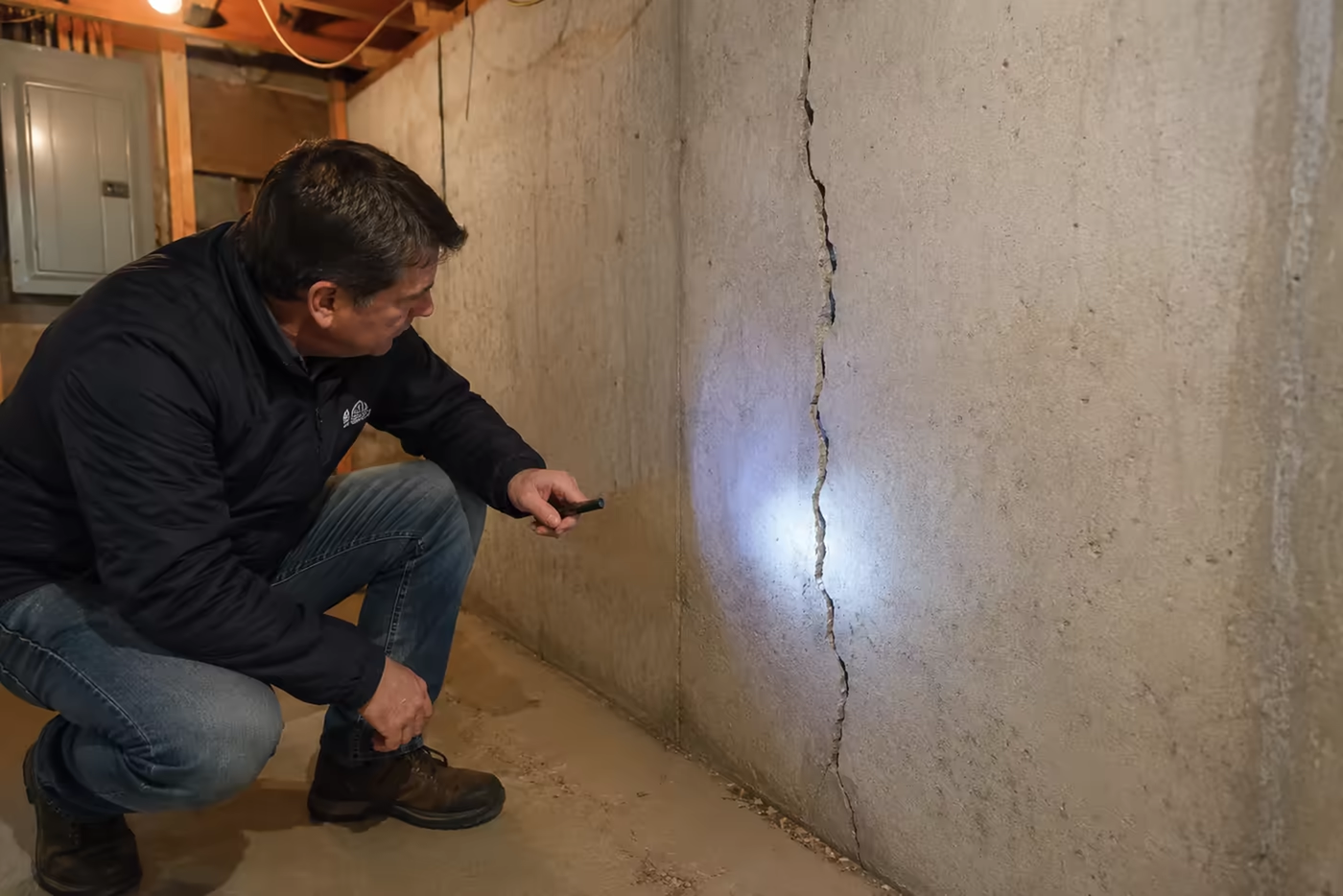
Winnipeg has a lot of beautiful older homes. Character neighbourhoods like Wolseley, River Heights, Crescentwood, and parts of St. Boniface and the North End are full of houses built anywhere from the early 1900s through the 1960s. These homes have charm, solid craftsmanship, and often more space than newer builds. They also frequently come with foundation issues.
That's not a reason to avoid older homes. It's just something you need to understand. Foundation problems in Winnipeg are incredibly common, and they range from minor cosmetic cracks to serious structural concerns. Knowing the difference, and knowing when to call a professional, can save you a lot of money and stress.
Why are Winnipeg homes prone to foundation problems?
Winnipeg sits on heavy clay soil — locals call it "gumbo" — that expands when it absorbs water and contracts when it dries, putting constant seasonal pressure on foundation walls. Manitoba's extreme freeze-thaw cycles add stress dozens of times a year as water in the soil freezes and pushes against the foundation. Older homes are especially vulnerable because rubble stone and concrete block foundations don't hold up to these forces as well as modern poured concrete.
It comes down to the soil. Winnipeg sits on heavy clay soil, sometimes called "gumbo" by locals. Clay soil expands when it absorbs water and contracts when it dries out. This seasonal movement puts constant pressure on foundations, pushing walls inward during wet periods and allowing them to settle unevenly during dry spells.
Add in Manitoba's extreme freeze-thaw cycles. Water in the soil around and under your foundation freezes, expands, and pushes against the walls. Then it thaws, the soil contracts, and things shift again. This happens dozens of times every year. Over decades, the cumulative effect takes a toll.
Older homes are especially vulnerable because they were often built with construction methods and materials that don't hold up as well to these forces.
- Rubble stone foundations (common in homes built before 1920) are made of irregularly shaped stones held together with morite mortar. They were never designed to be waterproof, and the mortar deteriorates over time.
- Concrete block foundations (common from the 1920s through the 1960s) can crack and bow under lateral soil pressure.
- Poured concrete foundations (more common from the 1960s onward) are generally stronger but still susceptible to cracking from soil movement.
What are the signs of foundation problems?
In the basement, watch for horizontal, vertical, or stair-step cracks, walls that bow or lean inward, water seepage, efflorescence (white mineral deposits), or a musty smell. Elsewhere in the house, sticking doors and windows, drywall cracks above doorframes, sloping floors, and cracks in exterior brick or stucco can all point to foundation movement. Horizontal cracks and stair-step cracks in concrete block walls are the biggest red flags.
Some signs are obvious. Others are easy to miss if you don't know what to look for.
In the basement:
- Horizontal, vertical, or stair-step cracks in the foundation walls
- Walls that are bowing, leaning, or bulging inward
- Water seepage, staining, or efflorescence (white mineral deposits) on the walls
- A musty smell or visible mould
- Gaps between the top of the foundation wall and the sill plate
Throughout the house:
- Doors and windows that stick or won't close properly
- Cracks in interior drywall, especially above doorframes and at corners
- Uneven or sloping floors
- Gaps between walls and the floor or ceiling
- Cracks in exterior brick or stucco
Not every crack is a crisis. Hairline cracks in poured concrete are often just shrinkage cracks and don't indicate a structural issue. But certain patterns are red flags. Horizontal cracks in block or concrete walls suggest lateral pressure from the soil and can indicate the wall is being pushed inward. Stair-step cracks in concrete block walls often mean the foundation is settling unevenly.
When should you worry about foundation cracks?
Hairline vertical cracks in poured concrete are usually harmless shrinkage cracks. Vertical cracks wider than 1/8 inch, cracks showing signs of movement, or minor seepage during heavy rain are worth monitoring. Call a professional for any horizontal cracking, visibly bowing or leaning walls, cracks wider than 1/4 inch, recurring water entry, uneven settling, or cracks that are actively growing — a structural engineer or foundation contractor can tell you whether it needs repair, monitoring, or immediate attention.
Generally not a big concern:
- Hairline vertical cracks in poured concrete (common shrinkage cracks)
- Minor efflorescence without active water entry
- Small cracks that haven't changed in size over time
Worth monitoring:
- Vertical cracks wider than 1/8 inch
- Cracks that show any signs of movement (you can mark them with tape or pencil and check over several months)
- Minor water seepage during heavy rain or spring thaw
Call a professional:
- Any horizontal cracking
- Walls that are visibly bowing or leaning
- Cracks wider than 1/4 inch
- Significant or recurring water entry
- Uneven settling (one side of the house noticeably lower than the other)
- Cracks that are actively growing
When in doubt, get it assessed. A structural engineer or foundation contractor can usually tell you exactly what you're dealing with and whether it needs repair, monitoring, or immediate attention.
How are foundations repaired in Winnipeg?
Repairs range widely in cost and scope. Crack injection seals leaking non-structural cracks for $300 to $800 per crack, interior waterproofing with a drainage system and sump pump runs $5,000 to $15,000, and exterior waterproofing with a membrane and weeping tile costs $10,000 to $30,000 or more. Bowing walls can be stabilized with carbon fibre straps, steel beams, or anchors, while serious settling may require underpinning at $30,000 or more.
The repair approach depends on what's wrong and how serious it is.
Crack injection. For non-structural cracks in poured concrete that are leaking water, epoxy or polyurethane injection is a common and relatively affordable fix. The material is injected directly into the crack to seal it. Cost is typically $300 to $800 per crack.
Exterior waterproofing. This involves excavating around the foundation, applying a waterproof membrane to the exterior wall, and installing or replacing weeping tile (drainage tile) around the footing. It's effective but expensive and disruptive, often $10,000 to $30,000 or more depending on the scope. However, it addresses the root cause of water entry rather than just treating symptoms.
Interior waterproofing. A less invasive option involves installing an interior drainage system along the base of the foundation walls, connected to a sump pump. It doesn't stop water from entering the wall but manages it effectively. Costs typically range from $5,000 to $15,000.
Wall reinforcement. For bowing or buckling walls, carbon fibre straps, steel I-beams, or wall anchors can be used to stabilize the wall and prevent further movement. Carbon fibre straps are less invasive and work well for minor to moderate bowing. Steel beams or anchors may be needed for more severe cases. Costs vary widely depending on the method and extent of the problem.
Underpinning. For serious settling issues, underpinning involves extending the foundation deeper into more stable soil. This is major structural work and is usually only necessary when the foundation is failing. It's expensive (often $30,000 or more) but sometimes it's the only real solution.
Parging and mortar repair. For older rubble stone or block foundations, repointing deteriorated mortar and applying a fresh parge coat can extend the life of the foundation and reduce water entry. This is more of a maintenance repair than a structural one.
Should you buy a home with foundation issues?
Foundation issues alone aren't a reason to walk away — they're something to factor into the deal. Always get a home inspection on older homes, and if concerns are flagged, a structural engineer's assessment ($500 to $1,000) will tell you exactly what's wrong and what repairs would cost, giving you real negotiating power. If a home needs $15,000 in foundation work, reflect that in your offer price or negotiate it as a condition of sale.
If you're buying an older home in Winnipeg, foundation issues should be on your radar from the start. Here's my advice.
Always get a home inspection. A qualified home inspector will identify visible foundation issues and recommend further assessment where needed. Don't skip this step, especially on homes built before 1970.
Consider a structural engineer. If the home inspector flags foundation concerns, a structural engineer's assessment (typically $500 to $1,000) is money well spent. They can tell you exactly what's happening, whether it's serious, and what repairs would cost. This information gives you real negotiating power.
Factor repair costs into your offer. If a home needs $15,000 in foundation work, that should be reflected in your offer price or negotiated as a condition of sale. An informed buyer doesn't walk away from foundation issues. They factor them into the deal.
Ask about history. Has the seller had any foundation work done? Is there a history of basement flooding? Any warranty documentation from previous repairs? Sellers are required to disclose known material defects in Manitoba, but asking specific questions can surface information that might not be in a standard disclosure.
Check the drainage. During your viewing, look at the grading around the home. Is soil sloping toward or away from the foundation? Are gutters and downspouts directing water away from the house? Poor drainage is the number one contributor to foundation problems in Winnipeg, and it's also the easiest thing to fix.
How do foundation issues affect selling your home?
Sellers in Manitoba must disclose known foundation defects on the Property Disclosure Statement, and failing to do so creates serious legal liability. Getting a professional assessment before listing and sharing that documentation shows transparency — a buyer who knows exactly what they're dealing with is more likely to make an offer than one who suspects problems but doesn't know the extent. Simple fixes like grading, gutter repairs, and sealing minor cracks also improve how buyers perceive the home.
If you're selling a home with known foundation issues, disclosure is not optional. Manitoba's Property Disclosure Statement asks sellers to identify known defects, and failing to disclose a known foundation problem can create serious legal liability.
The smarter approach is to address what you can before listing. Even if you can't afford a full repair, getting a professional assessment and providing that documentation to buyers shows transparency and reduces their uncertainty. A buyer who knows exactly what they're dealing with is more likely to make an offer than one who suspects problems but doesn't know the extent.
Simple things like fixing grading, repairing gutters, and sealing minor cracks can make a meaningful difference in how buyers perceive the home.
How do you prevent foundation problems?
You can't eliminate foundation movement in Winnipeg's clay soil, but you can minimize the damage. Keep soil sloping away from the foundation at a minimum of 1 inch per foot for the first 6 feet, keep gutters clean with downspouts extended well away from the house, and avoid planting large trees close to the foundation. During prolonged dry spells, run a soaker hose around the perimeter to keep soil moisture consistent, and mark and monitor existing cracks for growth.
You can't eliminate foundation movement in Winnipeg's clay soil, but you can minimize the damage.
- Maintain proper grading. Soil should slope away from your foundation at a minimum of 1 inch per foot for the first 6 feet.
- Keep gutters clean and ensure downspouts extend well away from the house.
- Avoid planting large trees too close to the foundation. Tree roots draw moisture out of clay soil, which causes it to shrink and can lead to settling.
- Water your foundation during dry spells. This might sound strange, but in prolonged dry weather, the clay soil around your foundation can shrink dramatically, pulling away from the walls. Running a soaker hose around the perimeter for 30 minutes a couple of times a week can help maintain consistent soil moisture.
- Monitor existing cracks. Mark them, measure them, and track whether they're growing. A crack that hasn't changed in five years is very different from one that's gotten wider over the past six months.
It's Part of Owning an Older Home Here
Foundation issues are a reality of homeownership in Winnipeg, especially in older neighbourhoods. They shouldn't scare you away from buying a character home, but they should be something you go in with your eyes open about. Understanding the problem, knowing the repair options, and budgeting accordingly puts you in control.
If you're considering buying or selling an older home and want to talk through how foundation condition might affect value, feel free to get in touch.

When buyers tell me they want a newer home in Winnipeg, three communities come up more than any others: Sage Creek, Bridgwater, and Prairie Pointe. All three offer modern builds, family-friendly amenities, and that "new neighbourhood" feel. But they're not interchangeable.
Each one has its own personality, price range, and set of trade-offs. If you're trying to decide between them, this comparison should help you narrow things down.
Sage Creek: The Most Established of the Three
Sage Creek is located in southeast Winnipeg, just south of the Perimeter Highway and east of Lagimodiere Boulevard. Development started in the mid-2000s, which means the earliest phases are now mature enough to have established trees, finished landscaping, and a lived-in feel.
The community was master-planned with a focus on green space. There are walking paths, ponds, parks, and a central commercial area with a grocery store, restaurants, and shops. For a suburban neighbourhood, the ability to walk to grab groceries or a coffee is a significant plus.
Homes in Sage Creek range from starter-sized two-storey homes in the $400,000s to larger executive homes pushing past $700,000. You'll also find condos and townhomes for buyers looking for a lower-maintenance option. Resale homes are readily available in the established phases, while newer phases still offer the chance to build custom.
Schools are a big draw. Sage Creek has its own elementary school within the community, and the area is served by the Louis Riel School Division. Families with school-aged children have found the school access convenient.
Commute considerations: If you work downtown, the drive from Sage Creek takes about 20 to 25 minutes in normal traffic. The Bishop Grandin corridor and Lagimodiere Boulevard are the main routes. During peak hours, expect that to stretch. If you work in the southeast industrial area or along the Perimeter, Sage Creek is very well-positioned.
Browse current Sage Creek listings here.
Bridgwater: Size and Variety
Bridgwater is located in southwest Winnipeg, south of McGillivray Boulevard and west of Pembina Highway. It's one of Winnipeg's largest newer developments and includes several sub-communities: Bridgwater Forest, Bridgwater Lakes, Bridgwater Trails, and Bridgwater Centre.
The scale of Bridgwater means there's a wider variety of housing types and price points compared to most new developments. You'll find everything from affordable townhomes in the $300,000s to premium custom builds over $800,000. That variety attracts everyone from first-time buyers to families upgrading to their forever home.
The commercial side of Bridgwater is growing steadily. Bridgwater Centre includes big-box retail, restaurants, and services. You don't need to leave the area for day-to-day errands, which is a real convenience factor.
Green space and recreation are built into the design. Walking trails connect the sub-communities, and there are multiple parks, playgrounds, and stormwater ponds that double as attractive water features. The Bridgwater neighbourhood association runs community events throughout the year.
Schools in Bridgwater fall under the Pembina Trails School Division, which has a strong reputation. There are schools within and near the community, and the school division has been responsive to the growing population in the area.
Commute considerations: Getting downtown from Bridgwater takes about 20 to 30 minutes depending on traffic. The Pembina Highway corridor is the main route, and it gets busy during rush hour. If you work at the University of Manitoba, you're close. If you work in the southwest industrial parks, this is an ideal location.
See what's available in Bridgwater right now.
Prairie Pointe: The Newest Option
Prairie Pointe is the newest of the three, located in south Winnipeg near Waverley Street and the Perimeter Highway. Because it's still in its early development stages, there's a different dynamic here compared to Sage Creek or Bridgwater.
The biggest advantage of buying in Prairie Pointe right now is that you can get a newer build at a competitive price point. Builders are actively offering lots and spec homes, and you have more selection for customization than you would in a nearly built-out community. Entry-level homes start in the low $400,000s, with larger builds moving into the $500,000s and $600,000s.
The trade-off is that Prairie Pointe doesn't have the established amenities yet. Commercial development, schools, and community infrastructure are still catching up to the residential growth. That's normal for a community this new, but it means you'll likely be driving to nearby areas for shopping and services in the short term.
What's planned: The long-term vision for Prairie Pointe includes parks, trails, commercial areas, and school sites. If you're comfortable buying into the potential of a community rather than what exists today, the value proposition is compelling.
Commute considerations: Prairie Pointe is close to the Perimeter Highway, which gives good access to multiple parts of the city. Downtown is roughly a 25 to 30-minute drive. The Waverley Street corridor connects you to the University of Manitoba area and southwest Winnipeg.
Check out Prairie Pointe listings here.
How do Sage Creek, Bridgwater, and Prairie Pointe compare?
Sage Creek is the most established, with single-family homes from $400,000 to $700,000+, a grocery store and shops in the community, and its own school in the Louis Riel School Division. Bridgwater offers the widest range of housing at $300,000 to $800,000+, extensive retail at Bridgwater Centre, and Pembina Trails schools. Prairie Pointe is the newest at $400,000 to $600,000+, with fresh builds but amenities and schools still to come. Downtown commutes run 20 to 30 minutes from all three.
Here's a quick look at how the three stack up on the factors that matter most to buyers.
Price Range
- Sage Creek: $400,000 to $700,000+ for single-family homes
- Bridgwater: $300,000 to $800,000+ (widest range due to variety of housing types)
- Prairie Pointe: $400,000 to $600,000+ (still early in development)
Maturity
- Sage Creek: Most established. Early phases feel settled and complete.
- Bridgwater: Mid-stage. Some areas are fully developed, newer phases are still growing.
- Prairie Pointe: Earliest stage. Fresh builds, but limited amenities.
Commercial Amenities
- Sage Creek: Grocery store, restaurants, and shops within the community.
- Bridgwater: Extensive retail at Bridgwater Centre, plus neighbourhood-level shops.
- Prairie Pointe: Minimal for now. Planned for the future.
School Access
- Sage Creek: School within the community (Louis Riel School Division).
- Bridgwater: Schools nearby and within the community (Pembina Trails School Division).
- Prairie Pointe: School sites planned but not yet built. Busing to nearby schools in the interim.
Green Space
- Sage Creek: Well-developed trail system, ponds, and parks.
- Bridgwater: Extensive trails connecting sub-communities, multiple parks.
- Prairie Pointe: Parks planned and under development.
Commute to Downtown
- Sage Creek: 20 to 25 minutes (via Lagimodiere or Bishop Grandin).
- Bridgwater: 20 to 30 minutes (via Pembina Highway).
- Prairie Pointe: 25 to 30 minutes (via Waverley or Pembina).
Which One Is Right for You?
It comes down to your priorities. Sage Creek suits buyers who want a newer community that already feels established, with a grocery store, school, and developed parks within walking distance, and it's a strong choice if you work in southeast Winnipeg. Bridgwater offers the widest selection of housing types and price points plus nearby retail and multiple school options. Prairie Pointe delivers the best value on a new build if you don't mind waiting a few years for amenities.
There's no single best answer. It really depends on your priorities.
Choose Sage Creek if you want a newer community that already feels established. If having a grocery store, school, and developed parks within walking distance matters to you, Sage Creek delivers that today. It's also a strong choice if you work in southeast Winnipeg.
Choose Bridgwater if you want the widest selection of housing types and price points. It's ideal if you want the convenience of nearby retail and multiple school options. The southwest location works well if your job is along Pembina Highway or in the southwest part of the city.
Choose Prairie Pointe if you're focused on getting the best value for a new build. If you don't mind that some amenities are still a few years away, and you like the idea of being one of the early residents in a growing community, Prairie Pointe offers an opportunity that the other two can't match at this stage.
What do all three communities have in common?
All three share traits typical of newer Winnipeg developments. Property taxes tend to be higher because recently built homes carry current assessments, and the suburban design means you'll likely need a vehicle. New homes in each community come with coverage under the Manitoba New Home Warranty Program, and resale values have been stable thanks to consistent demand for newer homes with modern layouts and low maintenance.
It's worth noting that all three communities share some characteristics typical of newer Winnipeg developments.
Property taxes tend to be based on newer, higher assessments. Since the homes are recently built, their assessed values are current. This can mean higher annual property tax bills compared to an older home of similar size in an established neighbourhood. The City of Winnipeg's property assessment page lets you look up assessments for specific addresses.
You'll likely need a vehicle. While all three communities have some walkable amenities, they're suburban by design. If being car-free is important to you, a more central neighbourhood might be a better fit.
Builder warranties apply. New homes in Manitoba come with coverage under the Manitoba New Home Warranty Program. If you're buying a new build, make sure you understand what's covered and for how long.
Resale values have been stable. All three communities have shown consistent demand in the resale market. Buyers like newer homes with modern layouts, efficient mechanicals, and low maintenance requirements. That demand supports property values over time.
Final Thoughts
I've helped buyers purchase in all three of these communities, and satisfaction tends to be high across the board. The key is matching the community to your lifestyle, your budget, and your timeline.
If you're still deciding, driving through each neighbourhood at different times of day can be surprisingly helpful. Pay attention to how busy the streets are, where the parks and schools are in relation to specific lots, and how the overall vibe feels to you. Sometimes the decision becomes obvious once you've spent an hour in each community.
For a closer look at what's currently on the market, you can explore listings in Sage Creek, Bridgwater, and Prairie Pointe on our website.

The RRSP Home Buyers' Plan (HBP) has been around for decades, and it's still one of the most valuable tools for first-time buyers in Canada. If you've been contributing to your RRSP, you might already be sitting on part of your down payment without realizing it.
Here's how the program works, what the rules are, and how to use it strategically when buying your first home in Winnipeg or anywhere else in Manitoba.
What Is the Home Buyers' Plan?
The Home Buyers' Plan lets you withdraw money from your Registered Retirement Savings Plan (RRSP) to buy or build a qualifying home, without paying tax on the withdrawal. It's essentially a tax-free loan from your own retirement savings.
As of 2024, you can withdraw up to $60,000 from your RRSP under the HBP. If you're buying with a partner who is also a first-time buyer, each of you can withdraw up to $60,000 from your own RRSPs, for a combined total of $120,000.
Full details are available on the Government of Canada Home Buyers' Plan page.
Who Qualifies for the HBP?
You qualify if you're a first-time buyer — meaning you didn't own a home you lived in as a principal residence in the withdrawal year or the four preceding calendar years — a Canadian resident with a written agreement to buy or build a qualifying home, and you intend to occupy it as your principal residence within one year. Your spouse or common-law partner must also meet the first-time buyer definition. Previous HBP users can qualify again once their earlier balance is fully repaid.
You can use the Home Buyers' Plan if you meet these conditions:
- You are a first-time home buyer, meaning you did not own a home you lived in as a principal residence in the withdrawal year or the four preceding calendar years
- You are a Canadian resident
- You have a written agreement to buy or build a qualifying home
- You intend to occupy the home as your principal residence within one year of buying or building it
Your spouse or common-law partner must also meet the first-time buyer definition. If your partner currently owns a home you live in, you won't qualify even if you personally have never owned property.
There is one exception worth noting. If you've used the HBP before, you can use it again as long as your previous HBP balance has been fully repaid by January 1 of the year you make the new withdrawal, and you meet the first-time buyer definition again.
How do you make an HBP withdrawal?
First, make sure your RRSP contributions have been in the account for at least 90 days. Then complete Form T1036 and submit it to your financial institution, which processes the withdrawal without withholding tax as long as you stay within the $60,000 limit. You must buy or build the home before October 1 of the year after the withdrawal, and multiple withdrawals are allowed provided the total doesn't exceed $60,000.
The process is straightforward, but there are steps you need to follow in order:
Step 1: Make sure your RRSP contributions have been in the account for at least 90 days. This is a rule that catches people off guard. If you deposit money into your RRSP today, you can't withdraw it under the HBP for at least 90 days. Plan ahead.
Step 2: Fill out Form T1036. This is the Home Buyers' Plan Request to Withdraw Funds from an RRSP form. You submit it to your financial institution, not to the CRA.
Step 3: Your financial institution processes the withdrawal. They won't withhold tax on the amount, as long as you don't exceed the $60,000 limit and you've completed the form properly.
Step 4: You must buy or build the home before October 1 of the year after the withdrawal. So if you withdraw funds in 2026, you need to have purchased or begun building your home by October 1, 2027.
You can make multiple withdrawals in the same year or across two calendar years, as long as the total doesn't exceed $60,000 and you complete the purchase within the required timeframe.
How do the HBP repayment rules work?
You have 15 years to repay the full amount to your RRSP, starting the second year after the year of withdrawal, at a minimum of 1/15th per year — $4,000 annually on a $60,000 withdrawal. Repayments aren't tax-deductible; you designate regular RRSP contributions as HBP repayments using Schedule 7 on your tax return. Any missed repayment amount gets added to your taxable income for that year, and you can always repay more than the minimum.
This is the part that matters most, and where the HBP differs significantly from the FHSA. The money you withdraw under the Home Buyers' Plan must be repaid to your RRSP.
Here's how the repayment works:
- You have 15 years to repay the full amount
- Repayments start the second year after the year you made the withdrawal. If you withdraw in 2026, your first repayment is due for the 2028 tax year.
- Each year, you must repay at least 1/15th of the total amount withdrawn
- Repayments are not tax-deductible. You're putting money back, not making new contributions.
For example, if you withdraw $60,000, your minimum annual repayment would be $4,000 per year for 15 years. You designate your regular RRSP contributions as HBP repayments on your tax return using Schedule 7.
What happens if you miss a repayment? The amount you were supposed to repay that year gets added to your taxable income. So if you owe $4,000 and repay $0, you'll have an extra $4,000 of taxable income that year. You don't get penalized beyond that, but it effectively turns that portion of the withdrawal into a taxable one.
You can always repay more than the minimum in any year to get ahead of the schedule.
How can Manitoba buyers get the most from the HBP?
Contribute to your RRSP early — you get the tax deduction now and a tax-free withdrawal later, keeping the 90-day rule in mind. Combining the HBP with the FHSA lets a single buyer access up to $100,000 in tax-advantaged funds, and a couple up to $200,000, which goes a long way in Manitoba's below-national-average market. Apply your RRSP tax refund toward your down payment or closing costs, and make sure the $4,000 annual repayment fits your post-purchase budget.
Start Contributing Early with the HBP in Mind
If you know you want to buy in the next few years, increasing your RRSP contributions now serves double duty. You get the tax deduction today, and you build up funds you can later withdraw tax-free under the HBP. Just remember the 90-day rule on new contributions.
Combine the HBP with the FHSA
This is the strategy I recommend most to first-time buyers. The First Home Savings Account (FHSA) lets you save up to $40,000 with no repayment required. Combined with the HBP's $60,000 limit, a single buyer could access up to $100,000 in tax-advantaged funds.
For a couple, the numbers get even better. Two buyers could theoretically access up to $200,000 between their combined FHSAs and HBPs. In the Manitoba market, where average home prices remain below the national average, that kind of purchasing power can make a massive difference.
Use the Tax Refund Strategically
When you contribute to your RRSP, you get a tax refund. A smart approach is to take that refund and apply it toward your down payment savings or closing costs. Some buyers even contribute to their RRSP, claim the deduction, use the refund to contribute to their FHSA, and then eventually withdraw from both for the purchase. It takes planning, but the math works out in your favour.
Factor Repayments Into Your Post-Purchase Budget
Before you withdraw the full $60,000, think about whether you can realistically repay $4,000 per year on top of your mortgage, property taxes, insurance, and other homeownership costs. If you're stretching your budget to buy, a smaller HBP withdrawal might be wiser so you're not facing taxable income penalties down the road when you can't make the repayments.
What HBP mistakes should you avoid?
Four mistakes catch buyers most often: forgetting that new RRSP contributions must sit for at least 90 days before an HBP withdrawal, failing to designate contributions as HBP repayments on your tax return (the CRA treats the shortfall as income), withdrawing more than you can realistically repay, and missing the October 1 purchase deadline the year after withdrawal — which forces you to repay the full amount or include it as income.
Forgetting the 90-day rule. If you need the money for a closing date in March, you can't make a large RRSP contribution in January and withdraw it right away. Those funds need to sit for at least 90 days.
Not designating repayments properly. When you make RRSP contributions during your repayment period, you need to indicate on your tax return that you're designating them as HBP repayments. If you forget, the CRA will treat the shortfall as income.
Withdrawing too much. Just because you can take $60,000 doesn't mean you should. Consider your ability to repay and whether the extra amount actually changes your home purchase. If you have enough for a 10% down payment without maxing out the HBP, that might be sufficient.
Missing the purchase deadline. If you withdraw funds and don't buy or build a home before the October 1 deadline the following year, you'll need to either repay the full amount to your RRSP by December 31 of the following year or include it as income on your tax return.
How does the HBP work with Manitoba's housing market?
In Winnipeg and the surrounding areas, the HBP goes further than it does in most major Canadian cities. A $60,000 HBP withdrawal on a $375,000 home represents a 16% down payment. That's enough to avoid CMHC mortgage insurance (which kicks in below 20%) or come very close to it.
Even for buyers looking in communities outside the city, like Selkirk, Stonewall, or the RM of Springfieldtps://www.andrewsthilaire.com/communities/springfield">Springfield, the HBP can cover a significant chunk of the purchase price. Homes in these areas often come with more space and lower price points, making the HBP even more impactful.
Don't forget to budget for closing costs on top of your down payment. In Manitoba, you'll need to account for land transfer tax, lawyer fees, a home inspection, and potential property tax adjustments. These typically run 1.5% to 3% of the purchase price.
Is the HBP Worth It?
For most first-time buyers, yes. The ability to access your own savings tax-free for a home purchase is hard to beat. The repayment obligation is manageable for most people, and the alternative of leaving the money in your RRSP while renting longer isn't always the better financial move.
That said, if you're close to retirement or your RRSP is your only significant savings, think carefully. Pulling money out of your retirement fund has a real long-term cost in terms of lost investment growth.
For younger buyers with time to rebuild their retirement savings, the HBP is almost always a good call. Pair it with the FHSA, plan your contributions carefully, and you'll be in a strong position when you find the right home.
If you're thinking about buying in Winnipeg or the surrounding areas and want to understand how these programs fit into your specific situation, check out our buyer resources or connect with a mortgage professional who can walk through the numbers with you.

When you're getting ready to sell your home, it's tempting to start a list of renovations you think will boost the sale price. New kitchen? Finished basement? Maybe a bathroom overhaul? Before you start tearing out cabinets or calling contractors, it's worth understanding which improvements actually pay off and which ones end up costing more than they return.
I've worked with sellers who spent $40,000 on a basement renovation only to see it add $15,000 to their sale price. I've also seen others spend $3,000 on paint and minor updates that helped their home sell for $10,000 more than comparable listings. The difference comes down to knowing where your money has the most impact.
Why shouldn't you over-improve for your neighbourhood?
Your home's value has a ceiling set by your neighbourhood. If every home on your street sells between $350,000 and $400,000, a $50,000 kitchen won't push your sale price to $450,000, because buyers shopping that area are budgeting for that price range. The goal of pre-sale renovations isn't to build your dream home — it's to remove barriers that would cause buyers to make a lower offer or skip your listing entirely.
Before you spend a dollar on renovations, understand this. Your home's value has a ceiling, and that ceiling is set by your neighbourhood. If every home on your street sells between $350,000 and $400,000, installing a $50,000 kitchen isn't going to push your sale price to $450,000. Buyers shopping in that neighbourhood are budgeting for that price range, and they're typically not going to pay a premium that exceeds what the area supports.
The goal of pre-sale renovations isn't to build your dream home. It's to remove barriers that would cause buyers to make a lower offer or skip your listing entirely.
Which low-cost updates add the most value?
Fresh paint in neutral colours is the single best investment before selling, typically $3,000 to $6,000 for professional interior painting in an average Winnipeg home. Other high-return updates include modern light fixtures ($50 to $200 each), kitchen refreshes like new hardware, painted cabinets, or a new countertop, bathroom updates such as a modern vanity and faucets, and replacing worn carpet with luxury vinyl plank at $3 to $6 per square foot installed.
These are the improvements that consistently deliver the best return on investment. They're relatively affordable and make a noticeable difference in how buyers perceive your home.
Fresh Paint
This is the single best investment you can make before selling. A fresh coat of paint in neutral, modern colours makes every room feel cleaner, brighter, and more inviting. It covers scuff marks, outdated accent walls, and general wear and tear.
Stick to warm whites, soft greys, or light greiges. Avoid bold colours or anything too personal. You want buyers to see themselves in the space, not your style.
For an average-sized Winnipeg home, professional interior painting runs between $3,000 and $6,000. If you're handy and willing to do it yourself, you can cut that cost significantly!
Updated Light Fixtures
Dated brass fixtures and builder-grade lighting can make a home feel stuck in the past. Swapping out key fixtures in the kitchen, dining room, entryway, and bathrooms is a quick win. Modern fixtures in black, brushed nickel, or matte finishes cost $50 to $200 each and make a surprisingly big difference.
Kitchen Refreshes (Not Full Renovations)
A full kitchen renovation can cost $30,000 to $60,000 or more, and you'll rarely get that money back dollar for dollar. Instead, consider targeted updates:
- New hardware on existing cabinets ($200 to $500 for the whole kitchen)
- Painting or refacing cabinets ($2,000 to $5,000 vs. $15,000+ for new ones)
- Replacing a dated countertop with quartz or butcher block ($2,000 to $5,000)
- Upgrading the faucet and sink ($300 to $800)
- Adding a tile backsplash ($500 to $1,500)
These targeted updates can make a 20-year-old kitchen feel current without the cost of a full gut job.
Bathroom Updates
Like kitchens, bathrooms don't need to be completely rebuilt to look great. Focus on:
- Replacing an old vanity with a modern one ($500 to $1,500)
- New faucets and hardware ($100 to $300)
- Re-caulking the tub and shower
- Replacing a dated mirror ($100 to $300)
- Updating the toilet if it's visibly old ($250 to $400)
A fresh-looking bathroom signals to buyers that the home has been well maintained.
Flooring
Worn or damaged flooring is one of the first things buyers notice. If your carpet is stained, matted, or outdated, it's going to hurt your sale price. Consider replacing it with luxury vinyl plank (LVP), which runs $3 to $6 per square foot installed and holds up well. It's a cost-effective alternative to hardwood that looks great and is practical for Manitoba's climate.
If you have hardwood floors hiding under carpet, refinishing them can be a smart investment. Buyers love original hardwood.
Which medium-sized improvements pay off?
Three mid-range projects can deliver a reasonable return: finishing a basement ($20,000 to $40,000 for a simple, functional space with a rec room and extra bathroom), adding a basic pressure-treated deck ($5,000 to $15,000 depending on size), and replacing old, drafty windows ($8,000 to $20,000 for a whole house). Windows matter especially in Manitoba, where heating costs are a concern, and Efficiency Manitoba occasionally offers rebates for energy-efficient upgrades.
These renovations cost more but can still deliver a reasonable return, especially if your home is noticeably behind the competition.
Finished Basements
In Winnipeg, a finished basement adds usable living space that buyers value, especially families. However, the return on investment varies widely. If you're finishing a raw basement from scratch, expect to spend $20,000 to $40,000 or more.
The key is to keep it simple and functional. Don't go overboard with custom built-ins or elaborate designs. A clean, dry, well-lit basement with a rec room and an extra bathroom will appeal to the broadest range of buyers.
If your basement is already finished but looks dated, cosmetic updates like new paint, flooring, and lighting can refresh it for much less.
Deck or Patio Addition
Outdoor living space is increasingly important to buyers. A well-built deck off the back of the house extends the living area and makes the backyard more functional during Winnipeg's warmer months. A basic pressure-treated deck runs $5,000 to $15,000 depending on size and complexity.
Window Replacement
Old, drafty windows are a turnoff for buyers, especially in Manitoba where heating costs matter. New windows improve energy efficiency, curb appeal, and comfort. The cost is significant, typically $8,000 to $20,000 for a whole house, but if your windows are visibly deteriorating or single-pane, this can be a worthwhile investment.
The Efficiency Manitoba occasionally offers rebates for energy-efficient upgrades, so check what's available before you start.
How much does curb appeal matter?
Buyers form an opinion about your home before they walk through the front door. Curb appeal doesn't have to cost a fortune, but it needs attention.
- Power wash the driveway, walkways, and siding
- Paint or replace the front door ($200 to $800)
- Add house numbers and a new mailbox ($50 to $150)
- Landscape the front yard with fresh mulch, trimmed shrubs, and seasonal plantings ($300 to $1,000)
- Repair any visible damage to steps, railings, or the driveway
These small investments make your home feel cared for and set the tone for the rest of the showing.
Which renovations don't pay off?
Swimming pools rarely recoup their cost in Winnipeg's climate and can actively turn buyers away. High-end luxury finishes like marble countertops and heated bathroom floors won't earn a premium, converting a bedroom into an office or gym reduces the bedroom count buyers value, and poor-quality DIY work can actually lower your home's value. Over-the-top landscaping is another trap — a $30,000 yard project won't return anywhere near that amount.
Not every improvement adds value relative to what it costs. Here are some common money traps.
Swimming pools. In Winnipeg's climate, a pool is a liability for many buyers. It adds maintenance costs, limits yard space, and has a short usable season. You'll rarely recoup the installation cost, and some buyers will actively avoid homes with pools.
High-end luxury finishes. Marble countertops, custom cabinetry, and heated bathroom floors are nice to have, and doing these renovations for yourself if fine, but buyers aren't willing to pay a premium for them.
Converting a bedroom. Turning a bedroom into a home office, gym, or walk-in closet might suit your lifestyle, but it can reduce the bedroom count, which hurts resale. Buyers value bedrooms, especially families.
DIY work that looks like DIY work. If a renovation isn't done well, it can actually reduce your home's value. Crooked tile, uneven paint lines, or a poorly finished basement tell buyers there may be other corners cut throughout the home. If you're not confident in the quality, hire a professional.
Over-the-top landscaping. A beautiful yard helps sell a home, but a $30,000 landscaping project won't return anywhere near that amount. Keep it neat, clean, and attractive without going overboard.
How do you decide which renovations are worth it?
Ask four questions before spending: does this fix a problem that would cause lower offers, does it bring the home up to the standard of competing listings, will it cost more than it returns, and will it appeal to a broad range of buyers? A renovation that costs $20,000 but might add only $10,000 to the sale price isn't worth doing. Your REALTOR® can walk through the home and advise on exactly what to fix, update, or leave alone.
Before spending money on any renovation, ask yourself these questions:
- Is this fixing a problem that would cause buyers to make a lower offer? If so, fix it.
- Is this bringing my home up to the standard of competing listings? If comparable homes have updated kitchens and yours doesn't, a refresh may be necessary.
- Am I spending more than I'd reasonably get back? If the renovation costs $20,000 but might add $10,000 to the sale price, it's probably not worth it.
- Will this appeal to a broad range of buyers? Personal taste projects rarely pay off. Neutral, widely appealing updates do.
Your REALTOR® can walk through your home and give you specific advice on what to fix, what to update, and what to leave alone. This is part of the listing preparation process and it's one of the most valuable things a good agent does. If you're preparing to sell your home, getting this guidance early can save you thousands.
The Bottom Line
Smart pre-sale renovations are about strategic spending, not maximum spending. Focus on the updates that remove objections, improve first impressions, and bring your home in line with the competition. Save the big-ticket dream renovations for your next home, where you'll actually get to enjoy them.

The rent vs. buy question comes up in almost every conversation I have with people who are thinking about getting into the housing market. And honestly, there's no one-size-fits-all answer. Your financial situation, your lifestyle, where you are in your career, and what the market looks like all play a role.
What I can tell you is that Winnipeg and the surrounding areas offer one of the more affordable housing markets in Canada, which makes the buy side of the equation more realistic here than in cities like Toronto or Vancouver. But that doesn't mean buying is always the right move.
Let's walk through the real considerations so you can figure out what makes sense for you.
How do monthly costs compare between renting and buying?
Renting is often cheaper on a pure monthly cash-flow basis. Average rent for a two-bedroom Winnipeg apartment runs $1,300 to $1,700 per month, while owning a $380,000 home with 5% down at around 4.5% means roughly $1,900 to $2,000 in mortgage payments — and $2,400 to $2,800 or more once property taxes, insurance, and maintenance are added. That comparison, though, misses equity and other long-term factors.
The first thing most people look at is the monthly payment, and that's a reasonable starting point. In Winnipeg, the average rent for a two-bedroom apartment has been climbing steadily and typically sits somewhere between $1,300 and $1,700 per month depending on the area and the building.
On the buying side, a $380,000 home with 5% down, a 25-year amortization, and a mortgage rate around 4.5% would give you a monthly mortgage payment of roughly $1,900 to $2,000. Add in property taxes ($250 to $400 per month depending on the home), insurance ($100 to $200 per month), and maintenance, and the total monthly cost of ownership could be $2,400 to $2,800 or more.
So on a pure monthly cash flow basis, renting is often cheaper. But that comparison misses some important things.
How does buying build equity?
A portion of every mortgage payment goes toward paying down your loan balance, and that principal becomes your equity. After five years on a $360,000 mortgage at 4.5%, you'd have paid down roughly $35,000 to $40,000 in principal — money essentially saved through housing. Add Winnipeg's moderate but steady property appreciation, and owning can start to pull ahead of renting financially, even though equity isn't liquid until you sell or refinance.
Here's the part that changes the math over time. When you pay rent, that money is gone. Your landlord benefits, not you. When you make mortgage payments, a portion of every payment goes toward paying down your loan balance. That's your equity, and it grows over time.
In the early years of a mortgage, most of your payment goes toward interest. But as the years go on, more and more goes toward principal. After five years on a $360,000 mortgage at 4.5%, you'd have paid down roughly $35,000 to $40,000 in principal. That's money you've essentially saved through housing.
Add in any appreciation in the property's value (Winnipeg has seen moderate but steady growth over time), and owning can start to pull ahead of renting financially. The Canadian Real Estate Association tracks national and regional price trends if you want to see the numbers.
Of course, equity isn't liquid. You can't spend it at the grocery store. But it's there, building quietly in the background, and it matters when you eventually sell or refinance.
What are the hidden costs of owning?
Owners should budget about 1% to 2% of the home's value per year for maintenance — $4,000 to $8,000 annually on a $400,000 home, with big items like a furnace or roof costing $5,000 to $15,000. Property taxes in Winnipeg typically run $3,000 to $5,000 per year, home insurance $1,200 to $2,500, and utilities are usually higher in a house than an apartment. One-time closing costs add another $10,000 to $15,000 beyond the down payment.
Buying a home comes with costs that renters don't have to think about. As an owner, you're responsible for everything.
Maintenance and repairs are the big ones. The general rule of thumb is to budget about 1% to 2% of your home's value per year for maintenance. On a $400,000 home, that's $4,000 to $8,000 annually. Some years you'll spend less, other years a lot more (a new furnace or roof can cost $5,000 to $15,000).
Property taxes in Winnipeg vary by neighbourhood and assessed value but typically run $3,000 to $5,000 per year for a standard single-family home. You can check assessed values through the City of Winnipeg's online assessment tool.
Home insurance runs $1,200 to $2,500 per year. Utility costs are typically higher in a house than an apartment. And then there are the one-time closing costs when you buy, which can add up to $10,000 to $15,000 beyond your down payment. We have a full breakdown of buying costs if you want to see the numbers.
What are the hidden costs of renting?
The biggest hidden cost is rent increases — in Manitoba, landlords can raise rent once per 12 months by the provincial guideline amount, which has been trending upward, so your rent could climb significantly over five or ten years. Renters also miss out on programs like the First Home Savings Account, the RRSP Home Buyers' Plan, and the First-Time Home Buyers' Tax Credit, and most rentals restrict renovations and pets.
Renting has its own costs that people sometimes overlook. The biggest one is rent increases. In Manitoba, landlords can increase rent once per 12 months by the provincial guideline amount, which has been trending upward. Over five or ten years, your rent could increase significantly.
You can check the current guideline on the Manitoba Residential Tenancies Branch website.
Renters also miss out on several tax advantages and government programs available to homeowners and first-time buyers. The First Home Savings Account (FHSA), the RRSP Home Buyers' Plan, and the First-Time Home Buyers' Tax Credit are all designed to make buying more affordable. The Government of Canada has details on all of these.
And there's the lifestyle side. Most rentals limit what you can do with the space. No major renovations, restrictions on pets, shared walls. For some people that's fine. For others, it's a dealbreaker.
When does buying make sense?
Buying tends to make financial sense when you plan to stay at least 3 to 5 years, have a stable income, and have saved a down payment of at least 5%. It also fits if you want to build long-term wealth — homeowners in Winnipeg have generally come out well ahead over 10, 15, or 20 years — and you're ready for the responsibility of repairs and maintenance.
Buying tends to make more financial sense when you meet most of these criteria:
You plan to stay for at least 3 to 5 years. The transaction costs of buying and selling are significant. Between land transfer tax, legal fees, real estate commissions, and moving costs, you need time for your equity growth and appreciation to outweigh those expenses. If you might move in a year or two, renting is probably smarter.
You have a stable income. A mortgage is a long-term commitment. You need to be confident that you can make payments consistently, even if interest rates change when your term renews.
You have a down payment saved. The minimum in Canada is 5%, but having more reduces your mortgage insurance costs and your monthly payments. If you have savings in an FHSA or RRSP, those can go toward your down payment as well.
You want to build long-term wealth. Real estate has historically been one of the most reliable ways to build wealth in Canada. It's not a guaranteed return, and values can dip in the short term. But over 10, 15, 20 years, homeowners in Winnipeg have generally come out well ahead of where they started.
You're ready for the responsibility. Owning a home means dealing with repairs, maintenance, and the occasional unpleasant surprise. If the furnace breaks on a Saturday night in January, it's your problem to solve.
When does renting make sense?
Renting is often the better choice if you value flexibility — you're early in your career, might relocate for work, or aren't sure where to settle. It also makes sense if you're carrying high-interest debt or lack an emergency fund, if you're saving toward a larger down payment to avoid CMHC insurance and lower your payments, or if you simply don't want the maintenance responsibilities of ownership.
Renting can be the better choice if:
You value flexibility. If you're early in your career, might relocate for work, or simply aren't sure where you want to settle, renting gives you the freedom to move without the financial hit of selling a home.
You're not financially ready. If you're carrying high-interest debt, don't have an emergency fund, or can't comfortably afford the full costs of ownership (not just the mortgage), it's better to wait.
You're saving toward a larger down payment. Waiting a year or two to save more can mean a lower mortgage balance, no CMHC insurance, and lower monthly payments. Sometimes patience pays off.
You prefer low maintenance. If you truly don't want to deal with home repairs, yard work, and all the responsibilities that come with ownership, renting offers a simpler lifestyle.
How does the Winnipeg market change the math?
Affordability narrows the gap between owning and renting here. A solid three-bedroom home in many parts of Winnipeg and surrounding areas like West St. Paul, Lorette, or Oakbank can still be purchased for $350,000 to $500,000, so monthly ownership costs aren't wildly higher than rent the way they are in Toronto or Vancouver. Winnipeg also avoids the extreme price swings of Canada's most expensive markets, making the investment relatively stable.
What makes this conversation particularly interesting in Winnipeg is affordability. In many Canadian cities, the monthly cost of owning is dramatically higher than renting, which makes the financial case for buying much harder. Here, the gap is narrower.
A solid three-bedroom home in many parts of Winnipeg and surrounding areas like West St. Paul, Lorette, or Oakbank can still be purchased for $350,000 to $500,000. Compare that to average prices in the Greater Toronto Area or Metro Vancouver, and it's a completely different conversation.
That affordability means you can often get into a home with a manageable monthly payment that isn't wildly more expensive than what you'd pay in rent. And because Winnipeg isn't subject to the same extreme price swings that hit the country's most expensive markets, the investment tends to be relatively stable.
You can explore different communities around Winnipeg and Manitoba to get a sense of pricing in different areas.
How do you run the numbers for yourself?
Start by talking to a mortgage broker, who can tell you exactly what you'd qualify for and what your payments would look like. Then factor in all ownership costs — not just the mortgage — and compare that total to your rent, keeping in mind that rent increases over time while a fixed-rate mortgage payment stays the same for the length of your term. The CMHC mortgage calculator is a helpful tool for testing different scenarios.
The best way to figure out whether buying or renting makes sense for you is to actually run the numbers with your real income, savings, and lifestyle in mind.
Start by talking to a mortgage broker. They can tell you exactly what you'd qualify for and what your payments would look like. Factor in all the ownership costs, not just the mortgage. Then compare that total to what you're paying in rent, keeping in mind that rent will increase over time while a fixed-rate mortgage payment stays the same for the length of your term.
The CMHC mortgage calculator is a helpful tool for running different scenarios.
There's No Wrong Answer
Both renting and buying can be the right choice depending on your circumstances. What matters is making the decision based on real numbers and honest self-assessment, not pressure from friends, family, or social media.
If you're leaning toward buying and want to explore what's available in your budget, browse our current listings or reach out to us and we can talk through your options. And if the answer is "not yet," that's perfectly fine too. The market will be here when you're ready.

If you ask long-time Winnipeg residents which neighbourhood has the most character, River Heights comes up almost every time. It's one of those areas that people move into and rarely leave. And when they do sell, their homes don't sit on the market for long.
I've worked with buyers who started their search in newer subdivisions, toured a few open houses in River Heights, and completely changed their plans. There's something about walking under a canopy of mature elms on a quiet street that's hard to replicate in a brand-new development.
So what makes River Heights so appealing? Let's break it down.
Where is River Heights located?
River Heights sits just south of the Assiniboine River, roughly between Pembina Highway to the east and Charleswood to the west. It's close to everything. Downtown is a short drive or bus ride away. Corydon Avenue and Academy Road provide walkable shopping, dining, and coffee shops right in the neighbourhood.
If you work downtown or at the Health Sciences Centre, your commute is minimal. If you're heading to the University of Manitoba, Pembina Highway runs straight south. For families, proximity to the Forks and Assiniboine Park means weekend activities are always close by.
The Assiniboine Park Conservancy manages one of the largest urban parks in Canada, and it's practically in River Heights' backyard. The zoo, the English Garden, the Leo Mol Sculpture Garden, and kilometres of trails along the river are all within reach without getting in a car.
What are the homes like in River Heights?
River Heights is known for its character homes. You'll find a mix of stately two-storey homes built in the early 1900s, wartime bungalows from the 1940s, mid-century designs, and some newer infills that blend modern features with the neighbourhood's established feel.
Many of the older homes have been lovingly maintained or renovated over the decades. Hardwood floors, built-in cabinetry, original woodwork, and large lots are common. The trade-off? Older homes may need updates to electrical, plumbing, or insulation. That's standard for any mature neighbourhood, and it's something a good home inspector will help you evaluate.
Lot sizes in River Heights tend to be generous compared to what you'll find in newer areas of the city. Backyards with mature trees, detached garages, and established gardens are the norm rather than the exception.
For buyers looking for something move-in ready, renovated character homes and newer infills pop up regularly. Price points vary quite a bit depending on the specific block and the condition of the home, which actually means there are options across different budgets.
You can browse current River Heights listings on our community page to see what's available right now.
What schools serve River Heights?
River Heights falls within the Winnipeg School Division. Elementary options serving the neighbourhood include Queenston School, Rockwood School, and Earl Grey School, while Robert H. Smith School offers a French immersion program. For older students, Kelvin High School and Grant Park High School are the main options, both with strong reputations and active extracurricular programs.
Families are drawn to River Heights for good reason. The neighbourhood falls within the Winnipeg School Division, which operates several well-regarded schools in and around the area.
Some of the elementary schools serving River Heights include Queenston School, Rockwood School, and Earl Grey School. Robert H. Smith School offers a French immersion program. For older students, Kelvin High School and Grant Park High School are the main options, both with strong reputations and active extracurricular programs.
Beyond school, River Heights is a neighbourhood where kids still play outside. You'll see families biking along the river paths, walking to the local parks, and gathering at the community centres. The Crescentwood Community Centre and River Heights Community Centre both run programs year-round for kids and adults.
River Heights also has a strong sense of community identity. Residents tend to be engaged, whether that's through the community associations, local events, or simply knowing their neighbours. It's the kind of area where you wave to people on your morning walk.
How walkable is River Heights?
One of River Heights' biggest draws is walkability. Depending on where you are in the neighbourhood, you can walk to grocery stores, restaurants, boutiques, schools, and parks. That's something many Winnipeg neighbourhoods simply can't offer.
Academy Road is a charming stretch of local shops, bakeries, and restaurants that feels more like a small-town main street than a city strip. Corydon Avenue offers a similar vibe with a wider variety of dining options, patios in summer, and a lively atmosphere.
For cyclists, the dedicated paths along the Assiniboine River connect River Heights to Wolseley, Osborne Village, and downtown. Winnipeg's active transportation network continues to expand, and River Heights is well-positioned within it.
Public transit access is solid too. Several bus routes run through the neighbourhood, and the Pembina Highway corridor provides frequent service south to the University of Manitoba and north to downtown.
What Does It Cost to Live in River Heights?
Single-family homes in River Heights list anywhere from the mid-$300,000s for a smaller bungalow needing work up to $800,000 or more for a fully renovated larger home or modern infill, with the sweet spot around $450,000 to $650,000 for a well-maintained three-bedroom. Condos and duplexes offer a more affordable entry point, often starting in the $200,000s. Property taxes, based on assessed value, tend to be higher here than in newer suburban areas.
River Heights is not the cheapest neighbourhood in Winnipeg. Let's be upfront about that. It commands a premium because of its location, mature streetscape, and consistent demand.
As of recent market activity, you can expect to see single-family homes listed anywhere from the mid-$300,000s for a smaller bungalow needing work, up to $800,000 or more for a fully renovated larger home or a modern infill. The sweet spot for many buyers tends to fall in the $450,000 to $650,000 range for a well-maintained three-bedroom home.
Condos and duplexes in the area can offer a more affordable entry point, often starting in the $200,000s. These can be a smart option for first-time buyers who want the River Heights lifestyle without the full cost of a detached home.
Property taxes in River Heights are based on the assessed value of the home, which tends to be higher here than in newer suburban areas. The City of Winnipeg provides a property tax calculator if you want to estimate costs for a specific property.
River Heights North vs. South: Is There a Difference?
The difference is mostly about home size, lot size, and price. The blocks closest to the Assiniboine River, particularly around Wellington Crescent, feature some of Winnipeg's most prestigious historic homes on oversized lots with price tags to match. Moving south toward Grant Avenue and Corydon, the homes become more varied, with approachable bungalows, side-by-sides, and smaller two-storeys closer to the Corydon shops and Grant Park Shopping Centre. Both areas share the same tree-lined streets and neighbourhood feel.
You'll sometimes hear people distinguish between River Heights North (closer to the river) and the southern portion of the neighbourhood. There are subtle differences worth knowing about.
The blocks closest to the Assiniboine River, particularly around Wellington Crescent, feature some of Winnipeg's most prestigious homes. These are large, historic properties on oversized lots, and they carry price tags to match. It's a beautiful area to walk through even if it's outside your budget.
As you move further south toward Grant Avenue and Corydon, the homes become more varied in size and price. This is where you'll find more of the approachable options, including bungalows, side-by-sides, and smaller two-storey homes. The southern portion also puts you closer to the shops on Corydon and Grant Park Shopping Centre.
Both areas share the same tree-lined streets and neighbourhood feel. The difference is mostly about home size, lot size, and price.
What should you consider before buying in River Heights?
Four things deserve honest consideration. Parking can be tight, since many older homes have a single-car garage or none at all, and winter street parking means navigating snow routes and parking bans. Renovations on character homes add up, so budget for a thorough inspection and possible costs like a new roof or updated wiring. Bidding wars happen on well-priced listings, so line up financing in advance, and while flooding risk is generally low, ask about weeping tile and sump pump status.
River Heights isn't for everyone, and that's fine. Here are a few things to think about honestly before committing.
Parking can be tight. Many older homes have single-car garages or no garage at all. Street parking in winter means navigating snow routes and alternate-side parking bans. If you have multiple vehicles, check what the parking situation looks like on the specific block you're considering.
Renovations on older homes add up. A beautiful character home might need a new roof, updated wiring, or foundation repairs. Always budget for a thorough home inspection and be prepared for the possibility of unexpected costs. That said, most buyers who invest in these homes find the character and location more than worth it.
Bidding wars happen. Desirable River Heights listings, especially well-priced ones, can attract multiple offers. If you're planning to buy here, get your financing lined up in advance and be prepared to move quickly. I've helped buyers navigate competitive situations in this neighbourhood more than once, and preparation makes all the difference.
Flooding risk is generally low, but check. River Heights sits on relatively high ground compared to some riverside areas. However, overland flooding from heavy rain can affect basements in older homes with aging drainage systems. Ask about weeping tile and sump pump status during your inspection.
Who Thrives in River Heights?
River Heights attracts a wide range of buyers. Young professionals love the walkability and proximity to downtown. Families appreciate the schools, parks, and community feel. Downsizers from the suburbs who want more convenience and less yard to maintain find condos and smaller homes that fit their needs.
It's also popular with people relocating to Winnipeg from other cities. When buyers from Toronto, Vancouver, or Calgary see what their money can buy in River Heights, they're often pleasantly surprised. A renovated character home here costs a fraction of what a comparable property would run in those markets.
If you value mature trees, established neighbourhoods, and being able to walk to a good restaurant on a Friday night, River Heights is worth serious consideration.
The Bottom Line
River Heights has stayed popular for over a century because it delivers on the things that matter most to homeowners: great location, strong schools, beautiful streets, and a real sense of community. It's not the newest neighbourhood in the city, and it's not the cheapest. But for buyers who value character and convenience, it consistently ranks among the most rewarding places to call home in Winnipeg.
If you'd like to explore what's currently listed in River Heights, check out our community page or get in touch with our team to set up a personalized search.
Photo by StraussNoah via Wikimedia Commons, modified from original, licensed under CC BY-SA 4.0. https://commons.wikimedia.org/wiki/File:Dji_fly_20240827_162602_267_1724794064509_photo_optimized.jpg

Pricing your home correctly is the single most important decision you'll make when selling. Set the price too high and your listing sits on the market while buyers scroll right past it. Price it too low and you leave money on the table. Getting it right from day one is what separates a smooth sale from a frustrating one.
I've helped homeowners across Winnipeg and the surrounding areas navigate this process, and the ones who approach pricing strategically almost always come out ahead. Here's how to do it properly.
Why does the right listing price matter so much?
Your home gets its peak attention from buyers and agents during the first two weeks on the market. Price too high during that window and serious buyers skip your listing in favour of competitively priced homes, often making offers elsewhere before you reduce. Long market time and price reductions also make buyers wonder what's wrong with the property, which can lead to selling for less than a correct original price would have brought.
There's a common belief that you can always list high and just lower the price later if it doesn't sell. In theory, that sounds reasonable. In practice, it's one of the most expensive mistakes a seller can make.
When your home first hits the market, it gets the most attention from buyers and agents during the first two weeks. That's your window of peak visibility. If your price is too high during that window, serious buyers skip over your listing in favour of homes that are priced competitively. By the time you reduce the price, those buyers have often already made offers elsewhere.
There's also a psychological factor at play. When a listing has been on the market for a long time or shows price reductions, buyers start wondering what's wrong with it. They assume there must be a problem, even if the only issue was the original price. This can actually result in selling for less than you would have if you'd priced it correctly from the start.
What is a comparative market analysis (CMA)?
The foundation of any good pricing strategy is a Comparative Market Analysis, commonly called a CMA. This is a detailed look at what similar homes in your area have recently sold for, what's currently on the market, and what listed but didn't sell.
A CMA considers factors like:
- Recent sold prices for homes similar to yours in size, age, condition, and location
- Active listings you'll be competing against
- Expired or withdrawn listings that didn't sell (often because they were overpriced)
- Days on market for comparable sales, which tells you how quickly homes are moving
- Price per square foot trends in your neighbourhood
Your REALTOR® should prepare a thorough CMA for you as part of the listing process. The data comes from the Winnipeg Regional Real Estate Board (WRREB), which tracks all MLS® sales in the region. This isn't guesswork. It's based on actual transaction data.
If you'd like to get a starting estimate of your home's value, you can request a free home evaluation to see where you stand.
What are buyers actually comparing?
One thing sellers sometimes overlook is that buyers don't care what you paid for your home, how much you spent on renovations, or what you "need" to get out of it. Buyers compare your home against everything else on the market in their price range.
If you've listed your 1,200 square foot bungalow in St. James at $380,000 but there's a similar bungalow two streets over listed at $355,000, most buyers are going to tour the cheaper one first. And if that home is in comparable condition, they're going to make an offer on it, not yours.
This is why your REALTOR® needs to look beyond just your home's features. They need to understand the competitive landscape in your specific neighbourhood and price bracket.
What factors affect your home's value?
Several factors determine where your home lands within the range of comparable sales: location within the neighbourhood (a quiet crescent versus a busy through-street, or backing onto a park), condition and updates like a newer roof or modern kitchen, lot size and features such as a heated and insulated garage, market timing across the seasons, and current interest rates, which directly affect what buyers can afford to pay.
While the CMA gives you the data, there are several factors that influence where your home falls within the range of comparable sales.
Location within the neighbourhood. Even within the same community, location matters. Backing onto a park, being on a quiet crescent, or sitting on a busy through-street all affect value. Proximity to schools, shopping, and transit also plays a role.
Condition and updates. A home with a newer roof, updated kitchen, and modern flooring will command a higher price than one that needs work. Buyers are willing to pay more for a home they can move into without major projects.
Lot size and features. A larger lot, a double garage, or a finished basement all add value. In Winnipeg, a heated and insulated garage is a significant selling point during the colder months.
Market timing. The same home can sell for different prices depending on the season and overall market conditions. Spring and early summer tend to see more buyer activity in Winnipeg, while winter has less competition but also fewer buyers.
Current interest rates. When rates are low, buyers can afford higher purchase prices with the same monthly payment. When rates rise, purchasing power drops and prices may soften. Keep an eye on the Bank of Canada's policy rate for an idea of where the market is heading.
What pricing strategies do sellers use?
Sellers generally choose between three approaches. Pricing at market value, based on comparable sales, is low risk and attracts the right buyers from the start. Pricing slightly below market can generate more interest and potentially spark multiple offers, especially in a low-inventory seller's market. Pricing above market to "test the market" usually backfires, with the exception of truly unique properties that have few comparables.
There are a few different approaches to pricing, and the right one depends on your situation, your home, and the current market.
Pricing at market value. This is the most straightforward approach. You look at comparable sales, assess your home's condition relative to those, and price accordingly. It's low risk and tends to attract the right buyers from the start.
Pricing slightly below market value. This strategy can generate more interest and potentially spark multiple offers. In a seller's market where inventory is low, this approach can drive the final sale price above what you would have listed at. It does carry some risk, though, so it's important to discuss this with your REALTOR® before going this route.
Pricing above market value. Sometimes sellers want to "test the market" at a higher price with the plan to reduce later. As I mentioned earlier, this approach usually backfires. The exceptions are truly unique properties with few comparables, where the market may need time to find the right buyer.
How do price points affect buyer behaviour?
Buyers search the MLS® using price brackets, so a home listed at $405,000 won't appear in results for someone searching $350,000 to $400,000. That's why homes are often listed at $399,900 instead of $405,000. Setting your price on the right side of the key thresholds in your bracket ensures your listing appears in the search results of the maximum number of buyers.
How you set the actual number matters more than you might think. Buyers search on the MLS® using price brackets. If a buyer is searching for homes between $350,000 and $400,000, a home listed at $405,000 won't show up in their results.
This is why you'll often see homes listed at $399,900 instead of $405,000. It's not just about the optics. It's about making sure your home appears in the right search results for the maximum number of buyers.
Your REALTOR® can help you identify the key price thresholds in your bracket and make sure your listing falls on the right side of them.
How accurate are online home value estimators?
There are several websites that offer automated home value estimates. While these can give you a rough ballpark, they're often inaccurate for the Winnipeg market. They don't account for your home's condition, specific upgrades, lot features, or how it compares to current competition.
I've seen automated estimates miss by $30,000 or more, in both directions. Use them as a starting point if you're curious, but don't base your pricing strategy on them. A local REALTOR® who knows the Winnipeg market and has actually walked through your home will give you a far more accurate picture.
What If You're Selling in a Buyer's Market vs. a Seller's Market?
In a seller's market with low inventory and high demand, homes sell quickly, often with multiple offers, and you may price at or slightly above recent comparable sales, though dramatic overpricing still hurts. In a buyer's market with high inventory and fewer buyers, pricing at or slightly below comparables helps your listing stand out against more choices. In a balanced market, pricing at market value based on your CMA is usually the best approach.
Market conditions play a big role in your pricing strategy.
In a seller's market (low inventory, high demand), you have more leverage. Homes sell quickly, often with multiple offers, and you may be able to price at or slightly above recent comparable sales. Even so, dramatic overpricing still hurts you.
In a buyer's market (high inventory, fewer buyers), you need to be more competitive. Pricing at or slightly below comparable sales helps your listing stand out. Buyers have more choices and more negotiating power, so an overpriced home will simply be ignored.
In a balanced market, pricing at market value based on your CMA is usually the best approach. Homes sell at a reasonable pace, and buyers and sellers have roughly equal negotiating power.
You can get a sense of current market conditions by reviewing the monthly statistics published by the Winnipeg Regional Real Estate Board.
When should you reduce your asking price?
Sometimes, despite your best efforts, the market tells you your price is too high. If your home has been on the market for three to four weeks with regular showings but no offers, the price is likely the issue.
When you do a price reduction, make it meaningful. Dropping $2,000 on a $400,000 listing isn't going to change anything. A reduction needs to move your home into a new price bracket or significantly change its position relative to competing listings.
The best approach is to avoid needing a reduction in the first place by pricing correctly from day one. But if you do need to adjust, do it early and do it decisively.
Work With Someone Who Knows the Local Market
Pricing a home in Winnipeg is different from pricing one in Toronto or Vancouver. Our market has its own dynamics, its own seasonal patterns, and its own buyer expectations. The neighbourhoods here have distinct characteristics that affect value in ways that a national algorithm can't capture.
Whether you're in Charleswood, Transcona, or anywhere else in the Winnipeg area, having someone who understands local pricing trends makes a real difference. If you're thinking about selling and want to know where your home sits in today's market, a free home evaluation is a good place to start.

If you're saving for your first home in Manitoba, the First Home Savings Account (FHSA) is one of the most powerful tools available to you right now. It combines the best features of an RRSP and a TFSA into a single account built specifically for first-time buyers.
I've helped buyers in Winnipeg and surrounding areas put this program to work, and the ones who start early get the biggest advantage. Here's everything you need to know about how the FHSA works, who qualifies, and how to make the most of it.
What Is the FHSA?
The First Home Savings Account is a registered savings account introduced by the Government of Canada in 2023. It lets you save up to $40,000 toward your first home purchase, with two major tax benefits:
- Your contributions are tax-deductible. Just like an RRSP, the money you put in reduces your taxable income for the year.
- Your withdrawals are tax-free. Just like a TFSA, you don't pay any tax when you take the money out to buy a qualifying home.
That double benefit is what makes it so valuable. You get a tax break going in and you pay nothing coming out.
You can learn more on the official Government of Canada FHSA page.
Who Qualifies to Open an FHSA?
Opening an FHSA requires meeting three conditions: you must be a Canadian resident, at least 18 years old (or the age of majority in your province), and a first-time home buyer, meaning you did not live in a home you owned as your principal residence in the year you open the account or the four preceding calendar years. Owning a rental property you never lived in may not disqualify you.
To open an FHSA, you need to meet all of the following:
- You are a Canadian resident
- You are at least 18 years old (or the age of majority in your province)
- You are a first-time home buyer, meaning you did not own a home that you lived in as your principal residence at any time in the year the account is opened or the four preceding calendar years
If you owned a rental property but never lived in it as your principal place of residence, you may still qualify. However, if you previously owned and lived in a home, you would not be eligible even if you sold it years ago, unless you meet the four-year rule above.
How Much Can You Contribute?
The FHSA allows contributions of $8,000 per year up to a $40,000 lifetime limit. Unused room carries forward, up to a maximum of $8,000, so the most you could contribute in a single year is $16,000. There's no carry-forward for years before the account exists, which is why opening one as early as possible matters even if you only deposit a small amount at first.
The FHSA has clear annual and lifetime limits:
- Annual contribution limit: $8,000 per year
- Lifetime contribution limit: $40,000
- Carry-forward room: If you don't max out your $8,000 in a given year, you can carry forward up to $8,000 of unused room to the following year. That means in a single year, the most you could contribute is $16,000 (your current year's $8,000 plus $8,000 of carried-forward room).
One important detail: there is no carry-forward room for the year you open the account. So if you open an FHSA in November and only contribute $2,000 before December 31, you can't carry the remaining $6,000 forward. That's a strong reason to open the account as early as possible, even if you can only put in a small amount at first.
What Can You Hold Inside an FHSA?
Like an RRSP or TFSA, an FHSA can hold cash and savings deposits, GICs, mutual funds, ETFs, stocks, and bonds. Something low-risk such as a high-interest savings account or a GIC makes sense if you plan to buy within a year or two, while a balanced portfolio of ETFs may suit a longer timeline. Your financial institution can help match investments to your timeline and comfort level.
Your FHSA isn't just a savings account. You can hold a variety of investments inside it, just like an RRSP or TFSA:
- Cash and savings deposits
- Guaranteed Investment Certificates (GICs)
- Mutual funds
- Exchange-traded funds (ETFs)
- Stocks and bonds
If you're planning to buy within a year or two, something low-risk like a high-interest savings account or a GIC makes sense. If your timeline is longer, you might consider a balanced portfolio of ETFs to potentially grow your savings faster. Talk to your financial institution about what works for your timeline and comfort level.
How Do FHSA Withdrawals Work?
A qualifying FHSA withdrawal is completely tax-free and requires no repayment, unlike the RRSP Home Buyers' Plan. To qualify, you must still be a first-time buyer at the time of withdrawal, have a written agreement to buy or build a qualifying home in Canada, intend to occupy it as your principal residence within one year, and remain a Canadian resident until the home is acquired.
When you're ready to buy, you can make a "qualifying withdrawal" from your FHSA. To qualify, you must:
- Be a first-time home buyer at the time of the withdrawal
- Have a written agreement to buy or build a qualifying home
- Intend to occupy the home as your principal place of residence within one year of buying or building it
- Be a Canadian resident from the time of the withdrawal until the home is acquired
The home must be located in Canada, so this works perfectly for buying in Winnipeg, Selkirk, Steinbach, Portage la Prairie, or anywhere else in Manitoba.
Unlike the RRSP Home Buyers' Plan, you do not need to repay the money you withdraw from your FHSA. It's yours, free and clear, with no repayment schedule.
FHSA vs. RRSP Home Buyers' Plan: What's the Difference?
The FHSA lets you contribute up to $40,000 lifetime with tax-deductible contributions, tax-free withdrawals, and no repayment required. The RRSP Home Buyers' Plan lets you withdraw up to $60,000 from your existing RRSP, but you must repay 1/15th each year over 15 years starting the second year after withdrawal, and any missed repayment becomes taxable income. The repayment obligation is the biggest practical difference between the two.
This is one of the most common questions I get from first-time buyers. Here's a straightforward comparison:
FHSA:
- Contribute up to $40,000 lifetime
- Contributions are tax-deductible
- Withdrawals are completely tax-free
- No repayment required
- Account must be closed within 15 years of opening or by age 71
RRSP Home Buyers' Plan (HBP):
- Withdraw up to $60,000 from your existing RRSP
- Original RRSP contributions were tax-deductible
- Withdrawals are tax-free only if you repay within 15 years
- You must repay 1/15th of the amount each year, starting the second year after withdrawal
- If you miss a repayment, that year's portion becomes taxable income
The biggest practical difference is the repayment. With the FHSA, you take the money and that's it. With the HBP, you're borrowing from your own retirement savings and you have to put it back.
Can You Use Both the FHSA and the HBP?
Yes. This is a big deal and not enough people know about it. You can use both programs for the same home purchase. That means you could potentially access up to $100,000 in tax-advantaged funds between the two:
- $40,000 from your FHSA (no repayment)
- $60,000 from your RRSP through the HBP (must repay over 15 years)
For a couple buying together who are both first-time buyers, you could combine both partners' FHSAs and HBPs. That's serious purchasing power, especially in the Manitoba market where home prices remain more affordable than in many other Canadian cities.
What Happens If You Don't End Up Buying a Home?
If you never buy, you have three options: transfer the funds to your RRSP or RRIF without affecting your RRSP contribution room, make a taxable withdrawal that gets added to your income for that year, or close the account. Either way, the FHSA must be closed by December 31 of the year 15 years after you opened it, or the year you turn 71, whichever comes first.
Life changes. If you open an FHSA and decide not to buy, here are your options:
- Transfer to your RRSP or RRIF. You can move the funds without affecting your RRSP contribution room. This is a great fallback because you already got the tax deduction when you contributed.
- Make a taxable withdrawal. You can take the money out, but the withdrawal amount will be added to your taxable income for that year.
- Close the account. The FHSA must be closed by December 31 of the year that is 15 years after you opened it, or by December 31 of the year you turn 71, whichever comes first.
Even if you're not 100% sure you'll buy a home, opening an FHSA can still make sense. The tax deduction on contributions is valuable on its own, and the ability to transfer to an RRSP later means you don't lose out.
How should Manitoba buyers use the FHSA?
Open the account as early as possible, even with a small deposit, because contribution room only starts the year the account exists and every year you wait is $8,000 in room you can never get back. Pair it with other savings, since $40,000 alone rarely covers a full down payment plus Manitoba closing costs of 1.5% to 3% of the purchase price. The FHSA is most powerful on a 3 to 5 year timeline where contributions can be maximized.
Open the account now, even if you can only contribute a small amount. Your annual contribution room starts the year you open the account. Every year you wait is $8,000 in room you can never get back. Even putting in $100 to open the account gets the clock started.
Use it alongside your other savings. The FHSA is great, but $40,000 alone won't cover your full down payment and closing costs on most homes. Remember that closing costs in Manitoba typically run 1.5% to 3% of the purchase price. Budget for land transfer tax, lawyer fees, home inspection, and moving costs on top of your down payment.
Talk to your accountant or financial advisor. The tax deduction on FHSA contributions works the same way as RRSP deductions. If you're in a lower tax bracket now but expect your income to rise, you might want to contribute to the FHSA but delay claiming the deduction until a higher-income year.
Keep your timeline realistic. If you're hoping to buy in the next year or two, the FHSA won't have time to accumulate much. It's most powerful for people with a 3 to 5 year timeline who can maximize contributions. In the short term, the RRSP Home Buyers' Plan might be more useful if you already have RRSP savings.
How does the FHSA fit into the Manitoba market?
Winnipeg and the surrounding areas continue to offer some of the most affordable housing in Canada for a major metro region. The average home price here remains well below the national average, which means the FHSA's $40,000 contribution limit goes further here than it would in Toronto or Vancouver.
For a home in the $300,000 to $400,000 range, a fully maxed-out FHSA covers roughly 10% to 13% of the purchase price. Combine that with the HBP and you could have your entire down payment covered through tax-advantaged programs.
If you're just starting to think about buying your first home in Manitoba, the FHSA should be at the top of your list. Open one, start contributing, and when you're ready to buy, you'll be glad you did.
For more information on buying your first home in this market, check out our first-time homebuyer guide for Winnipeg or reach out to our team with questions about timing your purchase.

If you're thinking about buying a home in Winnipeg or the surrounding areas, the purchase price on MLS is only part of the picture. Between the down payment, closing costs, legal fees, land transfer tax, and a handful of other expenses, the true cost of buying a home is always more than what you see on the listing.
I've worked with plenty of buyers who were surprised to learn about all the additional costs beyond the purchase price. The good news is that none of this is a mystery. Once you know what to expect, you can plan your budget properly and avoid any last-minute surprises.
Here's a full breakdown of what it actually costs to buy a home in Winnipeg in 2026.
How much is a down payment in Manitoba?
Canada's federal rules set the minimum down payment: 5% on the first $500,000 of the purchase price, 10% on the portion between $500,000 and $1,499,999, and 20% on homes priced at $1,500,000 or more. For a typical Winnipeg home in the $350,000 to $450,000 range, that means a minimum of $17,500 to $22,500. With less than 20% down, you'll also pay mortgage default insurance of roughly 2.8% to 4% of the mortgage amount, added to your mortgage balance.
Your down payment is the single biggest upfront cost, and how much you need depends on the purchase price of the home.
In Canada, the minimum down payment rules are set by the federal government:
- 5% on the first $500,000 of the purchase price
- 10% on the portion between $500,000 and $1,499,999
- 20% on homes priced at $1,500,000 or more
For a typical Winnipeg home in the $350,000 to $450,000 range, you're looking at a minimum down payment of $17,500 to $22,500. Of course, putting more down means lower monthly mortgage payments and less interest over the life of the loan.
If your down payment is less than 20%, you'll also need to pay for mortgage default insurance (commonly called CMHC insurance, though other providers like Sagen and Canada Guaranty also offer it). This insurance protects the lender, not you, and gets added to your mortgage balance. It typically costs between 2.8% and 4% of the mortgage amount, depending on the size of your down payment.
You can estimate your insurance premium using the calculator on the CMHC website.
For example, on a $400,000 home with 5% down ($20,000), your mortgage would be $380,000. The default insurance premium at 4% would add $15,200 to your mortgage, bringing the total to $395,200.
How much is land transfer tax in Manitoba?
Manitoba's land transfer tax is calculated on a sliding scale: 0% on the first $30,000, 0.5% up to $90,000, 1% up to $150,000, 1.5% up to $200,000, and 2% on anything over $200,000. On a $400,000 home that works out to approximately $5,650, and on a $300,000 home around $3,650. Manitoba offers no rebate for first-time buyers, so everyone pays the full amount at closing through their lawyer.
Manitoba charges a land transfer tax when you purchase a property, and it's calculated on a sliding scale based on the property's fair market value. This is sometimes called the "property transfer tax" and it's paid at the time of closing through your lawyer.
Here's how it's calculated:
- 0% on the first $30,000
- 0.5% on $30,001 to $90,000
- 1.0% on $90,001 to $150,000
- 1.5% on $150,001 to $200,000
- 2.0% on amounts over $200,000
On a $400,000 home, the land transfer tax works out to approximately $5,650. On a $300,000 home, it's around $3,650.
You can find more details on how this is calculated through the Manitoba Land Titles Office.
Important note for first-time buyers: Manitoba does not currently offer a land transfer tax rebate for first-time buyers the way some other provinces do. You'll pay the full amount regardless of whether it's your first home or your fifth.
What do legal fees cost when buying a home?
Expect to pay between $1,200 and $2,000 in legal fees, including disbursements such as title searches, registration fees, and courier charges. Your real estate lawyer handles the title search, registers the mortgage, and manages the transfer of funds at closing. Some lawyers charge a flat fee for a standard residential purchase while others bill by the hour, so it's a good idea to get a quote in advance.
You'll need a real estate lawyer to handle the closing of your transaction. Your lawyer takes care of the title search, registers the mortgage, handles the transfer of funds, and makes sure the legal side of things is airtight.
Expect to pay somewhere between $1,200 and $2,000 for legal fees, including disbursements. Disbursements are the out-of-pocket expenses your lawyer incurs on your behalf, things like title searches, registration fees, and courier charges.
Some lawyers charge a flat fee for a standard residential purchase while others bill by the hour. Either way, it's a good idea to get a quote in advance so you know what to expect.
What is title insurance and how much does it cost?
Title insurance is a one-time premium of roughly $250 to $750 that protects you against title fraud, survey errors, liens that weren't disclosed, zoning violations, and other defects that might not show up in a standard search. Most buyers choose it over a traditional title search with a real property report, since it's a relatively small expense that provides a lot of long-term protection.
Most buyers opt for title insurance rather than a traditional title search with a real property report. Title insurance protects you against issues like title fraud, survey errors, liens that weren't disclosed, zoning violations, and other defects that might not show up in a standard search.
Title insurance typically costs between $250 and $750 as a one-time premium. It's a relatively small expense that provides a lot of protection over the long term.
How much does a home inspection cost?
A standard home inspection in Winnipeg typically costs between $400 and $650, with older homes and larger properties running a bit more. For that price, a qualified inspector goes through the property top to bottom, checking the foundation, roof, electrical, plumbing, HVAC systems, and insulation, which makes it one of the smartest investments in the buying process.
A professional home inspection is one of the smartest investments you can make during the buying process. A qualified inspector will go through the property top to bottom, checking the foundation, roof, electrical, plumbing, HVAC systems, insulation, and more.
In Winnipeg, a standard home inspection typically costs between $400 and $650, depending on the size and age of the property. Older homes and larger properties tend to cost a bit more.
Do you need to pay for a property appraisal?
Your mortgage lender may require a property appraisal to confirm that the home is worth what you're paying for it. An appraisal typically costs between $300 and $500.
In some cases, particularly with insured mortgages (where you put less than 20% down), the lender or insurer may waive the appraisal or use an automated valuation tool instead. Your mortgage broker can tell you whether an appraisal will be required in your situation.
How much does home insurance cost?
A typical Winnipeg homeowner pays between $1,200 and $2,500 per year for home insurance, with the exact cost depending on the home's age, size, location, and the type of coverage you choose. Your lender will require insurance to be in place before closing, and you'll usually need to pay the first year's premium upfront or at least show proof of coverage before your closing date.
Your lender will require you to have home insurance in place before closing. The cost of home insurance in Winnipeg varies based on the age of the home, its size, location, the type of coverage you choose, and other factors.
A typical homeowner in Winnipeg can expect to pay somewhere between $1,200 and $2,500 per year for home insurance. You'll usually need to pay the first year's premium upfront or at least have proof of coverage arranged before your closing date.
What is a property tax adjustment?
A property tax adjustment is a payment you may owe the seller at closing if they've already paid the property taxes for the full year: you reimburse them for the portion of the year you'll own the home. The amount depends on when you close and the property's annual tax bill, and in Winnipeg the average residential property tax bill in 2026 runs roughly $3,000 to $5,000.
When you buy a home, you may owe the seller a property tax adjustment at closing. Here's how it works. If the seller has already paid the property taxes for the full year and you take possession partway through the year, you'll reimburse the seller for the portion of the year that you'll own the home.
The amount depends on when you close and the property's annual tax bill. In Winnipeg, the average residential property tax bill in 2026 is roughly $3,000 to $5,000 depending on the assessed value and the neighbourhood.
You can look up property assessments through the City of Winnipeg assessment portal.
How much should you budget for moving?
This one's easy to forget when you're focused on the big numbers, but moving costs can add up. If you hire professional movers in Winnipeg, expect to spend between $500 and $2,000 depending on how much you're moving and the distance.
If you're moving within the city, a local move with two movers and a truck might run $500 to $1,000. A larger home or a move from outside the city will cost more.
What utility setup costs should you expect?
Winnipeg buyers need to set up or transfer Manitoba Hydro for electricity and natural gas, City of Winnipeg service for water and sewer, plus internet, cable, and phone through their preferred provider. Costs are generally minor, though there may be small deposits or setup fees depending on the provider and your account history, and Manitoba Hydro lets you start or transfer service online.
You'll need to set up or transfer utilities when you move into your new home. In Winnipeg, that includes:
- Manitoba Hydro for electricity and natural gas
- City of Winnipeg for water and sewer
- Internet, cable, and phone through your preferred provider
There may be small deposits or setup fees depending on the provider and your account history. Manitoba Hydro makes it easy to transfer or start service online.
How much does it cost in total to buy a home in Winnipeg?
On a $400,000 Winnipeg home with the minimum 5% down payment, total upfront cash comes to approximately $32,700: a $20,000 down payment plus roughly $12,000 to $15,000 in additional costs including land transfer tax ($5,650), legal fees, title insurance, home inspection, appraisal, first-year home insurance, property tax adjustment, and moving. CMHC insurance of $15,200 is separate and gets rolled into the mortgage rather than paid up front.
Let's pull it all together with a real-world example. Say you're buying a $400,000 home in Winnipeg with the minimum 5% down payment.
- Down payment (5%) — $20,000
- CMHC insurance (added to mortgage) — $15,200
- Land transfer tax — $5,650
- Legal fees — $1,500
- Title insurance — $350
- Home inspection — $500
- Property appraisal — $400
- Home insurance (first year) — $1,800
- Property tax adjustment — $1,500 (varies)
- Moving costs — $1,000
Total upfront cash needed: Approx. $32,700
That's separate from the CMHC insurance, which gets rolled into your mortgage. The key takeaway is that beyond your $20,000 down payment, you should budget roughly $12,000 to $15,000 for all the additional costs.
How can you reduce your upfront costs?
Three programs help offset buying costs, especially for first-time buyers. The First Home Savings Account (FHSA) lets you save up to $40,000 tax-free toward your first home, the RRSP Home Buyers' Plan lets you withdraw up to $60,000 from your RRSP tax-free for a down payment, and the First-Time Home Buyers' Tax Credit provides a $1,500 non-refundable credit to help with closing costs.
There are a few programs that can help offset these costs, especially if you're a first-time buyer.
The First Home Savings Account (FHSA) lets you save up to $40,000 tax-free toward your first home purchase. The RRSP Home Buyers' Plan lets you withdraw up to $60,000 from your RRSP tax-free for a down payment. And the First-Time Home Buyers' Tax Credit provides a $1,500 non-refundable credit to help with closing costs.
You can learn more about these programs through the Government of Canada's home buying page.
If you're curious about what's on the market right now, you can browse our current listings across Winnipeg and surrounding areas or complete our Custom Search criteria form so we can enable a full MLS® search Portal for you to access and view all available listings.
Plan Ahead and You'll Be Fine
The costs of buying a home in Winnipeg are real, but they're also predictable. When you know what's coming, you can save accordingly and avoid scrambling at the last minute. Work with your mortgage broker to understand your numbers, set aside a buffer for unexpected expenses, and you'll walk into closing day feeling prepared instead of stressed.
If you have questions about buying costs or want to talk through the numbers for your specific situation, the Andrew St. Hilaire Team is always happy to help.
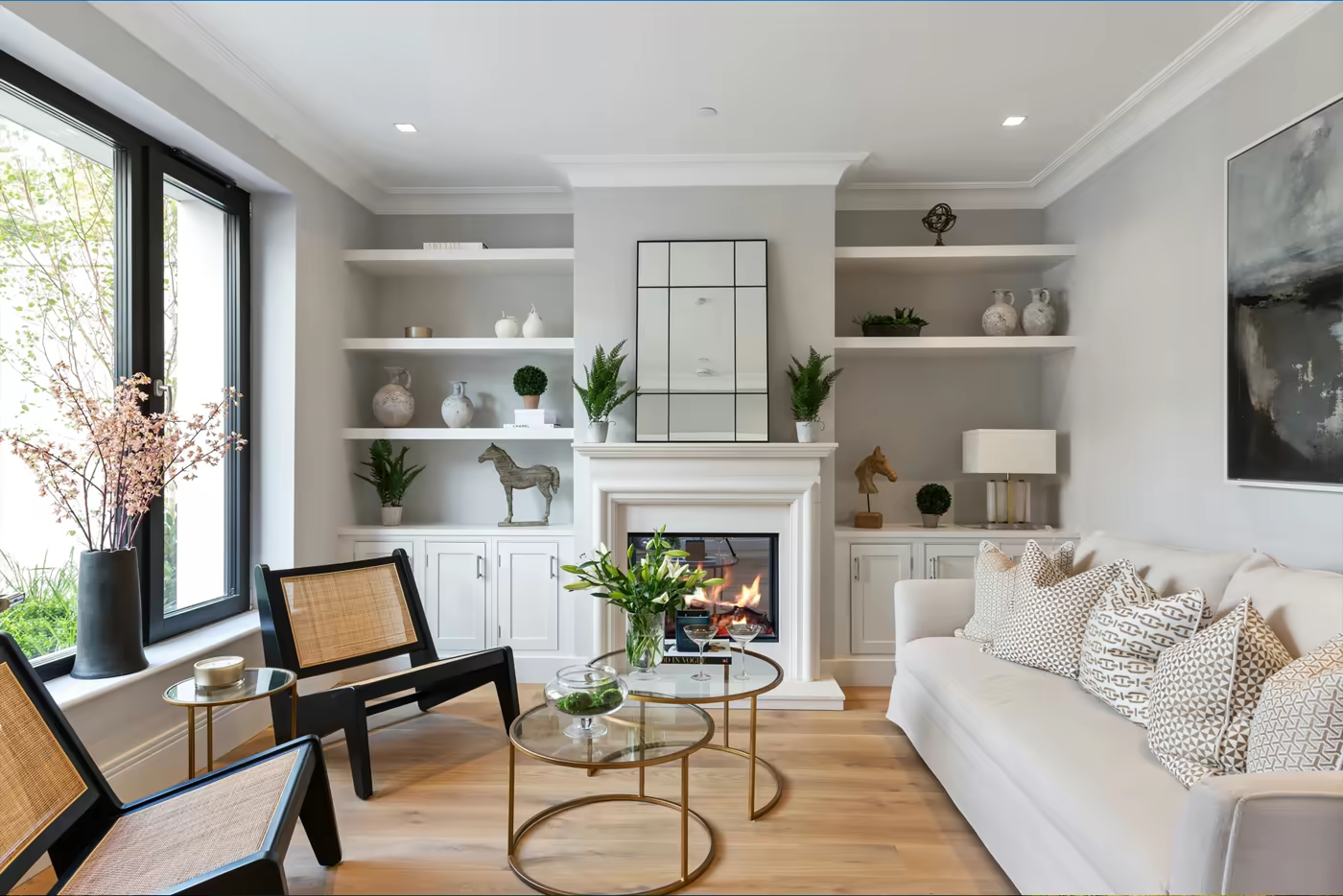
Selling your home involves more than sticking a sign on the lawn and hoping for the best. Whether you're upsizing, downsizing, relocating, or just ready for a change, the decisions you make before listing will directly affect how quickly your home sells and what you get for it.
I've been through this process many times with sellers in Winnipeg and the surrounding areas, and there are some things that consistently make a difference. Here's what I'd want you to know if you were sitting across from me at the kitchen table.
When is the best time to sell a house in Winnipeg?
The spring market typically sees the most activity. More buyers are out looking, days are longer for showings, and homes generally show better when the snow is gone and the yard is green. But that doesn't mean you should wait if your circumstances say otherwise.
The reality is that well-priced, well-presented homes sell in any season. I've seen homes sell in January with multiple offers because the seller prepared properly and the listing stood out. There are actually fewer competing listings in the winter months, which can work in your favour.
The worst reason to pick a time to sell is because someone told you "spring is best." The best time to sell is when you're ready and the home is prepared.
How important is pricing your home correctly?
Getting the price right is critical because overpricing is the most common mistake sellers make. A home priced too high sits on the market, accumulates days, and often sells for less than it would have if priced correctly from the start, since buyers treat a lingering listing as a red flag. A Comparative Market Analysis from your agent shows what similar homes actually sold for, and that's the data point that matters.
This is where many sellers struggle. Your home has emotional value to you. The kitchen you renovated, the backyard where your kids grew up. But buyers don't see that. They see a property compared to other options on the market.
Overpricing your home is the most common mistake sellers make. A home priced too high sits on the market, accumulates days, and eventually sells for less than it would have if it had been priced correctly from the start. Buyers look at days on market as a signal. A listing that's been sitting for weeks raises questions.
A Comparative Market Analysis (CMA) from your agent will show you what similar homes in your area have actually sold for, not what they were listed at, but what buyers actually paid. That's the data point that matters.
The Winnipeg Regional Real Estate Board publishes monthly market statistics that can give you a general sense of where the market stands, but your agent's CMA will be specific to your neighbourhood, property type, and condition.
How should you prepare your home before listing?
Preparation is about presentation, not renovation. Declutter ruthlessly, deep clean everything (ideally with a professional service), fix small things like leaky faucets, chipped paint, and burnt-out bulbs, and take care of curb appeal, whether that means mowing the lawn or clearing winter paths. Professional staging is also worth considering, especially for vacant homes, since the cost is often recovered many times over in the sale price.
You don't need to renovate your entire house before listing. But you do need to present it well. Buyers make snap judgements, and the first impression, both online and in person, sets the tone for everything that follows.
The basics go a long way:
- Declutter ruthlessly. Pack away personal items, excess furniture, and anything that makes rooms feel smaller than they are. If you can't see the floor or the countertops, there's too much stuff.
- Deep clean everything. Hire a professional cleaning service if you can. Baseboards, windows, grout, light fixtures. The details matter. (if you have a dog, consider NOT steam cleaning your rugs and carpets but only vacuuming thoroughly since steam cleaning can actually cause an issue with unwanted smells being enhanced)
- Fix the small things. Leaky faucets, chipped paint, sticky doors, burnt-out light bulbs. These are cheap fixes that send a message about how well the home has been maintained.
- Curb appeal counts. Mow the lawn, trim the hedges, clean the front entry. If it's winter, make sure paths are cleared and the front of the house looks inviting.
Professional staging is worth considering, especially for vacant homes or spaces that are difficult to visualize. A good stager can make a room feel larger, brighter, and more inviting, and the cost is often recovered many times over in the sale price.
Do you need professional photos to sell your home?
Yes. Professional real estate photography should be a standard part of your listing strategy, because the majority of buyers start their home search online and dark, blurry phone photos lose potential buyers before they ever book a showing. Look for wide-angle interior shots, proper lighting, and possibly drone footage for larger properties, and ask up front whether your agent includes photography in their services.
The majority of buyers start their home search online. If your listing photos are dark, blurry, or taken with a phone, you're losing potential buyers before they even consider booking a showing.
Professional real estate photography, including wide-angle interior shots, proper lighting, and possibly drone footage for larger properties, should be a standard part of your listing strategy. Some agents include this in their services, others don't. Ask about it up front.
The listing photos are your home's first showing. Make them count.
How much does it cost to sell a house in Manitoba?
Beyond the real estate commission, budget for legal fees of $800–$1,500 plus disbursements for the seller's lawyer, possible mortgage discharge or penalty fees if you're breaking your mortgage early, staging and repairs depending on your home's condition, moving costs, and property tax and utility adjustments calculated at closing. Your agent should provide a reasonable net proceeds estimate before you list so there are no surprises.
Selling isn't free. Beyond the real estate commission, there are other costs you should budget for:
- Legal fees: $800–$1,500 for the seller's lawyer to handle the transaction, plus dispursements
- Mortgage discharge fees: If you're breaking your mortgage early, there may be a penalty. Check with your lender before listing.
- Staging and repairs: Depending on the condition of your home
- Moving costs: These add up faster than people expect
- Property tax and utility adjustments: Calculated at closing
Your agent should be able to give you a reasonable net proceeds estimate before you list so there are no surprises.
What happens during showings, offers, and negotiation?
Once your home is listed, expect showings on short notice; the more flexible you are, the more buyers see your home, and more buyers means more competition. When offers arrive, your agent walks you through each one, weighing not just price but conditions like financing and inspection, possession date, deposit amount, and buyer flexibility. In multiple-offer situations, Manitoba has specific rules governing how your agent communicates with buyer agents.
Once your home is listed, be prepared for showings, sometimes on short notice. The more flexible you can be with showing times, the more buyers will see your home. And more buyers means more competition, which is exactly what you want.
When offers come in, your agent will walk you through each one. Price is important, but it's not the only factor. Conditions (like financing and home inspection), possession date, deposit amount, and the buyer's flexibility all play into which offer is the strongest.
In a multiple-offer situation, Manitoba has specific rules about how your agent communicates with buyer agents. I covered this in detail in a previous post, Real Estate Bidding War Rules in Manitoba, which is worth reading if you're expecting competition for your property.
The Bottom Line
Selling your home is a process, and the better you understand it, the more confident you'll feel when the time comes. Price it right, present it well, work with professionals who know your market, and the rest tends to fall into place.
If you're considering selling and want to know what your home might be worth in today's market, a home evaluation is a good place to start.

If you're raising a family or planning to start one, the neighbourhood you choose matters just as much as the house itself. Schools, parks, safety, and the overall feel of a community all play into whether a place works for your family long-term.
Winnipeg and the surrounding areas have a lot of variety when it comes to family-friendly living. Some people want a brand-new home with a playground around the corner. Others want mature trees, a walkable street, and a school their kids can bike to. There's no single "best" answer because it depends on what your family needs.
Here are some areas worth considering and what makes each one stand out.
Charleswood
Charleswood has a semi-rural feel even though it's well within city limits. Lots are generally larger than average, streets are often quieter, and the Assiniboine Forest is right there for anyone who wants to walk, bike, or cross-country ski. Families here tend to stay for a long time. It's the kind of place where your kids grow up knowing their neighbours.
The area is served by the Pembina Trails School Division, which includes several well-regarded schools like Oak Park High School and École Charleswood.
Average home prices in the broader Charleswood area typically range from the low $300,000s to over $700,000, depending on the specific pocket and the age of the home.
River Heights
River Heights is one of Winnipeg's most established neighbourhoods and it has a well-earned reputation for walkability. Academy Road has local shops and restaurants, Corydon Avenue brings patio culture in the summer, and there's no shortage of mature elm-lined streets.
For families, the draw is the combination of character and convenience. The neighbourhood is close to downtown, well-served by schools in both the Winnipeg School Division and private options, and has parks throughout. Homes here range from modest bungalows to large heritage properties along Wellington Crescent.
River Heights tends to hold its value well. It's a popular area and competition for homes can be strong, particularly for updated properties.
Sage Creek
Sage Creek is one of Winnipeg's newer developments on the southeast side of the city. It was designed with families in mind with walkable paths, modern playgrounds, and a community built around contemporary planning principles. The homes are newer, many built within the last 10–15 years, and come with the warranties and energy efficiency that go along with that.
The area is part of the Louis-Riel School Division and has École Sage Creek School serving the local population.
For families who want a newer home with modern finishes and a neighbourhood where everything is clean and well-maintained, Sage Creek checks a lot of boxes. Prices generally start in the mid $400,000s and go up from there.
Bridgwater
Bridgwater is another newer development in southwest Winnipeg that's been growing steadily. It includes several sub-areas including Bridgwater Forest, Bridgwater Lakes, Bridgwater Trails, South Pointe, and Prairie Point. The community is being designed with a mix of housing types including single-family homes, condos, and townhouses.
Parks, trails, and green spaces are central to the development plan. Shopping and restaurants continue to expand in the area as the population grows. Bridgwater is served by the Pembina Trails School Division.
Prices vary across the different pockets, but single-family homes typically start in the mid $400,000s and average around $690,000.
Transcona
Transcona has a small-town feel that's hard to find within a large city. It has its own downtown strip, its own identity, and a strong sense of community. The housing stock ranges from older character homes to newer builds, and prices are generally more affordable than many other parts of Winnipeg.
Families have access to schools through the River East Transcona School Division and there are plenty of community centres, parks, and recreational facilities.
For families who want more home for their money and a tight-knit community atmosphere, Transcona is worth serious consideration. Average prices here typically run from the $250,000s to the $500,000s.
East St. Paul
Just north of Winnipeg's Perimeter Highway, East St. Paul offers larger lots and a more rural lifestyle while still being a short commute from the city. It's a popular choice for families who want space, privacy, and a quieter pace without being far from urban amenities.
Properties here often sit on larger parcels of land, and the housing styles range from older bungalows to large custom-built homes. The trade-off is that public transit options are limited, so you'll need vehicles.
East St. Paul is served by the River East Transcona School Division and is close to Birds Hill Provincial Park for year-round outdoor recreation.
Niverville
Niverville is about 30 minutes south of Winnipeg and has seen significant growth in recent years. It appeals to families who want a small-town environment with newer housing stock and growing amenities. The town has its own schools, recreation facilities, and a developing commercial area.
For families willing to commute, Niverville offers considerably more space and newer homes for the price compared to buying within Winnipeg.
More details on Niverville and other communities outside Winnipeg can be found on our Communities page.
What should you look for in a family neighbourhood?
Five factors matter most when evaluating an area for your family: school proximity and ratings, which affect property values and resale even if your kids aren't school-age yet; parks and green spaces where kids can play safely; commute times tested during rush hour; future development plans that could change the area's appeal; and overall community feel. Walking the streets on a weekend afternoon is one of the best ways to judge whether a neighbourhood fits.
Beyond the specific neighbourhood, here are a few things worth checking when you're evaluating an area for your family:
- School proximity and ratings. Even if your kids aren't school-age yet, schools affect property values and resale
- Parks and green spaces. Look for areas where kids can play safely and where there are community gathering spots
- Commute times. Test drive the route to work during rush hour before you commit
- Future development. Check the City of Winnipeg development map to see what's planned nearby. New schools, roads, or commercial areas can significantly affect an area's appeal
- Community feel. Spend time in the neighbourhood. Walk the streets on a weekend afternoon. You'll get a sense of whether it feels like a place where your family would be comfortable
Choosing where to raise your family is personal, and no blog post can tell you which neighbourhood is right for you. But understanding what's out there and what each area has to offer puts you in a much better position to make a decision you'll be happy with for years to come.

Buying your first home is one of the biggest financial decisions you'll ever make, and if you're looking in Winnipeg or the surrounding areas, there's good news. This is still one of the most affordable major cities in Canada to buy a home. That said, the process can feel overwhelming if you don't know what to expect.
I've helped many first-time buyers navigate their way from "just looking" to getting the keys, and the ones who prepare ahead of time always have a smoother experience. Here's what you need to know before you start.
How much can a first-time buyer afford in Winnipeg?
A mortgage pre-approval from your bank or a mortgage broker tells you exactly how much you can borrow and what your monthly payments would look like. In Canada, the minimum down payment is 5% on the first $500,000 and 10% on any amount above that up to $999,999, so a typical Winnipeg home in the $350,000–$450,000 range needs roughly $17,500–$22,500 down. With less than 20% down, mortgage default insurance gets added to your mortgage as well.
Before you even look at a single listing, talk to a mortgage broker or your bank about getting pre-approved. A pre-approval tells you exactly how much you can borrow, what your monthly payments would look like, and it shows sellers that you're a serious buyer when it's time to make an offer.
In Canada, if your down payment is less than 20% of the purchase price, you'll need mortgage default insurance through the Canada Mortgage and Housing Corporation (CMHC). This gets added to your mortgage, so factor it into your budget.
The minimum down payment in Canada is 5% on the first $500,000 and 10% on any amount above that up to $999,999. For a typical Winnipeg home in the $350,000–$450,000 range, that means you'd need roughly $17,500–$22,500 as a minimum down payment.
What first-time homebuyer programs are available in Manitoba?
Manitoba buyers can take advantage of three main federal programs. The First Home Savings Account (FHSA) lets you save up to $40,000 tax-free, with tax-deductible contributions and tax-free withdrawals for a qualifying home. The RRSP Home Buyers' Plan allows a tax-free withdrawal of up to $60,000, repaid over 15 years, and it can be used together with the FHSA. The First-Time Home Buyers' Tax Credit adds a $1,500 non-refundable credit toward closing costs.
There are several government programs designed specifically to help first-time buyers, and not enough people take advantage of them.
The First Home Savings Account (FHSA) lets you save up to $40,000 tax-free for your first home. Contributions are tax-deductible (similar to an RRSP), and withdrawals for a qualifying home purchase are completely tax-free. If you haven't opened one yet, talk to your bank. The sooner you start contributing, the more you benefit.
The RRSP Home Buyers' Plan allows you to withdraw up to $60,000 from your RRSP tax-free to put toward your down payment. You have 15 years to repay it back into your RRSP. You can actually use both the FHSA and the Home Buyers' Plan together, which can add up to significant savings.
The First-Time Home Buyers' Tax Credit gives you a $1,500 non-refundable tax credit to help offset some of the closing costs. It's not a huge amount, but every bit helps when you're stretching to make it all work.
More information on these programs is available through the Government of Canada's first-time home buyer page.
What are the closing costs when buying a home in Winnipeg?
Closing costs in Manitoba typically run between 1.5% and 3% of the purchase price, which works out to $6,000–$12,000 on a $400,000 home. That includes lawyer fees of $1,200–$2,000, a few hundred dollars for property title insurance, a $400–$600 home inspection, Manitoba's land transfer tax calculated on a sliding scale based on property value, and any property tax adjustments owed to the seller.
The purchase price isn't the only cost you need to budget for. First-time buyers are often surprised by the additional expenses that come with closing on a home.
Closing costs in Manitoba typically run between 1.5% and 3% of the purchase price. On a $400,000 home, that's $6,000–$12,000. These include:
- Lawyer fees: $1,200–$2,000 for the real estate transaction
- Property title insurance: A few hundred dollars to protect against title defects
- Home inspection: $400–$600 and worth every penny
- Land transfer tax: Manitoba calculates this on a sliding scale based on the property value. The Manitoba Land Titles Office can provide the exact calculation for your purchase price.
- Property tax adjustments: You may need to reimburse the seller for prepaid property taxes
Do you need a home inspection in Manitoba?
It's always best to get a home inspection, especially on your first purchase. A qualified home inspector will go through the property from top to bottom and identify issues you'd never catch on your own. Foundation cracks, outdated electrical panels, roof damage, plumbing problems. These are things that can cost thousands to fix and you want to know about them before you commit.
However, in a competitive market there's pressure to waive the inspection condition to make your offer more attractive. If there's enough time before an offer date, it's sometimes possible to compelte a full home inspection before you make an offer so you don't need to include it as a condition of your offer and this is definitely money well spent for the inspection, to have piece of mind and still make a competative offer.
Which Winnipeg neighbourhoods are best for first-time buyers?
First-time buyers have strong options across three broad categories. Newer developments like Sage Creek, Bridgwater, and Prairie Pointe offer modern homes with warranties but fewer established amenities. Established neighbourhoods such as River Heights, Wolseley, and Charleswood have mature trees, character homes, and walkable streets, though they may need more maintenance. Suburban communities outside Winnipeg, including East St. Paul, Headingley, and Niverville, deliver more space and land for your money.
Winnipeg and the surrounding areas offer a wide range of communities, each with their own character, price range, and lifestyle. Spend some time exploring different areas before you narrow your search. Drive through neighbourhoods at different times of day. Check the commute to your workplace. Look at what's nearby: schools, grocery stores, parks, transit routes.
Some things to consider:
- Newer developments like Sage Creek, Bridgwater, and Prairie Pointe offer modern homes with warranties but may have fewer established amenities
- Established neighbourhoods like River Heights, Wolseley, and Charleswood have mature trees, character homes, and walkable streets but may need more maintenance and updates
- Suburban communities outside Winnipeg like East St. Paul, Headingley, and Niverville offer more space and land for your money
Our Communities page has detailed information on hundreds of neighbourhoods across Winnipeg and Manitoba, including current market statistics, school information, and homes for sale.
Why work with a local REALTOR® in Winnipeg?
Having your own agent typically costs a buyer nothing, since in most cases the seller pays the buyer's agent commission. In return, you get someone who knows the local market, guides you through the offer process and its conditions, and negotiates on your behalf. A good agent also sets up automated alerts so you're notified the moment a matching property hits the market, which can make the difference in a competitive situation.
Having your own agent doesn't cost you anything as a buyer. In most cases, the seller pays the buyer's agent commission. But the value you get from working with someone who knows the local market, understands the offer process, and can negotiate on your behalf is significant.
A good agent will set you up with automated alerts so you're notified the moment a property matching your criteria hits the market. In a competitive market, being first to see a new listing can make the difference between getting the home you want and missing out.
Your agent will also guide you through the offer process, explain the conditions you should include (or when you might consider waiving them), and help you avoid common mistakes that first-time buyers make.
What happens after your offer is accepted?
An accepted offer kicks off several final steps. You'll need to satisfy your conditions, such as the home inspection and final mortgage approval, within the timelines in your offer. Then you hire a lawyer to handle the title transfer and register the mortgage, arrange the home insurance your lender requires, plan your move, and do a final walkthrough before closing to confirm everything is as agreed.
Once your offer is accepted, there's still work to do. You'll need to:
- Satisfy your conditions. Complete the home inspection, finalize your mortgage approval, and review any other conditions in your offer within the specified timelines
- Hire a lawyer. Your lawyer handles the title transfer, registers the mortgage, and ensures everything is legally in order
- Arrange home insurance. Your mortgage lender will require proof of insurance before closing
- Plan your move. Book movers, set up utilities, arrange mail forwarding, and start packing
- Do a final walkthrough. Before closing, walk through the property one more time to make sure everything is as agreed
Ready to Start?
Buying your first home is a big step, but it doesn't have to be stressful. The key is preparation: understanding your budget, knowing what programs are available to you, and working with professionals who can guide you through each step.
If you're thinking about buying your first home in Winnipeg or the surrounding areas, the Andrew St. Hilaire Team would be glad to help. Whether you're just starting to explore or you're ready to make an offer, reach out to us and we'll make sure you're set up for success.

Synonymous with prime selling season, spring and summer are the perfect time to freshen up your space in preparation for getting your house listed on the market. I've rounded up some great cleaning tips that will not only transform your space into a swoon worthy dwelling but also attract home buyers looking to purchase their next home. Ready to embark on your cleaning journey? Read on to get started!
Why should you declutter before showings?
First things first: declutter your home. No prospective buyer wants to step into a house filled with perceived junk. Go around the house to identify items that have been taking up precious space for months and years. Perhaps it's your collection of novels you've been meaning to read. Or clothes you've held onto for special occasions or 'just in case' situations that never quite materialized. Once you figure out what needs to be donated or boxed up and stored in your garage, you'll breathe easier knowing that you've created a perfect space for the next owner to manifest their dream home.
Why do clean windows matter when selling?
There's nothing like dirty windows, screens, and sills that signal 'Don't look inside' to prospects. Tackle this moderately intense project by starting with the inside of your home, as you'll have more control over the outcome. To clean the windows outside, hose them down and remove excess water by using a squeegee or hire a professional for the harder to reach exterior windows. As for cleaning solutions, there are plenty of eco-friendly products that will yield sparkling, streak free results. More of a DIY person? Mix distilled white vinegar with water for the same results.
How should you clean your floors before showings?
Weekly sweeping and vacuuming isn't enough before showings, because stubborn dirt, dust, and allergens get deeply embedded in hardwood and carpet. It's well worth hiring a professional floor cleaning service so every square inch of your place looks and smells brand new, whatever the size of your home. To keep things fresh without added chemicals, use an air purifier instead of air fresheners.
Chances are, you already sweep, dust. or vacuum your house every week to keep your floor looking and smelling fresh. Despite your best efforts, stubborn dirt, dust. and allergens get deeply embedded in your hardwood floor or carpet, leaving behind a less-than-pleasant appearance and odor. Whether you live in a large compound or a smaller, cozier house, it's well worth the money to enlist the help of a professional floor cleaning service to ensure every square inch of your place looks and smells brand new. Want to maintain the freshness without added chemicals? Use an air purifier in lieu of air fresheners to eliminate funky smells.
How do you boost curb appeal?
Boost curb appeal by tackling the landscaping: give the lawn a proper cut, pull any weeds, and add fresh flowers and plants that thrive in your city, or hire a professional to tidy things up. A fresh coat of paint on the front door is another quick, inexpensive way to make the right impression, and neutral colours are the safest choice since they appeal to most home buyers.
Beautifying your outdoor space is just as important as cleaning the interior of your home. Take a mini-tour of your yard and garden; does your lawn need a proper cut? Are there any pesky weeds sprouting throughout your otherwise pristine yard? Take care of the landscaping duties your self or hire a professional to tidy things up while you bask in the sun and sip on a refreshing glass of Arnold Pa I mer. If neither of these applies, enjoy a weekend of embellishing your garden with fresh flowers and lush plants conducive to thriving in your city. Or try adding a fresh coat of paint to your front door for a quick, inexpensive way to make the right impression. (Pro tip: Stick to neutral colours as they appeal to most home buyers.)
Why clean the gutters and fix the roof before listing?
Clearing dead leaves and debris from your gutters prevents unwanted critters and insects from inhabiting the space and potentially clogging it, while inspecting the roof for holes, leaks, and other winter damage can save you hundreds if not thousands of dollars in costly repairs. It also means whoever buys your home gets a sturdy, comfortable roof over their head.
After months of snow-ridden (or unseasonably warm) winter days, chances are your gutter and roof show some weather-induced wear and tear. Remove the collection of dead leaves and debris from the gutter to prevent any unwanted critters and insects from inhabiting the space and potentially clogging it. While you're at it, inspect your roof for any holes, leaks, and other damages incurred during the previous season. Taking these steps will not only save you hundreds if not thousands of dollars in costly repairs, but whoever is lucky enough to snag your abode will have a sturdy yet comfortable roof over their head.
Should you service your A/C before selling?
With warmer weather ahead, make sure that your air conditioner is in tip-top shape. Not only will this prevent you from enduring sweltering heat once the temperatures rise but the next occupants will also appreciate the cool breeze that sweeps through the house. Start by changing the air filter regularly (the general rule is every 30 days) since that can be done easily by yourself. For more intense tasks such as cleaning air vents and ducts, hire an HVAC profession also they can access hard-to-reach areas in your house.
Ready to Sell?
For professional advice and information on selling a home with a top notch agent, contact Andrew St. Hilaire Winnipeg REALTOR®.

A 'bidding war' may sound like a military incursion fought over a real estate purchase, but really, it simply means there is competition from multiple buyers, all submitting an offer to purchase the same property and then increasing their offer to compete. It can cause frustration and serious issues for buyers looking for their next home, and can be very rewarding for sellers who end up selling for much more than they are expecting.
The competition in today's seller's market, where supply is low and demand is high, pushes buyers to submit offers with a price much higher than the list price, and in order to keep their offers competitive and 'clean', they may even exclude some conditions that would otherwise be reasonable to include such as a home inspection or even a financing condition. However frustrating or rewarding a bidding war might be for buyers and sellers, bidding wars are not absolute chaos and there are rules and guidelines for agents to follow when handling multiple offers.
What ethics rules apply in a bidding war?
REALTORS® handling a bidding war must follow the Canadian Real Estate Association (CREA) Code of Ethics, which requires them to protect and promote their clients' interests, including encouraging a multiple offer situation if that's what the client wants. They must also disclose when they represent more than one party in the same sale, obtain informed consent from everyone, and keep private information about motivations or circumstances from being shared between parties.
The Canadian Real Estate Association (CREA) has a Code of Ethics all REALTORS® must follow as a standard of conduct based on moral integrity, competent service to clients and customers, and dedication to the interest and welfare of the public. This standard ensures the protection of the rights and interests of consumers of real estate services. Under this code, REALTORS® have a duty to protect and promote the interests of their clients. This duty would require that if a client wishes to encourage a multiple offer situation and possibly a bidding war, it is the REALTORS® obligation to do what is best to promote their client's interests.
REALTORS® also have an obligation to disclose if they are representing multiple clients in a specific sale, such as if they represent both the seller and a buyer, since all parties need to provide informed consent, and no private information regarding motivations, circumstances, etc. is to be shared between parties that might give an advantage to either party.
What are Manitoba's disclosure rules for multiple offers?
In Manitoba, the listing agent must tell all buyers or their agents that multiple offers exist, and may share the total number, typically an hour to 15 minutes before offers are presented. Under Manitoba Securities Commission rules, agents must not disclose any details of competing offers, directly or by implication; beyond limited pre-qualification and clarification, they may only accept, reject, or counter an offer in writing. The listing agent must also keep a signed list of offers presented, available on request to any competing buyer.
When there are multiple offers submitted for a property, and there is a set date and time when offers will be presented to the seller for review and consideration, the listing agent is required to communicate to all buyers or their agents that there are multiple offers and may provide the total number of offers. Generally, this is done an hour to 15 minutes before the offers will be presented and this provides an opportunity for buyers to consult with their agents and decide if they wish to make any changes to their offer. If changes are to be made, the buyer or their agent will communicate the changes to the listing agent who will update their submitted offer.
According to the Manitoba Securities Commission, the listing agent must be very precise in their communication to the competing buyers or their agents. Listing agents must not disclose any details of the competing offers, whether directly or by implication, and likewise, must take heed of contract law, and traditional industry practice related to the options of acceptance, rejection or counter. Some very limited degree of "pre-qualification" and "clarification" is allowable. Any other variation will make the listing agent subject to discipline. Except as noted below, as a general rule, an agent (acting on a seller’s instruction) may only accept, reject or counter an offer, and do so in writing.
By way of an exception to the general rule, a listing agent may contact the buyer or their agent and communicate in the following manner:
- If there is something unclear (or there appears to be an error in drafting) on the buyer’s offer, the listing agent can seek clarification.
- The listing agent can enquire whether the buyer is flexible on a particular term (e.g. possession date, or the amount of the deposit).
In doing so, the listing agent must be precise in noting that they are not communicating a counter-offer, but are merely going through a pre-qualification or clarification exercise. Likewise, there is no guarantee that a seller will issue a counter-offer, or select the offer for further consideration, once the presentation process begins.
In the interests of transparency, a listing agent must keep a list of offers presented to the seller. The list will be maintained on a draft form provided by the Manitoba Real Estate Association (MREA). The form will note the following information:
- the number of offers presented to the seller;
- the identity of the buyer agent/selling agent;
- a notation of whether the offer was received in a sealed envelope;
- a notation of whether sealed envelopes were opened in the presence of the seller;
- the form will be signed by the seller and/or listing agent.
This list will be maintained on the listing brokerage’s file and will be provided to any buyer, buyer agent, or selling agent who wrote one of the competing offers, and requests a copy.
Why do sellers underlist their properties?
Sellers underlist to create interest from more buyers and spark a bidding war that pushes the final price above the list price. In Manitoba, though, deliberately undervaluing a property to create a bidding war qualifies as fraud under the Real Estate Brokers Act, and agents who do it face disciplinary action from the Manitoba Securities Commission. Sellers and agents should instead use a Comparative Market Analysis and list at a price the seller would actually accept.
Although the REALTOR® Code requires REALTORS® to protect and promote the interests of their clients, the Manitoba Securities Commission has cautioned agents about under listing properties and possibly committing fraud. They remind agents that the definition of fraud in the Real Estate Brokers Act includes "any course of conduct or business calculated or put forward with intent to deceive the public or the purchaser or the vendor as to the value of real estate." Deliberately under valuing a property in a listing in order to create a bidding war qualifies as fraud under the Act as the listing agent is deceiving the public and creating an interest in the property for buyers who are not qualified to purchase the property at the price the vendor is expecting to accept. In addition, advising a vendor to list a property below market value also qualifies as fraud under the Act.
If the Commission receives a complaint alleging that a listing agent under listed a property, it will be up to the agent to demonstrate how they determined the listing price. If the agent is found to have deliberately under listed the property, appropriate disciplinary action will be taken.
Sellers and their agents should use a Comparative Market Analysis to determine the fair market value when listing a property and the price at which the seller decides to list the property should be a number they would be willing to accept.
How do you win a bidding war?
Winning a bidding war means making your offer the most attractive overall, not necessarily the highest. Put your best price forward, keep the offer 'clean' with minimal conditions, get pre-approved for financing and tell the seller, make the deposit as high as possible and include the cheque, and match the seller's ideal possession date if it works for you. A personal cover letter can also tip the scales, and buyers have won without offering the highest price.
There are a few things in an offer that a seller is going to be looking at, and the more attractive your offer is to the seller, the more likely they are to accept your offer. The seller and their agent will be essentially looking at what additional terms may be included, what conditions are included, what price is being offered, and the possession date. In addition to these few things within the offer itself, sometimes including a personal cover letter can make a difference, especially if the offer matches closely with another one, the amount of the deposit cheque and whether it is included in with the offer can matter especially for unconditional offers, any mistakes on the documents, and if the documents are clear to read. I've had several buyer clients win bidding wars and not be the highest price by considering all of these factors and making the best offer possible for their specific needs. Remember that you may not know you're in competition until just before the time offers will be presented, so your initial offer doesn't need to be any higher than the asking price since you'll have an opportunity to update your offer and that's when the following tips will come into play if you want to fight to win the bidding war.
- Work with a good real estate agent.
- Put your best price forward.
- Be pre-approved for financing and let the seller know you are pre-approved.
- Make the offer as 'clean' as possible.
- Make the deposit amount as high as possible - it counts towards the downpayment.
- Include the deposit cheque if possible.
- Find out from the listing agent what the seller's ideal possession date would be and try to get it as close as possible in the offer if it works for the buyer.
- Include a personal cover letter - it can't really hurt.
Having a responsive, experienced, and knowledgeable agent to provide guidance and strategies to win the bidding war is key! Contact Andrew St. Hilaire Winnipeg REALTOR® to help you win as a buyer or a seller in today's real estate market.
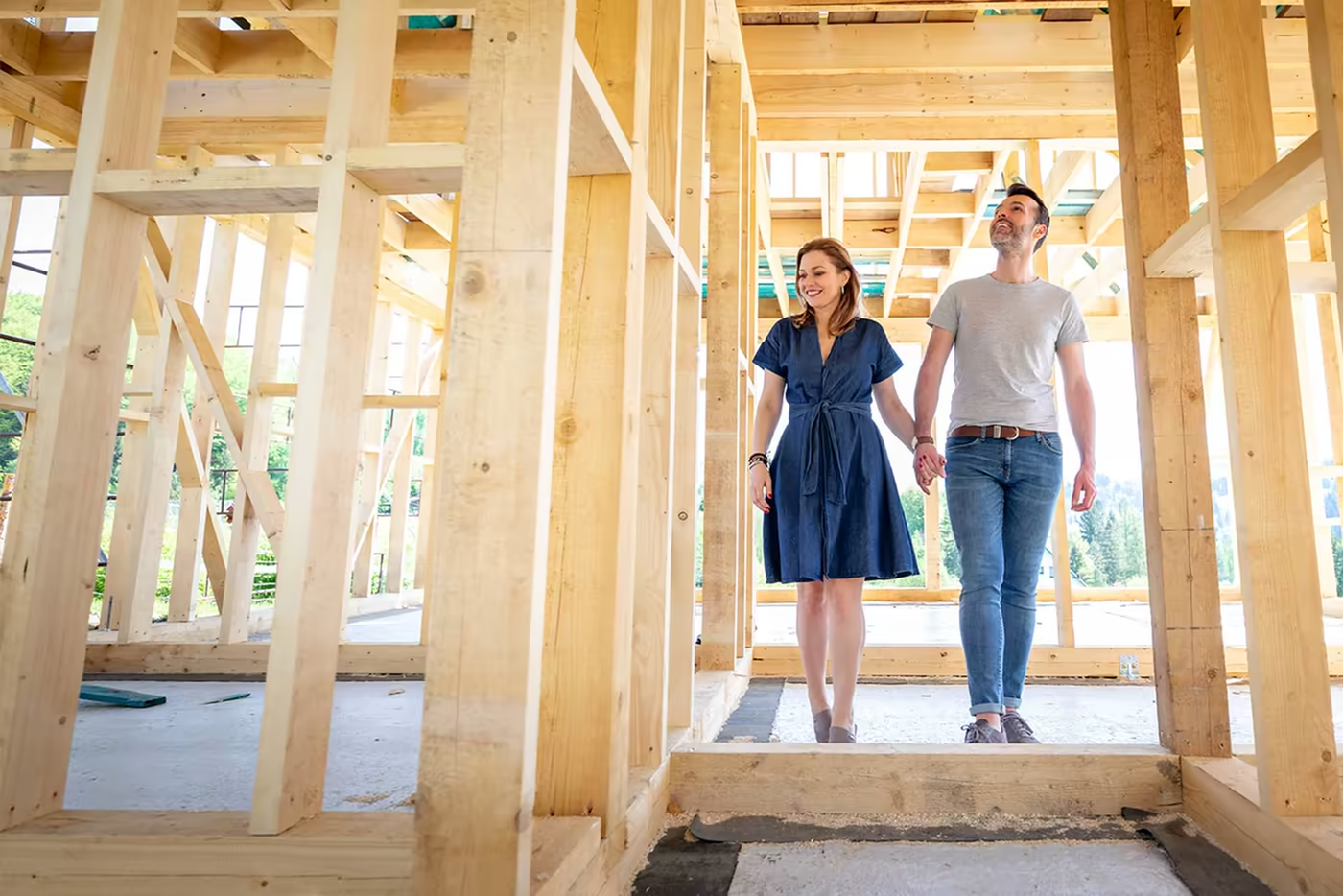
You might believe you don't need your own REALTOR® when buying pre-construction or new construction homes, but then who's there to protect your best interests? Most builders and developers have an on-site representative, usually a REALTOR®, who can take care of all the paperwork and who will say they can do everything for you themselves, but this representative also has the builder's goals in mind - to make the sale! Buyers should have their own agent involved to increase their advantage, protect their interests, and for guidance and support.
How does a REALTOR® simplify buying new construction?
A REALTOR® simplifies a new construction purchase, which is more complicated than buying resale, by bringing knowledge of the development, neighbourhood, construction materials, and sales and market data. They streamline your search with full access to a portal and notification system from REALTOR.ca and other sources, know builders' reputations for meeting deadlines and following up on issues, and can advise on the best time to buy, whether pre-construction, mid-construction, or after completion.
Buying a new construction home can be a lot more complicated and involved than purchasing a resale home. An experienced agent who understands the development, neighbourhood, construction materials, and sales and market data will be of great benefit to a buyer. An agent will also greatly enhance your search process, saving you time and effort while also providing full access to a search portal and notification system from REALTOR.ca and other sources. Agents also know the reputation of builders, how they meet deadlines, and how they follow-up on issues. Agents can also offer advice on a good time to buy, whether during pre-construction, mid-construction, or after the building is completed and may also have information on upcoming promotions or other development areas.
Can you negotiate with a home builder?
Yes, and a REALTOR® working for you will negotiate with the builder for the best terms, features, and upgrades while helping you understand all the fine print in the purchase agreement. A skilled agent can also spot the upgrades and extras that may not be worth what the builder would charge, and help you decide which are worth including or excluding.
A REALTOR® working for you will help you to understand all the fine print in a purchase agreement and they will negotiate for the best terms, features, and upgrades. A skilled agent can also spot the upgrades and extras that may not be worth the cost the builders would charge and they can help with the decision on which might be worth including or excluding.
Can a REALTOR® help you get a better price?
Not usually on price alone: builders price new homes very carefully and the purchase price is not typically negotiable, because other buyers can see the history of previously sold similar homes and would expect the same price. Skipping your own agent won't earn a discount either, since builders avoid subtracting the commission and setting a price precedent, and because the seller usually pays the buyer's agent commission, working with your own trusted agent makes the most sense.
Consider this: builders and developers price their products very carefully and the purchase price for new homes is not typically negotiable because other buyers will be able to see the history of previously sold similar homes and then expect to also be able to purchase the home at that price. Buyers are sometimes led to believe that by not using their own agent to buy a new construction home that the builder will subtract the potential commission from the purchase price, but this risks setting a price precedent on that model of home and builders generally prefer to avoid this. Since the seller usually pays the commission for a buyer's agent, it makes the most sense for you to work with your own trusted agent.
What guidance does a REALTOR® provide during the build?
During the build, a REALTOR® guides you through the multiple steps and stages before closing, including decisions on the design, electrical, and construction of the home, plus dealings with financing, home inspectors, contractors, appraisers, and alterations. Having that support through the entire process makes buying a pre-construction or new construction home less overwhelming, a lot easier, and helps ensure all your needs are met.
There are multiple steps and multiple stages to navigate with pre-construction and new construction homes as well as interacting with many people involved in the process before closing. Decisions may be needed on the design, electrical, construction of the home as well as dealings with financing, home inspectors, contractors, appraisers, alterations, etc. Working with a trusted REALTOR®, who can help guide and support you through the entire process, will make the process less overwhelming, a lot easier, and ensure that all your needs are met. Read a few great tips here.
A Trusted Agent
When buying pre-construction or new construction homes in Winnipeg or the surrounding areas, you can count on me to be your trusted REALTOR® - Andrew St. Hilaire Winnipeg REALTOR®.

To sell quickly and for top dollar, staging is probably the easiest and best way to succeed. Home staging allows buyers to see your home in the best light possible. A positive first impression and seeing the potential for each space makes a buyer more likely to write an offer and offer a higher purchase price in their offer. Seeing an empty room or a room with mismatched or outdated furniture, clutter, or lots of personal items makes it difficult to see the true potential of the property in photographs and in person which will result in fewer buyers scheduling viewing appointments, fewer buyers interested in writing an offer, and buyers offering a lower purchase price. Read on for home staging statistics, tips, and benefits that make it clear how you gain by staging your home for sale.
What do the statistics say about home staging?
In the National Association of REALTORS® 2021 survey, 82% of buyers' agents said staging made it easier for buyers to visualize a property as their future home, and 23% said staging increased the dollar value offered by 1% to 5% over comparable unstaged homes. Buyers found staging the living room most important (46%), followed by the primary bedroom (43%) and kitchen (35%), and the median spend on a staging service was $1,800 CAD.
According to the National Association of REALTORS® 2021 Survey:
- 82% of buyers' agents said staging a home made it easier for a buyer to visualize the property as a future home.
- 47% of buyers' agents cited that home staging had an effect on most buyers' view of the home.
- Staging the living room was found to be very important for buyers (46%), followed by staging the primary bedroom (43%), and staging the kitchen (35%).
- 23% of buyers' agents said that staging a home increased the dollar value offered between 1% to 5%, compared to other similar homes on the market that were not staged.
- The median dollar value spent when using a staging service was $1,800 (adjusted from USD to CAD).
Why does staging matter to today's buyers?
With so much information easily available online, buyers know what they want in their ideal home. Staging a home helps buyers to determine if a house meets their requirements and expectations, but with no staging may prevent a buyer from seeing the potential. According to the NAR Survey, 40% of buyers' agents said home staging had an effect on buyers' views of a home while only 6% said it made no difference.
How does staging create broad appeal?
Staging creates broad appeal by putting the buyer's taste ahead of the seller's personal style. Everyone decorates to their own preferences, but when selling, the home needs to appeal most to the buyer, not the seller. Intentionally staging a home so it attracts the widest possible range of potential buyers dramatically improves your chances of getting people through the door to visit.
Everyone has their own personal style and taste for the design and feel for their home, but remember that it's the buyer, not the seller, to which the home should appeal the most when selling. Getting buyers through the door to visit your home is key and staging will improve your efforts dramatically if you intentionally stage a home so it has a broad appeal in order to be attractive to the most potential buyers.
Does staging increase your sale price?
The numbers suggest it does: 23% of buyers' agents said staging increased the dollar value offered by 1% to 5% compared to similar unstaged homes, 22% of sellers' agents agreed, and 17% of sellers' agents said it raised the offered price by 6% to 10%. Meanwhile, 0% of sellers' agents and only 1% of buyers' agents said staging had a negative impact on offering price.
Remember, 23% of buyers' agents said that staging a home increased the dollar value offered between 1% to 5% compared to other similar homes on the market that weren't staged. Among seller's agents, 22% agreed, and 17% say it actually increased the offered price by 6% to 10%. That's a notable increase to the selling price. Also, 0% of sellers' agents and only 1% of buyers' agents said that staging had a negative impact on offering price. It's easy to see the value in the cost to stage compared to the return in the offered price.
Does staging help your home sell faster?
Homes that sit on the market tend to become harder and harder to sell since buyers can begin to think there's something wrong with the property. Staged homes tend to sell faster and for a higher price.
What are the best home staging tips?
The core staging tips are to de-clutter so rooms feel open and larger, de-personalize by storing family photos and personal items, clean as deeply as if you were just moving in, handle minor repairs like paint touch-ups, caulking, plumbing leaks, and burnt-out bulbs, and keep wall colours neutral to appeal to the most buyers. A professional stager, typically $1,000 to $1,500 for an average staging, can plan all of this and supply furniture and decor.
A professional home stager might charge between $1,000 to $1,500 for an average staging. They will visit a home for a consultation at which they will discuss staging options, prepare a list and plan for the staging, and make suggestions for de-cluttering, de-personalizing, and what pieces of furniture, artwork, or decor should be left or removed. Professional stagers also typically have an inventory of furniture and decor to choose from so filling a vacant house or making an occupied house look its best can be easier and much less expensive with their services. Working together can produce the best results and here are some tips to consider doing or which a pro might suggest at a consultation.
De-clutter
Entering a room and feeling like it is open and uncluttered makes it look bigger and more appealing. It's a good idea to box up everything you don't need for day-to-day living and store it out of the way until the property sells or you've moved into your next home. It's not uncommon to have a storage container dropped off on the driveway to store boxes and furniture items and have it hauled away for storage until the property sells or even just leave it on the driveway if the costs of moving and storing the container are prohibitive. It's ok to have the container in the driveway so long as the house can show it's best, but even better if it can be stored somewhere else.
De-personalize
Try to create a blank canvas for buyers to be able to picture themselves in a home. Seeing personal photos of the current owners can make it harder for buyers to imagine the house as their own home. Store family photos and any other overtly personal items like toothbrushes, clothes, etc. out of sight.
Clean
First impressions are important to get right, to leave buyers feeling positive about making an offer. Clean as deeply as you would if you were just moving into your home after unpacking. If you don't have the time to do the job well, hire a professional cleaning service instead. Don't forget to tidy up outside too by keeping the grass trim, the patio or deck clean, and the yard and garage tidy.
Minor Repairs
Make time to do any needed paint touch ups, caulking, fix plumbing leaks, replace missing electrical covers on light switches or outlets, replace burnt light bulbs, and anything else you may have been putting off. Buyers may not notice every little thing but they may be keeping a mental list of all these little things and they will add up to a bad impression.
Stay neutral
Remember that your taste may not be everyone's taste in style or colour choices. If you have brightly painted walls, or dated colour choices, it might be a good idea to paint with colours that will appeal to the most buyers. A professional stager might be able to help with some ideas at their consultation, or take some photos and ask for advice on social media or from a few experienced people you might know. Paint is relatively inexpensive and painting a few walls will help buyers to see the possibilities for the space instead of being distracted.
Hire An Experienced Agent
For professional advice and information on buying or selling a home with a qualified agent, contact Andrew St. Hilaire Winnipeg REALTOR®.

If you're considering selling your home or house hunting to buy, you might be wondering why you should use a real estate professional and how much benefit they might provide. Why not list your home for sale on your own or just call the agent on the sign or from the online listing when you see a house you might like? Here are five reasons why you need a real estate agent.
1. Industry Knowledge
Real estate professionals require extensive training before obtaining their real estate license and using the REALTOR® trademark. Agents must have knowledge about developments in real estate as well as actively updating their education. They have access to valuable market data that the general public can't access on their own including the ability to produce a Comparative Market Analysis and other reports that will help to develop a pricing and marketing strategy for the sale of a home or in determining a fair market value when buying. As well, they have real estate industry materials, experience, a network of colleagues and allied resources to further increase their knowledge and value.
2. Negotiation Skills
Having an experienced real estate agent with an arsenal of negotiating tactics and strategies at their disposal is the best way to maximize your results in a deal. A skilled negotiator will help to avoid blunders that could affect your negotiating position which could result in money left on the table. Terms and conditions are as important as the purchase price and having the ability to negotiate the entire agreement with the other party is essential.
3. Working for You
In an agent/client relationship, the salesperson and his/her real estate firm is required to protect and promote your best interests in the transaction as they would their own. The following outlines some of their duties arising out of an agent/client relationship in a typical real estate transaction:
- Loyalty to serve your best interests ahead of anyone else's, including their own, and at all times to exercise good faith and to disclose all known facts and information which may influence your decision.
- Obedience to follow all of your lawful instructions.
- Discretion to keep confidential your private circumstances, motivations, and confidences which you shared with the salesperson or which the salesperson or the real estate firm has learned.
- Competence to exercise reasonable care and skill in performing all assigned duties.
- Accounting of all money, deposits, or other property entrusted to them.
On top of these requirements, an agent helps to leverage your time and does a lot of the work for you. Successfully selling a house with the best outcome requires an effective marketing strategy that can involve promotional materials delivered to the surrounding neighbourhoods, social media posts and other online listing platforms, many phone calls, an attractive and visible yard sign, scheduling and doing showings, open houses, and so on. When buying a house, your agent will get to know your needs and wants and then provide you access to all the available homes that meet your criteria and stay on top of the market and new listings to be sure you see everything that might be a match for you. When buying or selling, an agent will be there to give advise, share market data, provide access to their resources, help you to easily handle all the paperwork, and most importantly, they will negotiate on your behalf.
4. Guidance and Support
Purchasing or selling a home is exciting, but it can also be emotional and even overwhelming. It's one of the largest financial commitments for most people and the place where you'll be making new memories with friends and family if you buy it and where those memories might make it difficult to move on when you sell. A real estate agent can provide guidance and support through each step and will be at your side for every home viewing, helping you to find the right house for you and your family, or working hard to sell your home with experience, advice, and being attentive to what's important for you.
5. Avoid Closing Issues
Everyone wants to avoid obstacles and problems when it comes to their purchase or sale of a home. An experienced agent can foresee any issues and help you to avoid, overcome, and resolve them before it's too late. Closing issues can include:
- Condition deadlines being missed
- Document errors
- Legal risks
- Last-minute requests
- Issues at possession
Avoid these frustrations and other issues by using an experienced real estate professional!
The Bottom Line
It's a lot to learn how to sell your house on your own or to buy a house with no one there working with you, especially for one of the biggest transactions of your life. Agents have access, experience, and knowledge that are incredibly beneficial to their clients. For more information on buying or selling a home with a qualified agent, contact Andrew St. Hilaire Winnipeg REALTOR®.
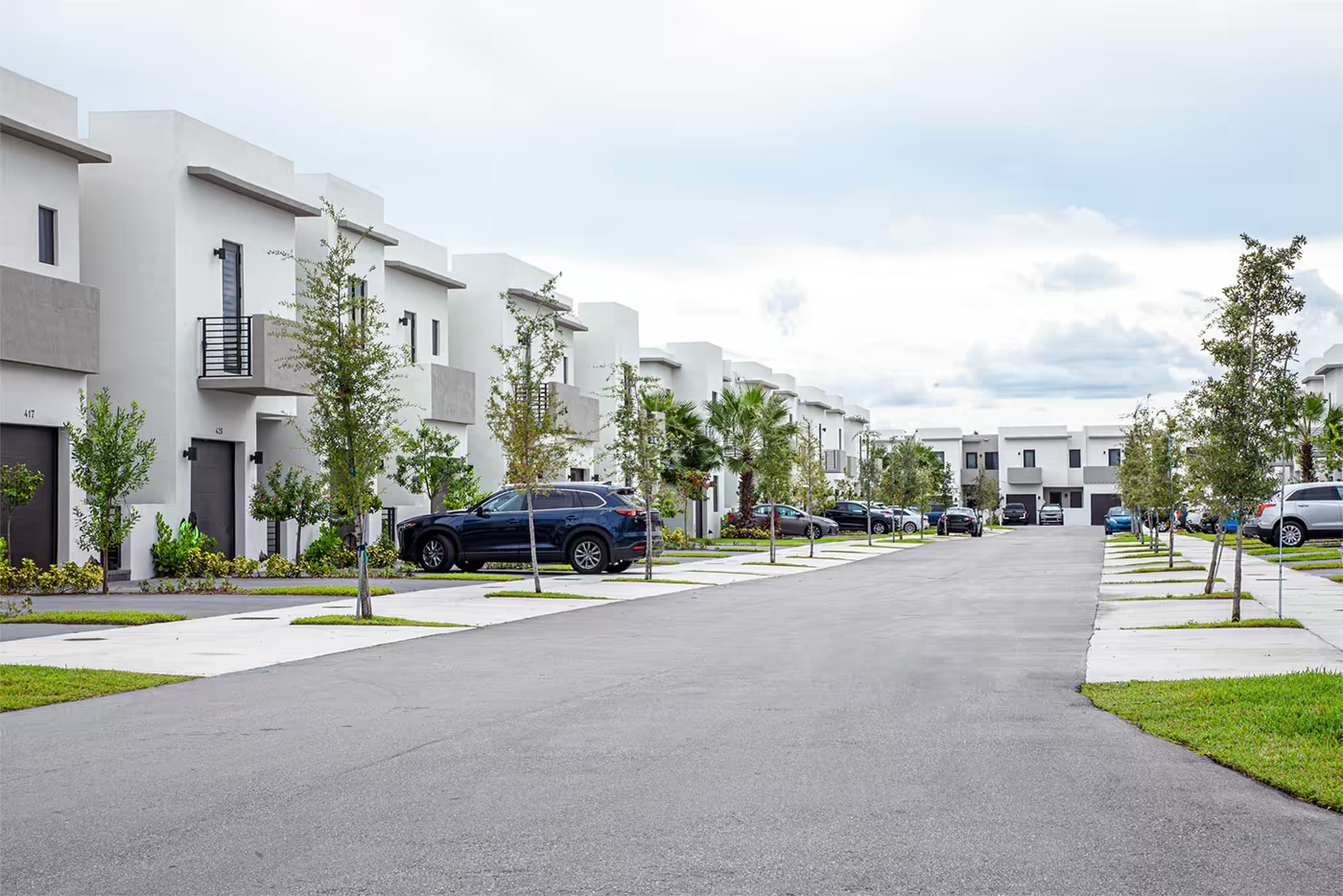
Deciding whether to buy a house or a condo may be an easy decision for some, but for others, there may be factors that make this decision more difficult. There are pros and cons to each considering resale value, amenities, convenience, and space.
The best approach for deciding is to identify what's most important for you as far as goals, lifestyle, and budget. An experienced REALTOR® will help you to make an informed decision by helping you focus on the things that matter the most for you and looking at the options available in your desired market which will make deciding between a house or a condo easier. You can start by entering your search criteria here to see all the available listings that match your needs and wants between houses and condos in your preferred neighbourhoods.
What types of condos are there?
There are two main types of condos on the market, freehold and leasehold.
Freehold condos include buildings divided into units, row townhouses, and standalone townhouses or homes. Within these freehold condos, there are standard condominiums where you will buy your unit with an interest in the property's shared common areas and elements, but you won't own the land. Common elements condominiums have no units but you own the property and the land on which it sits. Owners within the common elements condominiums community share the ownership of common elements, and they fund their maintenance and repair jointly.
Leasehold condominium corporations don't own the land in the condominium corporation, but the lease purchasers buy a leasehold in units and common elements.
Which costs more: a house or a condo?
In most markets a condo is more affordable than a house in the same area, because with a standard condominium you're buying only a unit in the building without any of the land. The size of the price gap varies, and it can be wider in cities like Toronto and Vancouver, but the gap may not exist at all with a common elements condominium, where you own the property and the land it sits on.
The difference when buying a standard condominium compared to a house is that you're only buying a unit in a building without any of the land. Other kinds of condominiums may be different though.
Most of the time, a condo is more affordable than a house in the same area, but this gap can be wider in some markets, and may not exist at all if it's a common elements condominium. Sacrificing a convenient location in certain cities like Toronto and Vancouver, for example, will significantly influence your decision for a house or condo. The choice is much easier in Winnipeg.
How do ongoing expenses compare?
Condo owners pay monthly fees for services, maintenance, and amenities, usually based on the size of the unit and the number of units in the building, with higher fees for luxurious amenities like a pool, gym, or 24-hour concierge. In exchange, those fees generally cover repairs in the building's common areas, costs a homeowner bears alone. Insurance rates and utility bills for heat and gas are also typically much lower for a condo than for a house.
Condos include monthly fees to pay for certain services, maintenance, and amenities. These are usually based on the size of your unit and the number of units in the building. Some condos offer luxurious amenities, like a 24-hour concierge, pool, gym, sauna, theatre, and even a bowling alley. Of course, your condo fees will be higher with the better amenities being offered.
The condo fees generally cover the costs when anything break inside the common areas of the building. Obviously, homeowners bear these costs on their own.
Typically, insurance rates for a condo are much less than for a house and utility bills for heat and gas are also generally less with a condo.
Who handles maintenance in a condo vs. a house?
Maintaining the yard, snow shovelling, seasonal repairs are not your problem with a condo so if you hate these chores, a condo might be a good fit. Houses require a lot more work in general.
How do location and lifestyle differ?
Condos usually offer central, convenient locations with an easy commute and access to public transit, restaurants, and shopping, which suits professionals who prioritize those conveniences over a back yard or extra living space. If you have children or plan to soon, a house's advantages in living space, yard space, noise, and privacy compared to a condo may weigh more heavily in your decision.
Condos usually have central and convenient locations to give owners an easy commute and easy access to public transit, restaurants, and shopping. Professionals may decide these conveniences are a priority over having a back yard of their own or more living space and would prefer to enjoy their free time without performing any maintenance on a house.
If you have children or plan to have any soon, considering living space and yard space, noise, and available privacy in a house compared to a condo may be important.
Which gives you more freedom?
A house generally gives you more freedom. Condos come with rules set by the condo board that all owners and tenants must follow, and these can limit how many pets you're allowed and what kinds, prevent smoking, restrict visitors in certain areas, prohibit renting out the unit, and even prevent having a BBQ on your patio, among other limitations.
Condo boards have rules that all owners or tenants need to follow. These rules may limit how many pets you're allowed and what kinds, prevent smoking, restrict visitors in certain areas, prohibit renting out the unit, prevent having a BBQ on patios, among other limitations.
Condo Pros
- Not responsible for repairs or maintenance outside of your unit
- Possible access to amenities like pool, gym, concierge
- Better security
- Usually easier to rent in the short term
- May be located in a more central or convenient location
Condo Cons
- Usually less privacy
- Limited outdoor space
- Monthly fees
- Possibly pay for amenities you aren't using
- Possible restrictions or limitations
House Pros
- More freedom to renovate or decorate
- More control of your space
- Like to have more outdoor space
- More privacy
House Cons
- Responsible for repairs and maintenance
- Utility bills are usually higher

Are you getting ready to put your home on the market? Maybe you’re curious how the pros sell homes faster and for top dollar? Whatever your situation, I’m going to break down the top 10 best tips for selling your home.
1. First impressions matter – Make it count!
First impressions are so critical that it would be unwise to ignore this when selling your home. The first time a prospective buyer sees your house will be a huge determining factor in their decision to go ahead or not. Using a professional staging service is one of the best ways to create a great first impression and especially when selling a vacant house.
2. Keep your home ready for buyers.
It goes without saying that if your home doesn’t look ready to show, it won’t encourage buyers to write an offer. Keep your home show-ready for buyers every time, and you’ll sell your home faster.
3. Your kitchen is the most important room.
The money you put into your kitchen generally comes back to you. When it comes to home buyers, the kitchen can make or break a potential sale. If you can’t afford to upgrade, use neutral paint colors and possibly replace the doors and visible surfaces or even simply update the cabinetry hardware.
4. Let buyers imagine the space.
The easiest way to keep your house clean and show-ready is to reduce the clutter. Rent a storage facility and stage your home to sell. Buyers want to imagine the space as their own, and they can’t do that with all your stuff there. The rule to follow is to de-clutter and de-personalize.

5. Don’t go overboard on the upgrades.
While upgrades in the kitchen and the bathroom matter, you don’t want to put upgrades everywhere. Instead, make simple changes for a dramatic effect. Fresh coats of paint, new curtains, new cabinetry hardware, and clean grout can go a long way.
6. Pets don’t sell a house.
This one is simple. Make arrangements to have your pets with family or at a day care or pet kennel and their litter box and toys hidden away. Find more helpful tips here.
7. Clean, Clean, & Clean!
Clean everything! Remember, you’re not just competing with other resale homes, but brand-new ones as well.
8. Bright and light are how it’s done right.
While not all homes are bright and airy, it’s crucial to find ways to let the light in for showings. Add some light features to improve the lighting in your home, and you’ll have buyers feeling the love. Light and neutral paint colours are best to lighten up a room.
9. Leave some space in your closets.
Home buyers want to see space, not clutter. Keep your closets at most halfway full so that they can imagine the space.
10. Price your home based on its value rather than its sentimentality.
It can be hard to look at your home objectively, but by having your agent prepare a CMA (Comparative Market Analysis) you’ll have a better sense of the selling price of similar homes in your area. An experienced agent will also help you decide on a pricing strategy based on your timeline and selling price needs as well as considering other factors like a buyer’s, balanced, or seller’s market.
Looking for an agent?
If you’re looking for an agent to sell your home in Winnipeg or the surrounding areas and who can help you to implement these tips, help with strategies to sell within your timeframe, and to get you the best price possible, contact Andrew St. Hilaire Winnipeg REALTOR®.